
Violin or viola? The differences and which to choose
They look so alike that many people mix them up, but they don't sound or read the same. We compare size, the C clef and their role in the orchestra, and how to switch from one to the other.
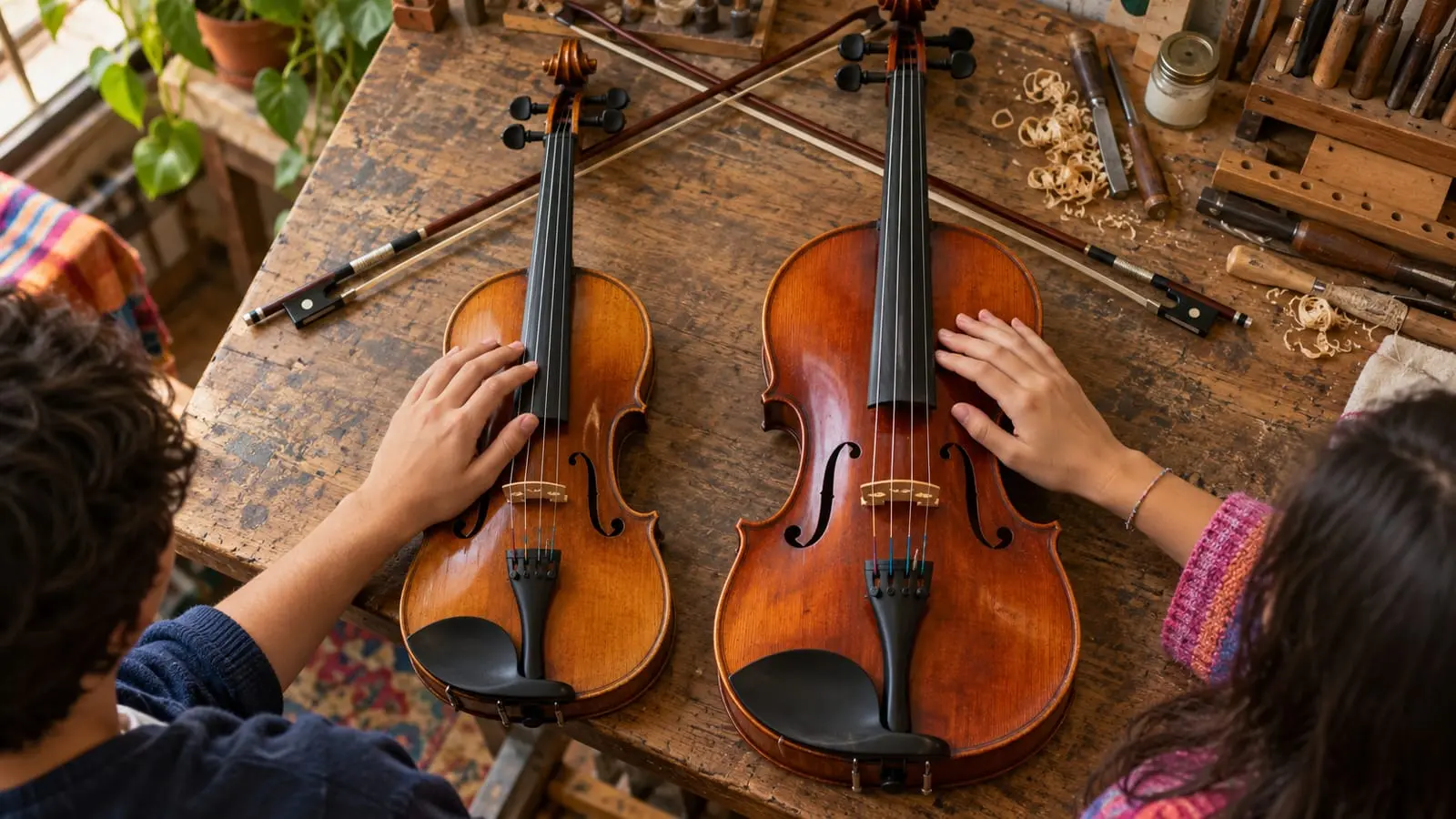
It depends on the sound and musical role you enjoy. If you want to carry the melody, love a bright high register, and want access to the largest solo repertoire in the string family, choose violin. If you're drawn to a darker, warmer sound and enjoy being at the heart of the harmony, choose viola.
The good news is that the technique is almost the same. That's why switching from violin to viola, or vice versa, is one of the most natural changes between instruments. What changes is the size, lowest string, clef, and bowing approach.
In short
- The viola is a little larger than the violin, is tuned a fifth lower (C, G, D, A), and has no E string.
- Viola reads alto clef, with C on the third line; violin reads treble clef.
- Violin usually carries the melody; viola fills the inner voices of the harmony and increasingly gets solo parts.
- Viola needs more arm weight on the bow and responds a little more slowly.
- Switching from violin to viola takes weeks; fluent alto-clef reading takes the most time.
Violin vs. viola: differences at a glance
| Aspect | Violin | Viola |
|---|---|---|
| Size | Standard adult size (4/4) and fractional sizes for children. | Slightly larger; measured in inches by body length, with several adult sizes available. |
| Strings | G, D, A, E. | C, G, D, A: a fifth lower, with no high E string. |
| Clef | Treble clef. | Alto clef, with C on the third line; treble clef for high passages. |
| Sound | Bright and penetrating. | Darker, warmer, and somewhat veiled. |
| Bow | Lighter. | A little heavier, with a wider frog. |
| String response | Fast. | Slower: the C string needs weight and time to speak. |
| Role in the orchestra | First and second violins: melody and fast figures. | Inner voices: harmony, countermelodies, and color, with increasingly frequent solos. |
| Solo repertoire | Vast, spanning every era. | Smaller but valuable, enriched by many transcriptions. |
| Suggested starting age | From age 4, with fractional sizes. | Small violas are available from around 10 inches, but many children start on violin and switch later. |
Alto clef: the most intimidating part (which shouldn't be)
Viola reads C clef on the third line, also called alto clef. Its logic is simple: the middle line of the staff is middle C. It was chosen because most of the viola's range fits there without filling the sheet music with ledger lines.
For a violinist, here's the trick: read each note one scale step higher than in treble clef, and it sounds an octave lower. What would be B on the third line in treble clef is middle C in alto clef.
- Start by reading melodies you already know, so your ear can confirm what you read.
- Don't write in every note name: mark only the ones that confuse you, and erase them once you recognize them.
- Read by intervals rather than note by note: notice whether the melody rises or falls by step or leap.
- Spend five minutes a day sight-reading simple pieces.
After a few weeks of daily practice, the clef stops being an obstacle. If you're still learning to read music, start with how to read sheet music.
The role in orchestral and chamber music
Violin is the voice you hear most: melodies, fast passages, and high notes shining above the orchestra. First violins usually carry the main theme, while second violins accompany it or play in dialogue with it.
Viola lives in the middle. It completes chords, carries countermelodies, and gives body to the string sound. In a string quartet, you feel the harmony from within, something many violists describe as the instrument's great pleasure. Composers have increasingly brought it to the forefront, and its solo repertoire includes works by Telemann, Schumann, Brahms, and Bartók.
A practical point: many youth and school orchestras have more violins than violas, so a violist is usually welcome.
Choose violin if… / choose viola if…
Choose violin if…
- You want to play the melody and brilliant passages.
- You're interested in solo repertoire or folk music, where violin has a strong presence.
- It's for a very young child: there are more fractional sizes and methods designed for starting at ages 4 or 5.
Choose viola if…
- You prefer a low, warm sound to a bright high register.
- You enjoy playing in a group and feeling the harmony from within.
- Your arms and hands are large, and the violin feels too small.
- You already play violin and want a new tonal color or a place in the orchestra.
In violin lessons and viola lessons, your teacher considers your build and preferences before recommending a size or instrument.
How to switch from violin to viola
- Find the right size with your teacher: with your left arm extended, the scroll should reach your palm without you stretching.
- Adjust the chin rest and shoulder rest: viola has a deeper body and may need a different height.
- Switch to a viola bow: its extra weight helps the C string sound rounded.
- Aim for your tone with more weight, slower bow speed, and a contact point a little closer to the bridge.
- Open up your left hand: the spacing is wider and the vibrato becomes broader.
- Learn alto clef with easy repertoire before tackling orchestral works.
To tune the C string, which violin doesn't have, use the site's viola tuner. If you're going the other way, from viola to violin, expect a lighter bow, closer spacing, and an E string that demands great precision.
Frequently asked questions
Is viola easier than violin?
It isn't easier; it's different. There are fewer passages in the extreme high register, but the instrument is larger, the spacing is wider, and the bow needs more weight to make the low strings respond.
Can you play viola with a violin bow?
You can in a pinch, but the sound is thin, especially on the C string. A viola bow is a little heavier and designed for its thicker strings.
How do I know what viola size I need?
It depends on your arm length and hand size, not just your height. Ideally, try several sizes with your teacher, because two people of the same height may need different violas.
Can a child start directly on viola?
Yes. Small violas are available, and more and more children are starting on them. Many start on violin simply because more instruments and methods are available, then switch to viola without difficulty.
Sources
We checked the facts in this article against these sources on October 22, 2026.