
Violin or cello? How to choose between them
One is played standing up and shines in the high register; the other is played sitting down and sings in the low register. We compare posture, sound, transport, repertoire and age.
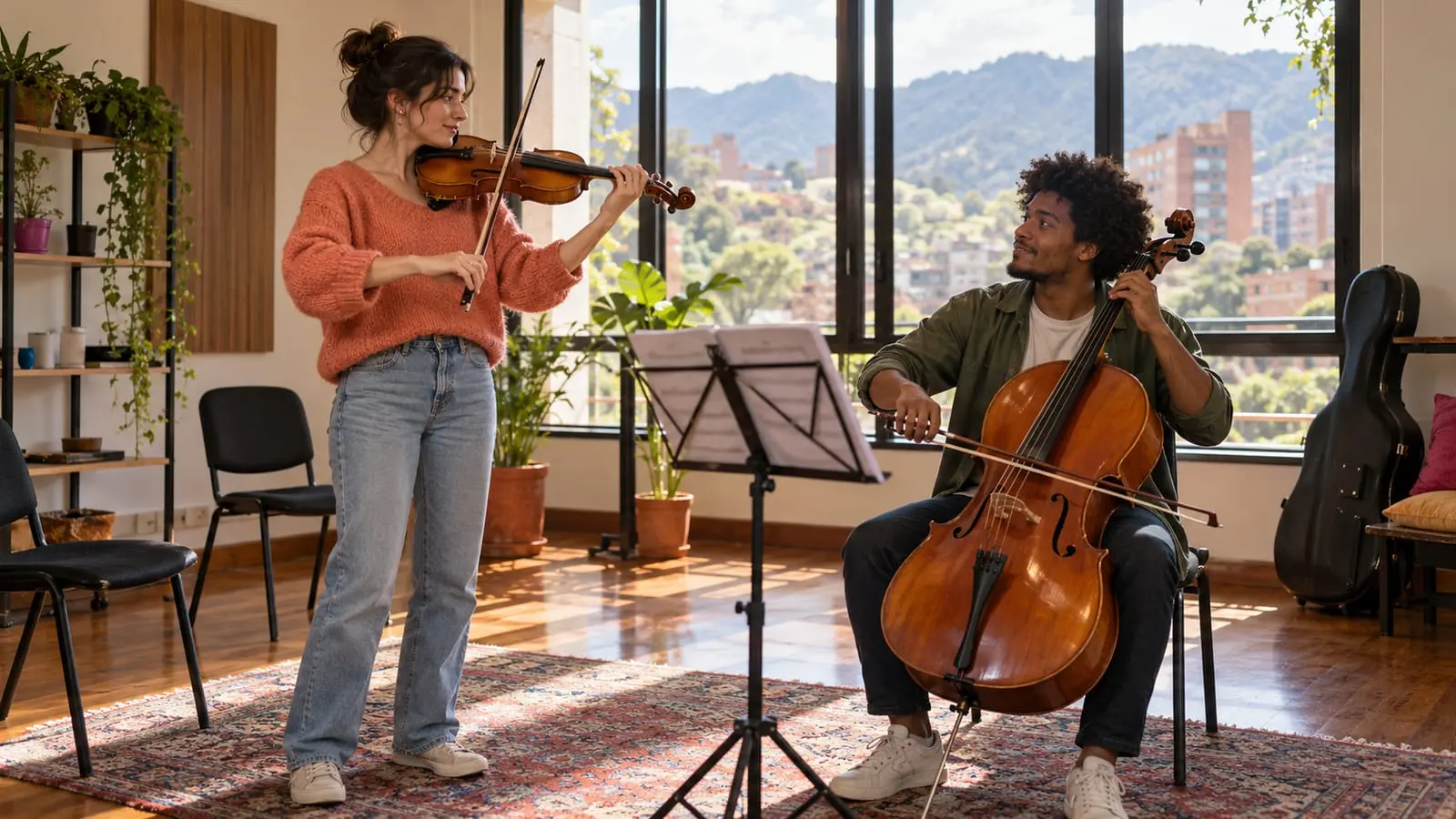
It mainly comes down to which sound moves you and how comfortable you feel with the playing position. If you love a bright melody, want an instrument that's easy to carry and picture yourself playing standing up, choose the violin. If a warm, low sound moves you—one that many people compare to the human voice—and you prefer to play sitting down, choose the cello.
Neither is easier: both require you to play in tune without frets and learn to produce a sound with the bow from scratch. What changes is how your body interacts with the instrument, and you'll feel that from your very first lesson.
In short
- You hold the violin between your shoulder and jaw; you play the cello sitting down, with the instrument between your knees and supported by its endpin.
- Violin music uses treble clef and has a bright, high sound; cello music mainly uses bass clef and has a warm, low sound.
- On the violin, notes are very close together on the fingerboard; on the cello, they are farther apart, so your hand stretches more.
- A violin is easy to take on a bus; a cello needs more space, so transportation is part of the decision.
- Both come in sizes for children: violin lessons usually start from age 4, and cello a little later, around age 5 or 6.
Violin and cello, side by side
| Aspect | Violin | Cello |
|---|---|---|
| Posture | Standing or sitting; the instrument rests between your collarbone and jaw, with your left arm raised. | Always sitting; the instrument sits between your knees, with the endpin resting on the floor. |
| Sound | High, bright and prominent. | Low and warm, with a very expressive upper register. |
| String tuning | G, D, A, E. | C, G, D, A, in a much lower register. |
| Reading | Treble clef. | Bass clef, with tenor or treble clef in high passages. |
| Left hand | Small distances: millimeters make a difference to intonation. | Wider spacing; the hand stretches for extensions. |
| Bow | Longer and lighter; drawn at an angle, close to your face. | Shorter and heavier; drawn almost horizontally, using the weight of your arm. |
| Children's sizes | From 1/16 to 4/4. | From 1/10 to 4/4. |
| Transport | Small case, carried on your back. | Large case; taking it on a bus at rush hour is a challenge. |
| Relative cost | More affordable, as are the strings and accessories. | Higher: the instrument, case and strings cost more. |
| Suggested starting age | From age 3 or 4, with a play-based approach and very small sizes. | Around age 5 or 6; very small sizes are available, starting at 1/10. |
Posture: the difference you'll feel most
With the violin, the challenge is to hold the instrument without gripping it tightly. Your head rests lightly on the chin rest, your shoulder stays down and your left arm rotates inward so your fingers can reach the fingerboard. Many beginners build up tension in their neck and shoulder, so teachers spend the first few lessons finding the right height for the shoulder rest and chin rest.
With the cello, your posture is more open: you sit at the edge of the chair, with your feet firmly planted and the instrument tilted against your chest. Your arms work at a more natural height. Common mistakes include an incorrectly adjusted endpin that leaves the instrument too high or too low, and a left thumb that presses too hard against the back of the neck.
If you already have neck or shoulder discomfort, tell your teacher before deciding: some people find the cello's seated position more comfortable, though both instruments can be played without pain with good technique.
Sound and repertoire: what you'll play
The violin is the orchestra's high voice, divided between first and second violins. It has one of the largest solo repertoires of any instrument, from Baroque to Romantic concertos, and a rich life beyond classical music: tango, chamber music, folk traditions from many countries and, in Colombia, traditions such as violin playing in Cauca.
The cello provides the low foundation of the orchestra and string quartet, but it also sings long melodies in the middle register. Bach's solo cello suites are classics that stay with students for years, and the instrument is increasingly heard in film scores, pop song covers and contemporary music.
Here's one way to decide: listen to the same piece played by a violinist and a cellist, and ask yourself which sound you'd like to hear at home every day.
If the deep sound of the cello moves you, why learn the cello explains what makes it special, from the orchestra to chamber music.
Choose violin if… / choose cello if…
Choose violin if…
- You picture yourself carrying the melody, in an orchestra or as a soloist.
- You use public transportation and need a light instrument.
- It's for a child of 4 or 5 who will start through play, with family support.
- You're drawn to folk music, tango or chamber music with a prominent violin part.
Choose the cello if…
- You're moved by a low sound and like the idea of supporting the harmony.
- You prefer to play sitting down, with your arms at a more natural height.
- You can travel by car or take lessons at home.
- You have a spot with a sturdy chair and room for the instrument.
See what you'll work on in violin lessons and cello lessons. With in-home or online lessons, the cello can stay at home, which solves much of the transportation challenge in Bogotá.
For children: age and size
Both instruments come in fractional sizes that change as a child grows. For violin, the teacher measures the child's outstretched arm; for cello, they check height and seated position. An oversized instrument is the most common cause of tension and frustration, so buying “a bigger one to grow into” isn't a good idea.
For younger children, the violin has the advantage of allowing a slightly earlier start and being easy to take to lessons. The cello requires a little more maturity to maintain a seated posture, and an adult to help move it. To choose a size, see how to choose your first cello or the guide to choosing your first violin and its size.
If you want to switch later
Switching from violin to cello, or the other way around, is more common than you might think. Your ear for playing in tune without frets, rhythm reading, understanding of bowing and practice habits all carry over. What you'll need to learn again is posture, bow hold and left-hand spacing—and, when moving from violin to cello, reading bass clef.
If you like the violin but want a darker sound without changing your playing position, there's a middle option: the viola. We explain the differences in violin or viola.
Frequently asked questions
Which is harder, violin or cello?
They present different challenges. On the violin, intonation requires finer adjustments because the spacing is small, and the playing position requires a relaxed neck and shoulder. On the cello, your left hand stretches farther and the instrument is larger to handle. For most people, motivation matters more than difficulty.
Which sounds better when you're just starting?
Both sound scratchy at first. The violin's sound is very close to your ear, so those first few months can seem harsher; the cello's lower register is often easier on the family.
Can you start learning cello as an adult?
Yes. Many adults start cello because they love its sound and find the seated position comfortable. With consistent practice, you can play simple, beautiful repertoire within a few months.
Is the cello the same as the double bass?
No. The double bass is larger and lower-pitched, is played standing or sitting on a high stool, and is tuned in fourths. The cello is played sitting down, between your knees.
Sources
We checked the facts in this article against these sources on October 22, 2026.
- Philharmonie Luxembourg: everything you need to know about the cello
- Fiddlershop: how to choose a violin size (from 1/16 to 4/4, arm length and age)
- Fiddlershop: cello size guide (from 1/10 to 4/4, age and height)
- Cancillería de Colombia: the violin tradition of Cauca, more than 300 years of history
- Wikipedia: double bass (tuning in fourths and posture)