
Benefits of learning violin: ear training, discipline and orchestras
The violin asks for patience, but gives a lot back: a trained ear, discipline and a way into orchestras and ensembles. Here's what to expect.
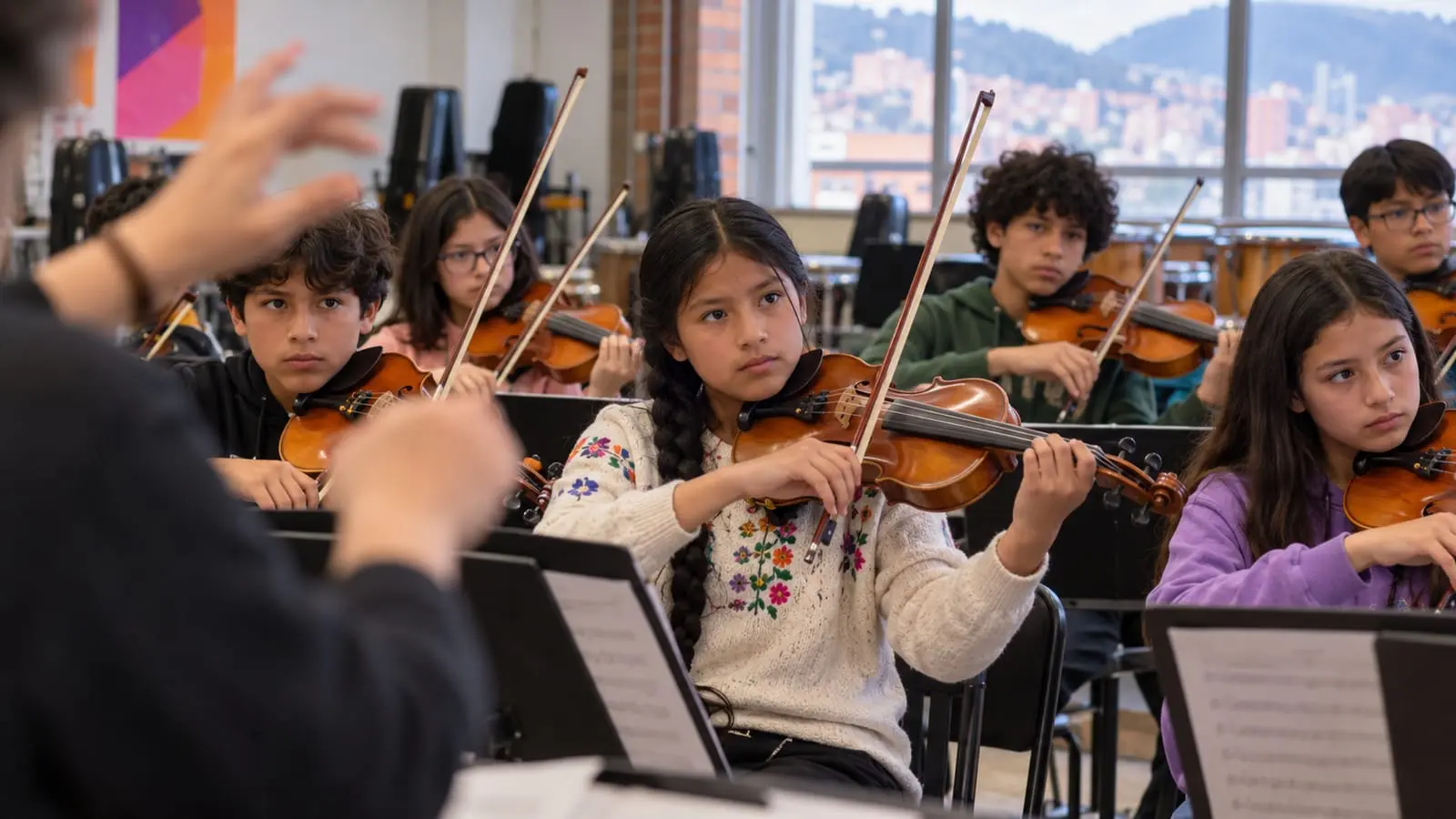
Violin's great benefit is ear training: with no frets or keys, every note depends on where you place your finger and how carefully you listen. This develops a finely tuned ear and a patient, organized approach to practice. It also opens the door to orchestras, quartets, and ensembles, with repertoire ranging from Baroque to Colombian music.
It also takes time before it sounds beautiful. That's why we cover both sides here: what it offers and what it asks of you.
In short
- The violin challenges and trains your ear: you shape the intonation with each finger.
- It teaches you how to practice: small steps, slow work, and attention to detail.
- It has the most seats of any instrument in an orchestra, opening many opportunities to play with others.
- Its repertoire is vast: classical music, mariachi, tango, pop, violines caucanos, and Andean music.
- The honest challenge: producing a good tone is difficult in the first few months, and that requires patience from you and your family.
A much more finely tuned ear
On piano, C is already in tune. On violin, it isn't: the fingerboard is smooth, and C sounds a little sharp or flat depending on where you place your finger, with differences of mere millimeters. That's why violinists learn to listen as they play and adjust along the way.
That training often shows beyond the instrument: over time, you get better at hearing when a singer is a little flat, distinguishing intervals, and recognizing the tone colors of different instruments. Studies indicate that classical musicians distinguish pitch differences better than people who don't play, and that this skill can be trained; it isn't a gift you either have or don't, but something the violin makes you work on week after week.
How lessons develop your ear
- Open strings and long tones checked against a violin tuner or a sustained reference note.
- Slow scales while listening for resonance: when a note is in tune, the violin vibrates more strongly.
- Singing the melody before playing it, so you hear the sound in your head before finding it with your fingers.
Discipline and practice habits
Violin offers no shortcuts. Holding the instrument without tension, applying the right bow weight, and placing your fingers precisely all develop through frequent, slow practice. This routine builds habits that many students and families value:
- Breaking a big problem into small steps: first the bow alone, then the left hand, then both together.
- Handling frustration when something doesn't work and trying again the next day.
- Listening to yourself honestly, without exaggerating either the good or the bad.
- Keeping practice short but consistent, which is more productive than occasional long sessions.
Remember: discipline doesn't mean rigidity. A good teacher adjusts expectations to the student's age and includes motivating repertoire, so consistency doesn't feel like punishment.
Youth orchestras and groups you can join
A symphony orchestra usually has more violins than any other instrument, divided into first and second violins. In practice, that means more seats available for learners.
Colombia has a strong tradition of children's and youth orchestras: programs such as Batuta's, school, cultural center, and conservatory orchestras, and university ensembles. Playing in one changes your experience of violin: you learn to follow the conductor, breathe with your section, and sound like part of something larger. Beyond symphony orchestras, violin also has a place in:
- String quartets and trios, performing at weddings, graduations, and ceremonies.
- Mariachi groups, a familiar part of Colombian serenades, where violins carry the melody.
- Colombian Andean music groups, which include violin in pasillos and bambucos.
- Violines caucanos, an Afro-Colombian tradition from northern Cauca heard at traditional celebrations and Pacific music festivals.
- Pop, rock, or fusion bands, where electric violin adds a different tone color.
A repertoire with no end in sight
Few instruments have so much music written for them. Here are some paths a student can explore over time:
| Path | What you play | What it requires of you |
|---|---|---|
| Classical | Minuets and student concertos, Baroque sonatas, and later, major concertos. | Bow technique, shifting, and solid music-reading skills. |
| Colombian music | Pasillos, bambucos, guabinas, and arrangements for Andean groups. | Feeling each style's rhythm and characteristic ornaments. |
| Mariachi and ranchera | Rancheras, huapangos, and boleros. | A bright tone, section playing, and playing from memory. |
| Tango and Latin American music | Tangos, valses criollos, and bolero arrangements. | Accented articulations and bow effects. |
| Pop, film, and fusion | Film scores, song covers, and electric violin. | Playing with backing tracks and sometimes improvising. |
| Folk | Celtic music, country, or bluegrass. | Playing by ear and ornamenting the melody. |
If a lower sound appeals to you later, what you've learned helps you move to viola; we explain the differences in violin or viola.
Who does violin tend to suit?
- Anyone who enjoys details and doesn't mind repeating something until it works.
- Children willing to practice, with a family who can support them in the early years; find more ideas in violin for children.
- Anyone who dreams of playing in an orchestra or group rather than alone.
- Anyone who enjoys singing: violin sings the melody, and hearing it in your head helps enormously.
- Patient adults who value the process as much as the result.
If you want to accompany yourself while singing, or play alone with a complete sound, piano or guitar may suit you better. Neither is better or worse; they serve a different musical role.
The real challenges of violin
- The sound in the first few months. Coordinating bow weight, speed, and contact point takes time, and squeaks happen at first. They're part of the process.
- Intonation is never completely settled. Even professionals work on it daily.
- Posture. Holding the violin between your jaw and shoulder without tension requires adjusting the shoulder rest and checking your posture often.
- Volume at home. In an apartment, it's louder than you might think; a practice mute helps you get along with neighbors.
- The right size. A violin that's too large for a child encourages poor habits; see how to measure in how to choose your first violin.
Frequently asked questions
Is violin harder than other instruments?
At first, it's usually more demanding than piano or guitar because you produce the sound with the bow and shape the intonation yourself. Every instrument presents challenges over time; violin's is that early results take a little longer to sound good.
Can you play in an orchestra without being a professional?
Yes. There are school, youth, cultural center, university, and adult amateur orchestras. They usually require some music-reading skills and basic intonation, and some hold auditions; your teacher can tell you when you're ready to audition.
Does learning violin help in other areas of life?
Many students and families notice habits that carry into other settings: organizing practice time, handling frustration, and listening carefully. These come from consistent work, aren't guaranteed, and depend on how you practice.
Acoustic or electric violin for beginners?
Acoustic violin is the usual choice for learning: it gives you the real response of the bow and instrument. Electric violin works for quiet practice with headphones or playing in a band, but it's better to add it later, once you have a foundation.
Sources
We checked the facts in this article against these sources on October 22, 2026.
- Hearing Research: Micheyl and colleagues, musical training and pitch discrimination (2006)
- Fundación Batuta: the organization's account of its children's and youth orchestras
- Cancillería de Colombia: the Cauca violin tradition in Santander de Quilichao
- Universidad de Sídney: why violins are the largest section of the orchestra