
How do you do vibrato on the violin? Step by step
Vibrato isn't a tremble: it's a controlled motion you learn slowly, first without the bow and then with a metronome. When to start and how to practice it without tension.
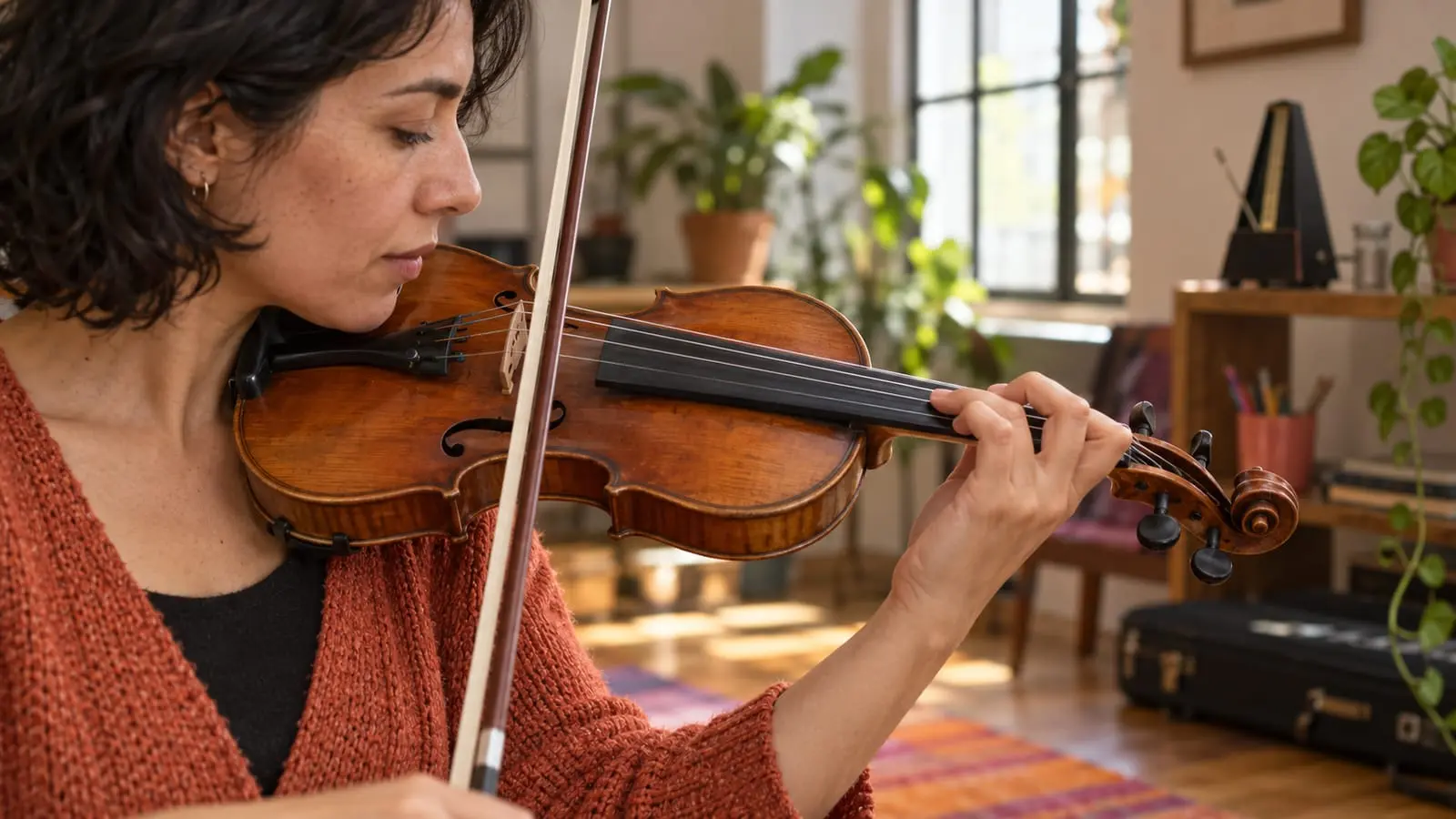
To play vibrato on violin, the finger stopping the string rocks regularly toward the scroll and back without lifting or sliding, while the wrist or forearm drives the movement. The pitch dips slightly below the note and returns, adding warmth and projection to the sound. Learn it first without the bow, very slowly and in time with a metronome.
There's no set age to start, but there are prerequisites: a relaxed left hand, reliable intonation in first position, and the ability to hold the violin without gripping the neck. If any of these is missing, vibrato becomes tense and is difficult to correct later.
In short
- Start when your first-position intonation is stable and you can hold the violin with your chin rest and shoulder, without your left hand.
- The finger rolls from the note toward the scroll and back, so you hear the note in tune. Rocking toward the bridge makes it sound sharp.
- The finger's last joint must stay flexible; a rigid finger blocks any vibrato.
- Practice it in measured patterns: two, three, and four oscillations per beat with a metronome, only then moving to free vibrato.
- Wrist, arm, or a combination: it depends on your hand and position, and your teacher will guide the choice.
How vibrato works
When you play vibrato, your fingertip doesn't slide along the string: it rolls. The fingertip joint bends and straightens, and this rocking slightly lengthens and shortens the vibrating part of the string. The result is a small, regular pitch fluctuation.
On violin, most teachers teach you to rock downward from the note, toward the scroll, then return to the note. Your ear tends to hear the highest point of the oscillation as the actual note; if the finger rolls toward the bridge, the vibrato sounds sharp.
| Variable | What it is | How it sounds |
|---|---|---|
| Width | How wide the rocking movement is | Narrow: bright and restrained. Wide: warm and dramatic; too wide, and it sounds like wavering intonation |
| Speed | How many oscillations per second | Slow: relaxed; too slow, it sounds uncertain. Fast: intense; too fast, it sounds nervous |
Good vibrato isn't one fixed sound: it changes with the dynamics, character, and style of the piece. But before you vary it, you need control, and that's what the exercises in this article develop.
When should you start? A checklist
Many students begin vibrato between their second and fourth years of study, but timing matters less than these conditions:
- You play confidently in tune in first position, including with your fourth finger. If you're still unsure about finger placement, review how to place your fingers on the violin.
- You can hold the violin with just the chin rest and shoulder, releasing your left hand for a few seconds.
- Your left thumb is relaxed: you can move it while playing.
- Your bow produces even, sustained notes; if the sound still breaks, vibrato only makes things more complicated.
- Your teacher considers your hand ready. Some introduce vibrato before shifting and others after; both approaches work.
Starting too soon has a cost: vibrato learned with a tense hand becomes a habit, and undoing it takes longer than waiting a few weeks would have.
Wrist, arm, or finger vibrato
| Type | Where the movement comes from | Advantages | Watch out for |
|---|---|---|---|
| Wrist | The hand rocks from the wrist; the forearm stays almost still | Fine control, narrow and agile vibrato; comfortable in first position | A stiff wrist or gripping thumb |
| Arm | The forearm moves from the elbow, carrying the hand and finger with it | Greater width and warmth; very natural in higher positions | Becoming wide and slow, or shaking the whole violin |
| Finger | Almost entirely the finger joint | Useful for short notes and fast passages | Rarely works alone; usually combined with the others |
Most violinists eventually use a combination, adjusting it to the note. With wrist vibrato, the palm doesn't rest against the neck; with arm vibrato, especially in higher positions, the base of the hand may rest against the violin's rib. Your teacher will suggest which to start with based on your hand's shape.
Exercises without the bow to prepare your hand
These exercises separate movement from sound. Do them for a few minutes daily in front of a mirror and stop if your hand tenses.
- Polish the railing. Without the violin, rest your fingertips on a broom handle or your other forearm and slide them back and forth as if polishing it, with a relaxed wrist. This is the basic movement without the challenge of the string.
- Knock-knock. Hold the violin in playing position without stopping any string and “knock on a door” with your left hand: bend the wrist back and return, staying relaxed. This prepares wrist vibrato.
- Bending finger. Place your second finger on the A string and, without moving your hand, slowly bend and straighten the last joint. If it won't bend, vibrato won't work; it's worth spending days on this step.
- Siren in third position. Rest the base of your hand against the violin's rib, place your second finger very lightly on the A string, and slide it up and down a few centimeters. The rib provides stability, and sliding loosens the arm.
- Shrink the siren. Repeat with progressively smaller slides and slightly more pressure until your finger rolls in place rather than sliding. That rocking is your first vibrato.
Measured vibrato with a metronome
Now add the bow, with the metronome at 60. Each backward-and-return movement counts as one oscillation. Start with your second or third finger, usually the easiest, and sustain long notes with a slow bow.
| Stage | Oscillations per beat | What to look for |
|---|---|---|
| 1 | 2 (like eighth notes) | Wide, even, relaxed movement; the bow's sound stays unchanged |
| 2 | 3 (like triplets) | Evenness even when the beat is no longer divided in two |
| 3 | 4 (like sixteenth notes) | Speed without tension; if your hand tightens, return to the previous stage |
| 4 | Free | Stop counting and sustain continuous vibrato on long notes |
- Once it works with fingers 2 and 3, move to 1, then finally 4, the hardest.
- Increase the metronome gradually, from 60 to 66 and then 72, without skipping stages.
- Keep the vibrato going through bow changes: a common mistake is stopping whenever the bow changes direction.
- Check occasionally with the violin tuner that your starting note hasn't drifted sharp.
Then apply vibrato to a slow melody you already know, such as the theme of Beethoven's Himno a la alegría, only on the long notes. The aim is to use it when you choose, rather than out of habit.
Common mistakes and how to correct them
| Error | How it shows up | Correction |
|---|---|---|
| Gripping thumb | Vibrato gets stuck or becomes a rapid tremble | Move your thumb while playing vibrato; if it won't move, it's gripping |
| Rigid finger | Your hand moves, but the pitch barely changes | Return to the bending-finger exercise |
| Rocking toward the bridge | Vibrato sounds sharp | Start at the note and roll toward the scroll |
| The violin shakes | The scroll shakes and the bow's sound changes | Use less width and more support from the chin rest |
| Nervous vibrato | Fast, narrow, and impossible to slow down | Return to two oscillations per beat with a metronome |
| Late vibrato | The note begins without vibrato, which only appears at the end | Prepare the movement before the bow begins the note |
What about cello?
The principle is the same: the finger rolls on the string without sliding, with a flexible fingertip joint. What changes is where the movement comes from. On cello, vibrato almost always starts in the forearm, which moves parallel to the string and carries the hand along, while the thumb rests lightly behind the neck. The wrist follows, but isn't the main source.
The siren exercises and metronome progression work the same way. In cello lessons, your teacher also checks elbow height, because a dropped elbow restricts the movement. If you play violin, violin lessons build vibrato in stages, checking your hand week by week.
Frequently asked questions
How long does it take to learn violin vibrato?
It varies a lot. The basic movement may develop after a few weeks of daily practice; getting it to sound natural and continuous with every finger usually takes months. Short, measured practice every day helps more than occasional long sessions.
Can you play vibrato on an open string?
No, because there's no finger to move. If you need vibrato on that note, play it with your fourth finger on the next lower string: open E, for example, can be played with the fourth finger on the A string.
Should you use vibrato on every note?
It depends on the style. In much of the Romantic repertoire, it's used almost continuously; in Baroque music, many performers reserve it as an ornament for important notes. Very short notes usually don't need it. Your teacher will help you decide for each piece.
Why does my vibrato sound like trembling?
It's almost always tension: a tight thumb or wrist produces a fast, narrow movement you can't control. Slow down with the metronome, release your thumb, and rebuild the movement from two oscillations per beat.
Sources
We checked the facts in this article against these sources on October 22, 2026.