
How to choose your first cello: size, bow and case
Cello size is tested sitting down with the endpin adjusted. What to check on the instrument and bow, how to move it around and when renting beats buying.
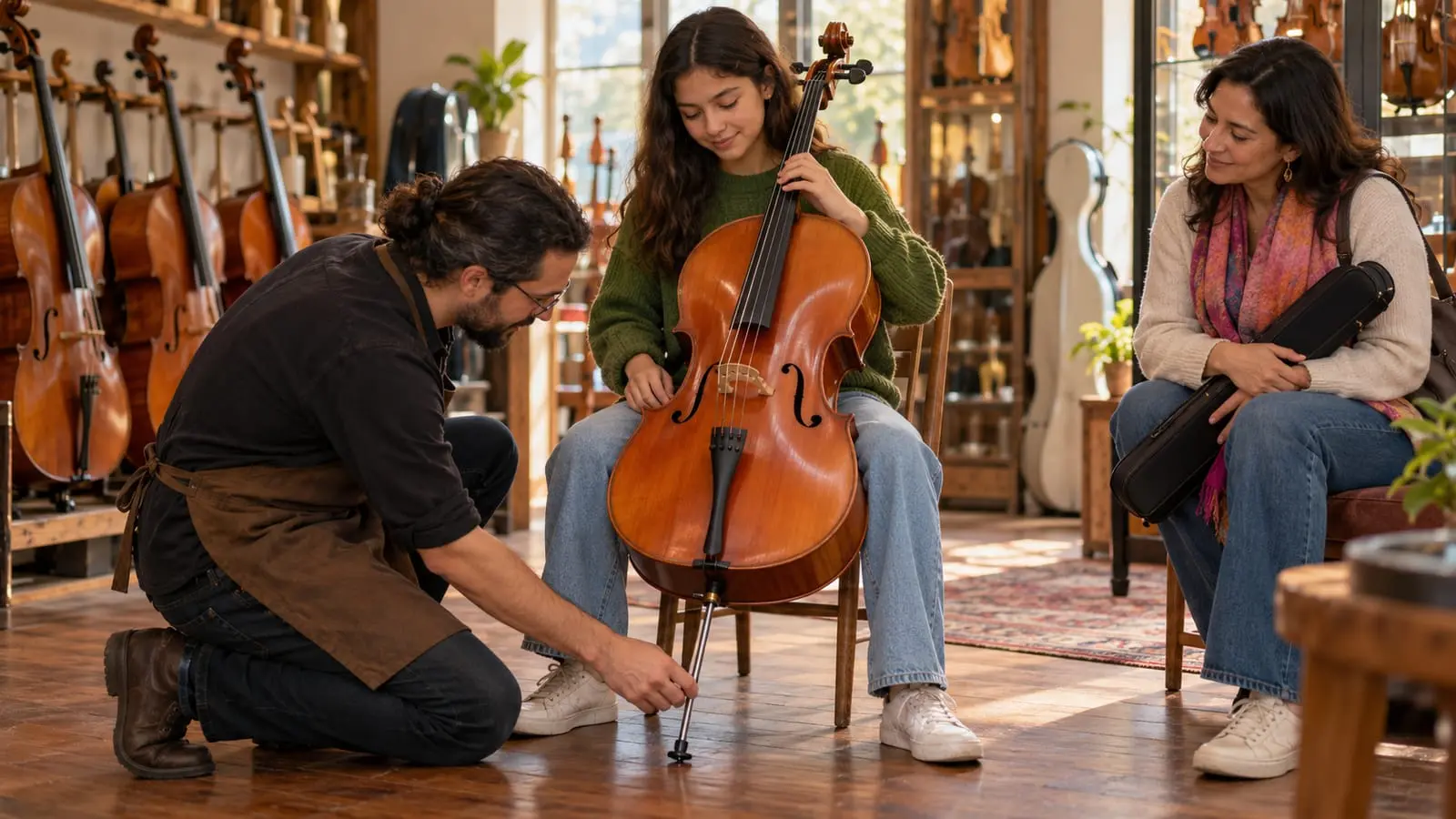
To choose your first cello, start with the size and try it while sitting on a chair of the right height, with the endpin adjusted. If the C-string peg is near your left ear, your knees touch the cello's body, and your left hand reaches first position without stretching, the size is right. Adults almost always use 4/4; children use fractional sizes that change as they grow.
Next, check the setup—bridge, strings, and soundpost—the bow, and how you will transport it. If your child is still growing, consider renting or buying used rather than new.
In short
- Confirm the size while seated: the C-string peg should be near the left ear, with the knees touching the cello's body.
- A flat, armless chair of the right height is part of your equipment.
- Ask whether the cello has been set up by a luthier: the bridge, soundpost, and string height determine whether it is playable.
- For growing children, renting, borrowing, or buying used usually makes more sense than buying new.
- Choose a padded bag if you move it often on foot; a hard case if it travels or shares transport with other instruments.
Cello sizes: a guide by height
| Size | Approximate height | Approximate age |
|---|---|---|
| 1/10 and 1/8 | Less than 1.05 m | 4 to 5 years |
| 1/4 | 1.05 to 1.20 m | 5 to 7 years |
| 1/2 | 1.20 to 1.35 m | 7 to 10 years |
| 3/4 | 1.35 to 1.50 m | 10 to 12 years |
| 4/4 | More than 1.50 m | From 12 or 13 years, and adults |
Age is not much of a guide: two nine-year-olds may need different sizes. Height, leg and arm length, and the size of the left hand matter most. There is also a less common 7/8 size for shorter adults or those with small hands.
The seated fitting test: chair, endpin, and posture
Before judging the cello's fit, get the chair right. With a chair that is too high or too low, any size can seem wrong.
The chair
- A flat, firm seat, with no backward slope and no armrests.
- A height that leaves your thighs parallel to the floor or sloping slightly forward, with your feet flat on the ground.
- Sit on the front half of the seat without leaning back.
- For children, use a lower chair or an adjustable stool; never an adult chair that leaves their feet dangling.
Positioning the cello
- Extend the endpin until the upper edge of the cello's back rests against your chest at breastbone height.
- The C-string peg, for the lowest string, should sit near your left ear without touching it.
- Your knees should lightly touch the lower edges of the body, supporting it without squeezing.
- Your left hand should reach first position with a comfortable arm position, and the bow should pass between the fingerboard and bridge without hitting your right knee.
If the neck sits above your shoulder even with the endpin almost fully retracted, the cello is too large. If you extend the endpin fully and the instrument still sits too low, or your knees extend beyond the body, it is too small.
You will also need an endpin stop or anchor: it prevents slipping and protects wooden or tiled floors.
What to check on the instrument: bridge, soundpost, and more
| Part | What it should have | Warning sign |
|---|---|---|
| Cello bridge | Straight, perpendicular to the top, with the feet sitting flush | Leaning toward the fingerboard, warped, or with lifted feet |
| String height | Easy to press down, without the strings rubbing against the fingerboard | Very high strings at the end of the fingerboard, or buzzing |
| Soundpost | In place, near the bridge foot on the A-string side | Something loose inside the cello when you move it |
| Pegs and fine tuners | Turn smoothly and hold the tuning; four fine tuners help beginners | Pegs that slip back or fine tuners that rub against the top |
| Endpin | Extends and retracts smoothly, the screw locks it, and the tip is intact | An endpin that slips while playing, or a stripped screw |
| Body | No cracks, with closed seams | Cracks near the f-holes or the endpin socket |
| Fingerboard | Ebony or hardwood, smooth | A painted or grooved fingerboard |
Student cellos sometimes leave the factory with an uncarved bridge or a poorly positioned soundpost. Ask whether it has a luthier's setup; if not, plan to have that done before your first lesson.
A wolf tone is not a defect
Many cellos have a note, often around E or F-sharp, that stutters or vibrates oddly. This is called a wolf tone, and it does not mean the instrument is damaged. A wolf tone eliminator, a small device fitted to a string between the bridge and the tailpiece, can usually control it.
The cello bow
It is shorter, thicker, and heavier than a violin bow, with a wider frog. Check:
- A stick that looks straight when viewed from the tip, with its natural curve toward the hair.
- Clean, even hair with no bare patches.
- A screw that tightens and loosens without sticking.
- For children, carbon fiber stands up better to knocks and drops; brazilwood is the traditional student option.
Use cello rosin: violin rosin is harder, and double bass rosin is too soft. A new bow needs several applications of rosin before it produces sound. We explain the grip in how to hold the bow.
Bag or case: how will you transport it?
| Padded bag | Hard case | |
|---|---|---|
| Protection | Good against scratches and light knocks | High: protects the bridge and body from impacts and crushing |
| Weight and bulk | Lightweight | Heavier and bulkier |
| Transport | Backpack straps; convenient for walking and getting into a car | Many have wheels; better for long journeys |
| Who it is for | Children who regularly go to lessons or school | Anyone who travels or keeps the cello beside other instruments |
Whichever you choose, check for a bow pocket that protects the tip. Traveling with a cello on public transport in Bogotá is awkward, so plan your trips: in a car, lay it on the back seat with nothing on top. Never leave it in a closed car in the sun. Find more advice in how to care for a cello.
Renting, borrowing, or buying
A child who starts on a 1/4 cello may go through two or three sizes before reaching 4/4. That is why it is worth considering alternatives to buying new:
- Rental: some luthiers and shops rent fractional sizes. Ask whether the rental allows size changes and what happens if the instrument is damaged.
- Loan: some school orchestras and music programs lend instruments to students; ask at your child's school.
- Used: buying used and reselling or exchanging when it is time to change sizes is common among families of cellists. Have it inspected first.
- New: makes more sense for a 4/4, or a 3/4 that the student will use for several years.
Frequently asked questions
At what age can a child start playing cello?
Very small cellos are available for children from 4 or 5 years old, and many start between 6 and 8. Coordination and enthusiasm matter more than age. If you are still choosing an instrument, see violin or cello.
What size cello does an adult use?
Almost all adults use 4/4. Some shorter people or those with small hands feel more comfortable with a 7/8, although it is less common and harder to find.
Can you learn on an electric cello?
Silent electric cellos are useful for practicing without disturbing others, but the bow response and the feel of the body are different. An acoustic cello is preferable for learning, with an electric one as a complement.
How do I know when my child needs a larger cello?
Check posture regularly, for example every six months. If the cello still sits too low with the endpin fully extended, if the knees extend beyond the body of the instrument, or if the left hand feels cramped, it is time to talk to the teacher.
Sources
We checked the facts in this article against these sources on October 22, 2026.