
Violin for kids: what parents need to know
The violin takes patience, especially in the first few months. How to choose the size, what's normal at the start and what role parents play.
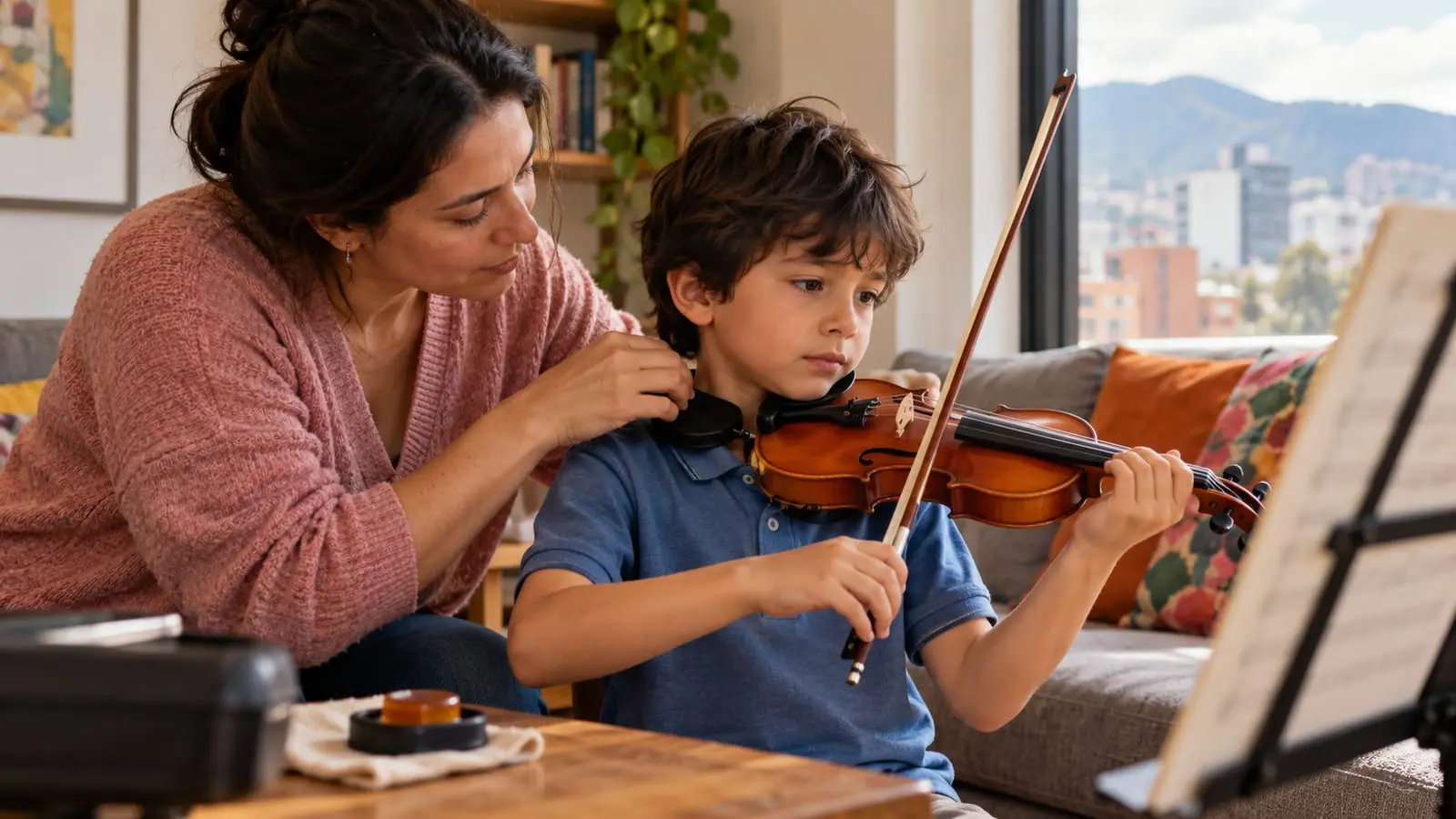
Children can start violin at a young age if the instrument fits them and an adult is willing to support their practice. Here's what to know from the start: the first few months focus on posture, bowing and developing the ear, and the sounds aren't always pretty. That's normal, and it's part of learning.
This guide explains how to choose the right size, what to expect at the start, which ideas from the Suzuki approach can help even if your teacher doesn't use it, and how to support practice at home without taking over as the teacher.
In short
- Choose a violin based on your child's arm length, rather than age or buying a bigger one “to grow into.”
- The first few months focus on posture, bowing and open strings; a rough sound at first is normal.
- A young child can't tune alone: an adult learns to use the tuner and fine tuners.
- Daily listening and family involvement are useful ideas from the Suzuki approach, even if your teacher uses another method.
- Short daily practice with an adult nearby leads to more progress than occasional long sessions.
Age and size: the violin needs to fit your child
Violins come in fractional sizes, from very small instruments to an adult 4/4. The right size depends more on arm length than age. The basic test: with the violin resting on the shoulder and the left arm extended, the scroll (the curled end) should reach the wrist or palm, and the fingers should be able to wrap around it comfortably.
| Size | Approximate age | Note |
|---|---|---|
| 1/16 and 1/10 | Ages 3 to 5 | For very young children, almost always with substantial parental involvement. |
| 1/8 | 5 to 6 years | First steps with very simple pieces. |
| 1/4 | 6 to 7 years | A common starting size for school-age children. |
| 1/2 | 7 to 9 years | Many children are already combining playing by ear with reading music. |
| 3/4 | 9 to 11 years | The last step before full size. |
| 4/4 | From ages 11 or 12 | Adult size; arm length decides, not a birthday. |
As children grow, they'll need to change violins several times. That's why renting, buying used or selling the previous violin when moving up a size is common. Before you buy, ask the teacher to measure your child and check the instrument; see the full guide in how to choose your first violin and its size.
Violin size by age and arm measurement
A 1/2-size violin is for children around 7 to 9 years old, with an arm measuring between 51 and 56 cm from the neck to the center of the palm. The outstretched arm measurement takes priority over age, and a teacher should confirm the fit with the violin in hand.
| Size | Approximate age | Arm measurement (neck to center of palm) |
|---|---|---|
| 1/16 | 3 to 4 years | Less than 42 cm |
| 1/10 | 4 to 5 years | 42 to 44 cm |
| 1/8 | 5 to 6 years | 44 to 47 cm |
| 1/4 | 6 to 7 years | 47 to 51 cm |
| 1/2 | 7 to 9 years | 51 to 56 cm |
| 3/4 | 9 to 11 years | 56 to 58.5 cm |
| 4/4 | From 11 or 12 years, and adults | 58.5 cm or more |
To measure, ask your child to extend their left arm out to the side, palm up, and measure from the neck to the center of the palm. Charts vary a little between manufacturers and shops, so use them as a guide. If your child falls between two sizes, choose the smaller one. You’ll find step-by-step instructions in how to choose your first violin and the right size.
Developing the ear and making the first sounds
The violin has no frets or keys: the exact pitch depends on where your child places a finger, down to the millimeter. The sound also depends on the bow: its weight, speed and contact point between the bridge and fingerboard. That's why squeaks, slightly sharp or flat notes and an uneven sound are normal at first.
- Many teachers use fingerboard tapes during the first few months to show children where to place their fingers. The tapes come off when the ear takes over.
- Singing before playing helps a lot: if your child can sing the melody, they can look for it on the violin.
- Listening to the piece many times before learning it gives the ear a sense of where the music is going.
Who tunes the violin?
A young child can't tune alone, so someone at home needs to learn. Student violins usually have fine tuners on the tailpiece, which allow small adjustments without using the pegs. With the site's violin tuner and a little practice, any parent can learn. If a string is very far out of tune or the bridge looks tilted, it's better to wait until the lesson: forcing the pegs can break a string or move the bridge. See how to tune a violin for more details.
Patience in the first few months: what's normal
Getting started on violin takes longer than on some other instruments because you need to establish your posture first. Here's a common sequence:
| Stage | What you'll work on | Signs of progress |
|---|---|---|
| Posture | Standing with good posture and holding the violin between the jaw and shoulder without squeezing. | Holds the violin for a few seconds without using a hand to support it. |
| Bow | Bow hold, sometimes starting with a pencil; straight bow strokes. | The bow stays parallel to the bridge when playing open strings. |
| Pizzicato and open strings | Plucking the strings with a finger and bowing rhythms on a single string. | Changes strings without playing two at once. |
| First finger placements | Placing fingers 1, 2 and 3 on the fingerboard tapes. | Plays a simple scale in tune. |
| First pieces | Familiar melodies, such as rhythmic variations on “Estrellita”. | Plays a complete piece from memory. |
Don't worry if there are no “songs” in the first few weeks. That foundation makes it possible to play with a good sound later. Bow hold deserves special attention, and we explain it in how to hold a violin bow.
The Suzuki approach and parents' role
The Suzuki method, created by Japanese violinist Shinichi Suzuki, starts with an idea: children can learn music the way they learn their native language, through lots of listening, imitation and family involvement. In practice, that means listening to the pieces daily, learning by ear before reading music, and having a parent attend lessons and guide practice at home.
Teaching the Suzuki method itself requires specific training, so not every teacher uses it, and it isn't the only way to learn violin. If you're interested in this approach, ask your teacher about their training. Either way, some of its ideas are useful with any method:
- Play recordings of the pieces your child is learning, at home or in the car.
- Attend some lessons and write down what the teacher asks your child to do.
- Repeat what your child can already play well, not just new material.
- Celebrate small steps: good posture is an achievement too.
How to practice violin at home with your child
- Tune together at the start, using the tuner.
- Check posture in a mirror: feet, violin and bow. Thirty seconds is enough.
- Prepare the bow: tighten the hair without overtightening, and apply rosin when the teacher tells you to. Don't touch the bow hair with your fingers.
- Work on the week's goal in short blocks; 10 to 15 minutes is enough to start.
- Finish with something your child can already play, to end on a positive note.
- Put everything away properly: loosen the bow hair, wipe rosin dust off the strings and close the case.
If you live in an apartment, a practice mute brings the volume down considerably. Also avoid leaving the violin by a window in direct sunlight or inside a closed car: sudden changes in temperature and humidity affect the wood. See the care routine in how to clean and care for a violin.
Common mistakes parents make (and how to avoid them)
- Buying a large violin “to grow into.” It creates tension in the neck and arm and makes playing in tune almost impossible.
- Buying the cheapest one without checking it. Some very inexpensive violins arrive with a poorly fitted bridge or pegs that won't hold their tuning. Ask the teacher to check it.
- Expecting songs too soon. If you demand pieces in the first month, your child may feel they're doing badly when they're actually making good progress.
- Giving corrections that differ from the teacher's. Ask what to watch for that week and focus on that.
- Saving practice for the weekend. Violin needs regular practice; little and often works better.
With patience at the start, violin opens the door to children's and youth orchestras, chamber music and a finely trained ear. If you're looking for a teacher, see how to get started with violin lessons.
To learn everything it trains, from the ear to study habits, read benefits of learning violin.
Frequently asked questions
What's the best age to start violin?
Some children start at 3 or 4, with lots of parental involvement, while others start at 7, at 9 or later. What matters is that the violin fits, the child is interested and someone supports practice at home.
How often does my child need a different violin size?
When your child's arm has grown enough that the current violin is too small. Ask the teacher to measure them from time to time, especially after a growth spurt. Don't move up to the next size too soon.
Is it normal for my child to get frustrated with violin?
Yes, especially in the first few months, when the sound still isn't what they'd like it to be. Listening to recordings of the pieces, celebrating small achievements and keeping sessions short all help. If frustration becomes constant, talk to the teacher about adjusting the repertoire or pace.
Does my child need a good ear to learn violin?
Your child doesn't need to start with a special ear for music: the ear develops through playing, singing and listening. Fingerboard tapes, singing before playing and weekly work with the teacher help intonation improve over time.
What age is a 1/2-size violin for?
A 1/2-size violin is usually used by a child aged 7 to 9 whose arm measures between 51 and 56 cm from the neck to the center of the palm. Arm measurement takes priority over age: the teacher checks the fit with the violin in hand before you buy.
Sources
We checked the facts in this article against these sources on October 22, 2026.