
Why learn cello? What makes the cello special
The cello sings in the range of the human voice, is played sitting down and has a place in orchestras, quartets and bands. Here's what it gives you.
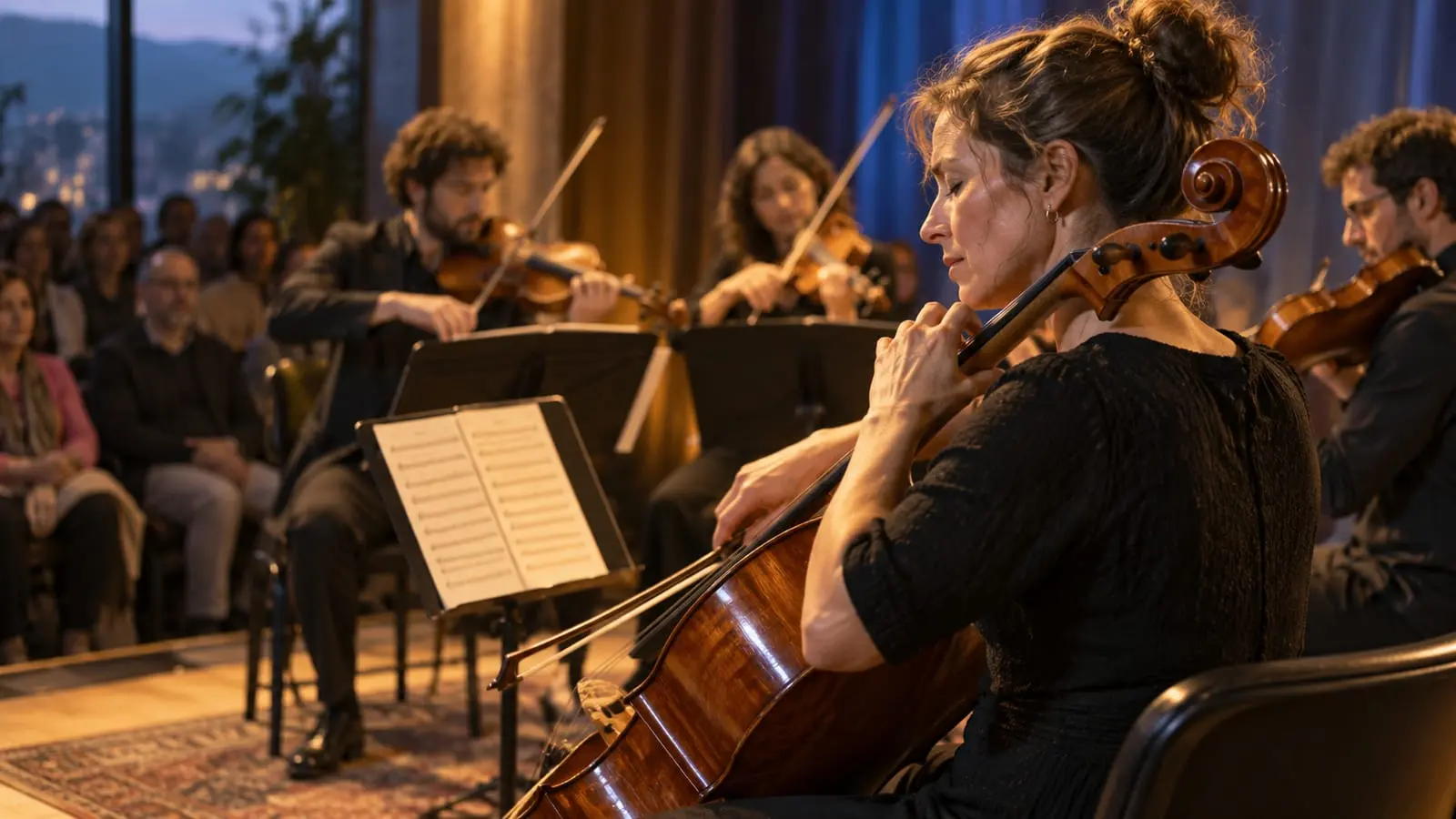
The cello wins you over with its sound: its range covers almost the entire span of the human voice, from the deepest bass to soprano, giving it a singing quality. You also play sitting down, with the instrument resting on the floor for a stable posture. It has an established place in orchestras and chamber music, and increasingly in pop and film music.
Here we explain what makes it special, where you can play it in Colombia, who it tends to suit, and its real challenges, starting with its size.
In short
- The cello has a range similar to the human voice, from deep low notes to singing high notes.
- You play sitting down with the instrument resting on the floor, a stable posture for children, teenagers, and adults.
- It serves three roles—melody, accompaniment, and bass—so it fits into almost any ensemble.
- Youth orchestras usually have fewer cellists than violinists, so a cellist with solid fundamentals is welcome.
- The challenges: transporting it, reading several clefs, and the patience bowing requires.
A range similar to the human voice
If a cello has ever given you goosebumps, it is no coincidence. Its range extends from low notes you can almost feel in your chest to high notes that sound like someone singing. That closeness to the voice is why a slow cello melody can reach you so directly.
For the player, this has a practical effect: the cello invites you to phrase like a singer. You learn to breathe with the bow, give a phrase direction, and use vibrato to bring warmth to the sound. That is why teachers so often ask you to sing a phrase before playing it.
Melody, accompaniment, and bass in one instrument
Few instruments change roles so much from piece to piece. The cello can:
- Carry the main melody, as in many solo pieces and film scores.
- Accompany with long notes or arpeggios while another instrument sings.
- Play the bass line, especially in small groups without a double bass.
That versatility helps you understand music from several perspectives. A quartet cellist knows what it means to support everyone's harmony and then take a solo one measure later.
Orchestras, chamber music, and other places to play
Children’s and youth orchestras tend to have far more violinists than cellists, so a cellist with solid fundamentals is usually welcome. Here are some settings where the cello is played in Colombia:
| Space | What the cello does | What you learn |
|---|---|---|
| School, youth, and university orchestras | Cello section, between the violas and double basses. | Follow the conductor, tune within a section, and read confidently. |
| String quartets and trios | The group's low voice and harmonic foundation. | Careful listening, shared breathing, and individual responsibility. |
| Colombian Andean music groups | Countermelodies and bass lines in pasillos and bambucos. | The rhythm and phrasing of Colombian music. |
| Churches and choirs | Accompanies choirs and services alongside organ or piano. | Play with singers and adapt to the venue's acoustics. |
| Events and ceremonies | Music for weddings, graduations, and celebrations. | A varied repertoire and playing through live performance nerves. |
| Pop, rock, and film | Arrangements of songs and film scores, sometimes on electric cello. | Play with backing tracks, amplification, and contemporary styles. |
Chamber music deserves a special mention: in a trio or quartet, there is nowhere to hide. Everyone plays their own part and depends on everyone else, an experience that does a great deal to develop you as a musician.
Playing seated: a real advantage
Unlike the violin and viola, held between the jaw and shoulder, the cello rests on the floor on its endpin and sits between your knees. For many people, that is an advantage:
- The floor supports the instrument's weight, not your neck.
- Your bow arm uses its own weight to produce a full sound without squeezing.
- It is a comfortable posture for adults and older adults who want to avoid tension in their neck and shoulders.
- Children can start on fractional-size cellos suited to their height.
You still need to learn how to sit: the chair height, endpin length, and instrument angle are adjusted until your back is upright and relaxed. A teacher checks this from the first lesson, because it is what allows you to play for an hour without discomfort.
Who tends to enjoy the cello?
- Anyone more moved by low, warm sounds than bright ones.
- Anyone who wants to play in an orchestra or chamber group.
- Patient learners who enjoy building their sound gradually.
- Anyone who prefers to play seated with the instrument supported.
- Anyone interested in classical music, but also film music, covers of current songs, and Colombian music.
If you are deciding between cello and violin, violin or cello helps you compare them. And if you want to support the orchestra from its lowest register, take a look at the double bass.
An honest look at the cello's challenges
- Transporting it. A cello in its case is large and will not fit everywhere. Taking it on TransMilenio at rush hour or in a small taxi requires planning, which makes in-home or online lessons especially practical.
- Several clefs. You read bass clef and, later, tenor clef and treble clef for the high notes.
- The bow. A full tone depends on weight, speed, and contact point, and coordinating them takes time.
- Intonation. Like the violin, it has no frets: your left hand learns the distances by ear. The cello tuner helps you tune the open strings.
- Care. It is sensitive to knocks and changes in climate, and a shifted bridge or crack needs a luthier's attention; learn more in how to care for a cello.
Frequently asked questions
Is cello easier than violin?
It is different rather than easier. Playing seated with the instrument supported often feels more comfortable at first, and the low sound is a little more forgiving of bow noise. In return, the distances between notes are larger, and you need to read several clefs.
Can I start cello as an adult?
Yes. The seated posture and floor support make it an approachable instrument to start at any age. Your progress depends on consistency, and over time you can join amateur orchestras or form a chamber group with friends.
Is it hard to get a place in an orchestra as a cellist?
It is often easier than with violin because there are fewer cellists. Still, each orchestra requires a certain standard of reading and intonation, and some hold auditions; your teacher will tell you when you are ready to try out.
How do cello, viola, and double bass differ?
The viola is a little larger than the violin, is played the same way, resting on the shoulder, and has a middle register. The cello is played seated and has a lower range. The double bass is the largest and lowest-pitched of the family and is played standing or on a high stool. All three share the same basic bowing principles.
Sources
We checked the facts in this article against these sources on October 22, 2026.