
Easy Christmas carols to learn to play
Tutaina, Los peces en el río or Silent Night: simple carols for playing at the novena on recorder, guitar, tiple or piano, without complications.
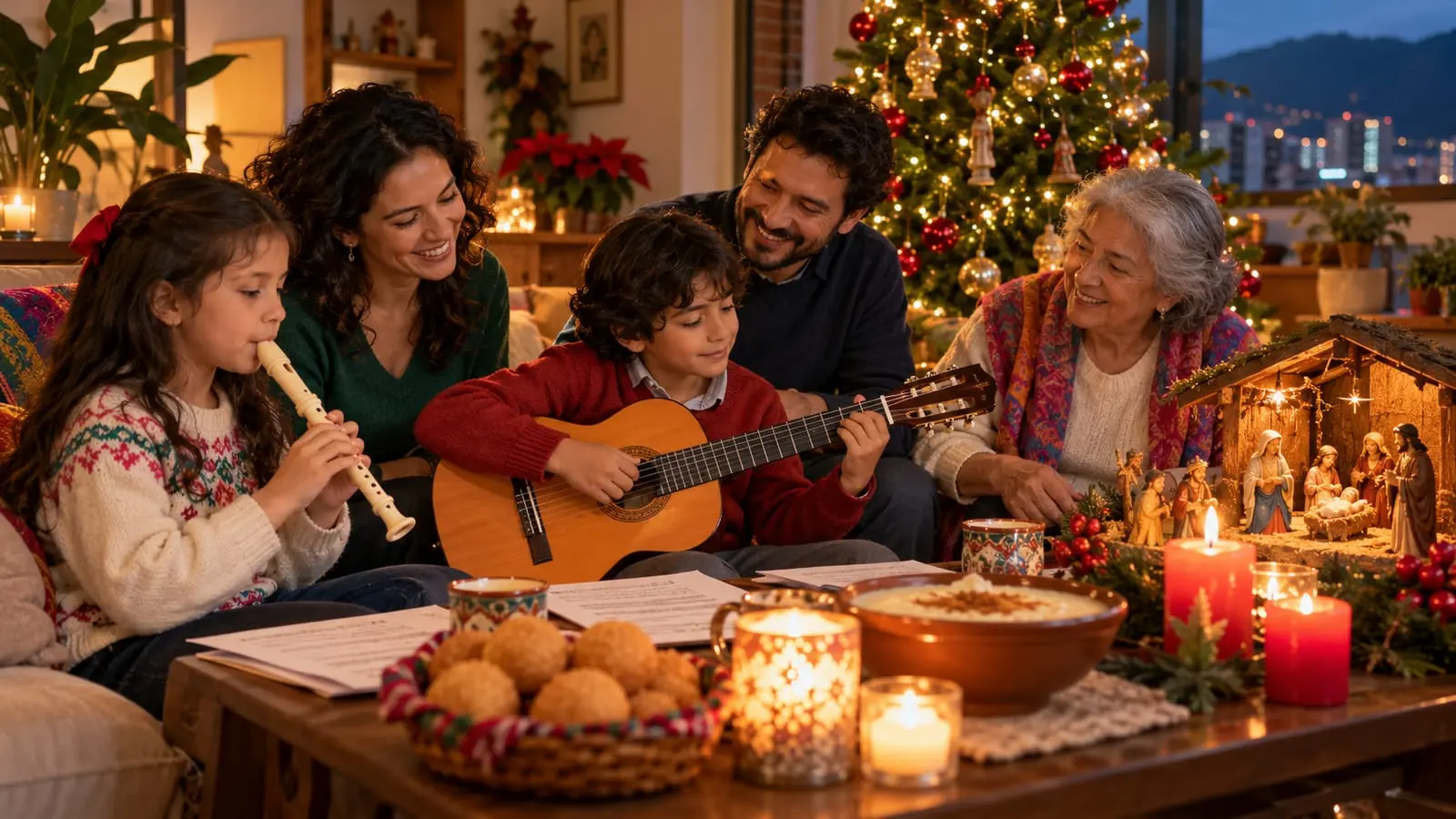
Ideally, start practicing Christmas carols in early November, or by the middle of the month at the latest: with about twenty minutes most days, you'll reach the novena de aguinaldos, from December 16 to 24, with three or four pieces you can play confidently.
The easiest Christmas carols to start with have short, repetitive melodies and just a few chords: Campana sobre campana, Los peces en el río, Tutaina, and Noche de paz top the list. On recorder and piano, they're comfortable in C or G major; on guitar and tiple, you can play them with two or three open chords.
If you start in mid-November, you'll be ready for the novena, December 16 to 24, with three or four carols you can play confidently. Here's how to choose them for your instrument, pick a key, and organize your practice. We don't include lyrics: the idea is for you to play while the whole household sings.
In short
- A carol is easy when its melody moves by step, its phrases repeat, and it needs only two or three chords for accompaniment.
- On recorder and piano, C and G major are the most comfortable keys; on guitar and tiple, choose keys with open chords such as G, D, C, and A minor.
- If the key doesn't suit your family's voices, transpose or use a capo rather than making the singers strain.
- Four weeks of short practice sessions from mid-November are enough to prepare a small, reliable repertoire for the novena.
- The carols most often sung during the Colombian novena, such as Tutaina, Mi burrito sabanero or Los peces en el río, can be shared out among the instruments: melody on flute or piano, chords on guitar or tiple, and rhythm on tambourine or maracas.
- Carols shine in a group: melody on recorder or piano, chords on guitar or tiple, and children on maracas or tambourine.
The easiest Christmas carols to start with
These are our top recommendations for your first December with the instrument. Traditional songs have no known author; where the songwriter is known, we include their name.
| Christmas carol | Origin | Why it's easy | Watch out for… |
|---|---|---|---|
| Campana sobre campana | Traditional | Short, repeated phrases and accompaniment with few chords. | The chorus tempts you to speed up: keep the beat steady. |
| Los peces en el río | Traditional, origins uncertain | Catchy melody in a minor key, with very few chords. | One of the few in a minor key; useful for hearing that different tonal color. |
| Tutaina | Traditional, a staple of Colombian novenas | Short, highly repetitive melody, ideal for recorder. | Since everyone sings it fast, learn it slowly first. |
| Vamos pastores, vamos | Traditional | Cheerful feel and symmetrical phrases that are easy to memorize. | Repeated notes should sound even. |
| Noche de paz | Franz Xaver Gruber (music, 1818) and Joseph Mohr (lyrics, 1816) | Slow and built on three basic chords; perfect for working on tone. | It uses triple meter (6/8, or 3/4 in many songbooks): don’t force it into four beats. |
| Mi burrito sabanero | Song by Hugo Blanco (Venezuela) | Few chords and a cheerful rhythm that draws children in. | More rhythmic activity: practice it with a metronome. |
| Feliz Navidad | Original song: José Feliciano (1970) | A four-chord cycle repeats through almost the entire song. | Ideal for guitar; the melody has fast-moving syllables. |
| Jingle Bells | James Lord Pierpont (1857) | The chorus fits within five consecutive notes on the piano. | The verses are more active: start with the chorus. |
The novena's gozos, or sung refrains, are another great option: they're repeated on all nine nights, giving you a new chance to play them every day.
Christmas carols for the novena de aguinaldos and the instruments that suit them best
The main carols heard during the Colombian novena are Mi burrito sabanero, Tutaina, Los peces en el río, Ven a nuestras almas, Campana sobre campana, A la nanita nana and The Little Drummer Boy. Each shines on a different instrument, so everyone in the family can play something.
| Christmas carol | For the melody | For the accompaniment | For the little ones |
|---|---|---|---|
| Mi burrito sabanero | Recorder or keyboard, playing the melody slowly at first. | Guitar or tiple, with cheerful, steady strumming. | Maracas and tambourine keeping the beat. |
| Tutaina | Recorder: the tune is short and repeats. | Guitar or tiple with just a few chords. | Tambourine or claves following the beat. |
| Los peces en el río | Recorder or piano, in a minor key. | Guitar or tiple in A minor. | Maracas, played softly on each beat. |
| Ven a nuestras almas | Piano or keyboard, which sustains long phrases well. | Guitar or tiple, with sustained chords. | Triangle or small bells at the ends of phrases. |
| Campana sobre campana | Recorder or piano. | Guitar or tiple with clearly accented strumming in duple meter. | Small bells or triangle, living up to the song's name. |
| A la nanita nana | Piano or recorder: it's a lullaby and calls for a soft sound. | Guitar with a slow arpeggio. | Best without percussion, or with a very soft sound. |
| The Little Drummer Boy | Piano or keyboard. | Guitar with just a few chords. | Small drum or bongos, played softly. |
If you prefer accompanying on guitar, also see Colombian December songs on guitar, where we move from Christmas carols to the merengue, paseo and porro of the holiday celebrations.
Which key to use for your instrument
The same song can be very easy or frustrating depending on the key you play it in. These are the most comfortable keys for each instrument:
| Instrument | Comfortable keys | Why |
|---|---|---|
| Soprano recorder | G major and C major | They use the first fingerings you learn; if the melody drops to low C, which requires covering every hole, transpose it to G. |
| Guitar | G, D, C, A minor, and E minor | Everything uses open chords, with no barre chords. |
| Tiple | G, D, C, and A minor | Its four courses are tuned like the guitar's first four strings, so many open chord shapes are similar. |
| Piano or keyboard | C major, G major, and A minor | Few black keys; the left hand can start with one note per chord. |
What if the key doesn't suit the voices?
A key that's comfortable for your fingers may be too low or too high for the singers. Change it before making your family strain: on guitar, a capo lets you keep the same shapes and raise the pitch; on other instruments, you'll need to transpose. We explain how in how to transpose a song. If children are singing, avoid taking the melody too low: their voices sound better in a middle register.
Christmas carols on recorder and piano: the melody
Recorder
In many schools, it's the instrument of December, and carols are a natural fit for its repertoire. To keep the melody clear:
- Blow gently, as if warming your hands: squeaking is almost always caused by too much air.
- Cover the holes with your finger pads, not your fingertips.
- Start each note with your tongue, using a gentle syllable like “tu”, especially on the repeated notes in Tutaina or Vamos pastores.
- Mark breathing points in pencil: at the end of each phrase, never in the middle.
If your child is starting this instrument, recorder lessons work on exactly these skills: breathing, articulation, and reading, using repertoire like this.
Piano or keyboard
Start with the melody in your right hand. The chorus of Jingle Bells in C major fits entirely within a five-finger position (C, D, E, F, G), so you do not need to move your hand. Once it flows smoothly, add the left hand with one note per chord — its root — and later the full chord.
Noche de paz is the next stop: slow, in triple meter, and with three basic chords (in C major: C, G7, and F), it lets you work on tone and legato at an unhurried pace.
Christmas carols on guitar and tiple: chords and strumming
On guitar and tiple, accompaniment takes the lead. Almost all carols work with three chords: the tonic (I), dominant (V or V7), and subdominant (IV). In G major, those are G, D7, and C.
| Christmas carol | Suggested key | Basic chords | Strumming |
|---|---|---|---|
| Noche de paz | G major | G, D7, C | In triple meter: bass on 1 and a chord on 2 and 3. |
| Los peces en el río | A minor | Am and E7, plus an occasional passing chord | In duple meter, with clear downstrokes on every beat. |
| Campana sobre campana | G or D major | I, IV, and V7 of the key | In duple meter, with an accent on the first beat. |
| Feliz Navidad | D major | G, A, D, B minor, in a cycle | Down, down-up, steady and cheerful. |
On the tiple, those same chords are played across its four courses. If you already strum pasillo, Noche de paz will feel natural because it shares the triple meter. Before each practice session, take your time tuning: the octave strings go out of tune easily, and an out-of-tune tiple is noticeable throughout the room. Here is how to tune the tiple step by step, and if you want to accompany the novena with confidence, tiple lessons can help you refine your strumming pattern.
A four-week plan to get ready for the novena
Twenty minutes on most days from mid-November are enough for three or four carols. Here's one way to organize it:
| Week | Goal | Tip |
|---|---|---|
| 1 | Choose three carols and learn the first one all the way through, slowly. | Start with the shortest: an early success builds motivation. |
| 2 | Learn the second and review the first. | Use the metronome a few beats per minute below the final tempo. |
| 3 | Learn the third and rehearse with someone at home singing along. | Playing while others sing is a separate skill: don't stop if someone makes a mistake. |
| 4 | Review all three at tempo and practice beginnings and endings. | Agree on a cue to start together and a clear way to finish. |
Always keep a piece you already know well in reserve. On the day of the novena, nerves and noise in the room make everything feel faster; having a reliable piece gives you peace of mind.
When and how to play during the nine days of the novena
You don't need to play everything on the first night. The easiest approach is to introduce one carol each night, starting with the one you feel most confident playing, and repeat it on the following nights: by the last day, it will sound as if you've always played it.
- Nights 1 to 3 (December 16 to 18): play only the carol you know best while you get used to the noise and nerves.
- Nights 4 to 6 (19 to 21): add the second carol and let the children join in with a tambourine or maracas.
- Nights 7 to 9 (22 to 24): try the third carol and close the evening of the 24th with everyone's favorite.
If your children are on school break and you want them to keep making music after the holidays, take a look at our school-break music courses.
How to play them as a family (and common mistakes)
A carol comes alive when more than one person plays. A simple arrangement: recorder or piano on melody, guitar or tiple on chords, and the youngest children on maracas, tambourine, or a drum. If you're looking for percussion instruments for them, here are some musical gift ideas for children.
- Learning the more elaborate radio version instead of the simpler traditional melody.
- Always rehearsing from the beginning and never practicing the difficult sections separately.
- Speeding up without noticing: the accompanist keeps the pulse for everyone.
- Tuning each string instrument separately, without a shared reference.
- Leaving practice until December 15.
Frequently asked questions
What is the easiest Christmas carol to play on recorder?
Tutaina and Campana sobre campana are often the first: short, repetitive phrases with few notes. Play them in G or C major and learn them slowly before increasing the speed.
What chords do I need to play Christmas carols on guitar?
G, C, D7, A minor, and E7 cover much of the Christmas repertoire in comfortable keys. If you can change between them without stopping your strumming, you're ready to accompany the novena.
Can I learn a Christmas carol in a week if I've never played before?
A simple one, yes: on recorder or piano, a short melody like Campana sobre campana is within reach with daily practice. Chord accompaniment on guitar or tiple usually takes longer, because you first need to build finger strength and ease of movement.
Is Mi burrito sabanero a traditional Christmas carol?
No. Although it's heard at every novena, it's a song with a known composer, written by Venezuela's Hugo Blanco in the early seventies. Traditional songs such as Tutaina and Los peces en el río have no known author.
How far in advance should I start practicing Christmas carols?
Ideally, start in early or mid-November, with about twenty minutes of practice most days. That way, by the novena, from December 16 to 24, you'll have three or four carols you can play confidently and one in reserve.
Which Christmas carols are sung during the novena de aguinaldos in Colombia?
The most common are Mi burrito sabanero, Tutaina, Los peces en el río, Ven a nuestras almas, Campana sobre campana, A la nanita nana and The Little Drummer Boy. During the novena, they alternate with prayers and gozos, and each family adds its own favorites.
Sources
We checked the facts in this article against these sources on October 22, 2026.
- Stille Nacht Gesellschaft: history of the song (Mohr, Gruber, 1816 and 1818)
- Radio Nacional de Colombia: essential Christmas carols for a Colombian Christmas
- El Tiempo: traditional Colombian Christmas carols (Mi burrito sabanero, Tutaina)
- Portafolio: the novena de aguinaldos, a Colombian tradition and its origins (December 16 to 24)
- Library of Congress: origins of Jingle Bells (Pierpont, 1857)
- GRAMMY.com: how José Feliciano created Feliz Navidad (1970)