
Colombian songs to learn on tiple or guitar
From La cucharita to La gata golosa: an Andean repertoire for tiple and guitar ordered by difficulty, with what each piece teaches you.
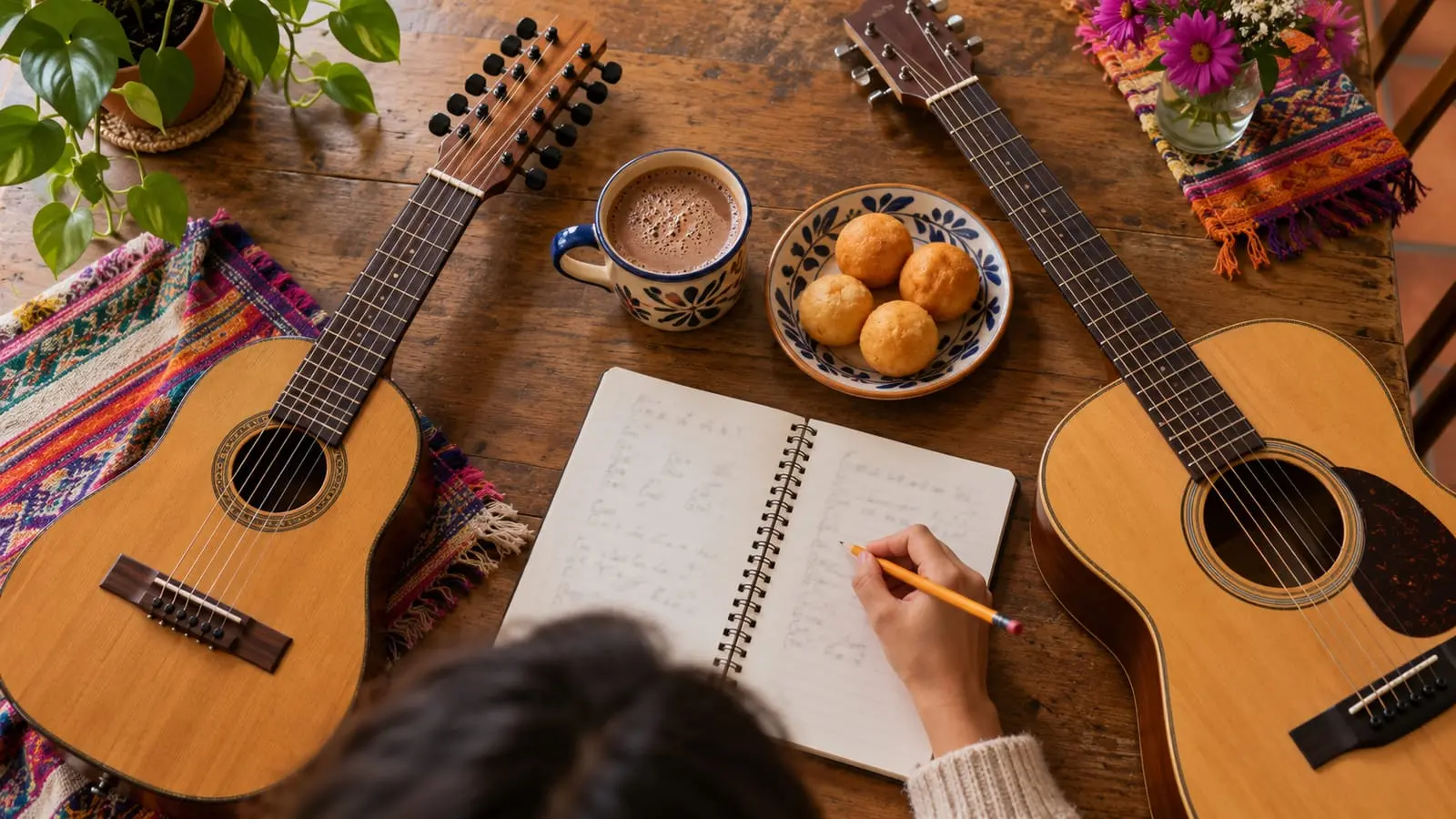
To get started with Colombian music on tiple or guitar, move from simple pieces to more demanding rhythms: first a carranga such as La cucharita or a slow waltz such as Pueblito viejo, then a sung pasillo such as Espumas, followed by bambucos such as Soy colombiano or Cuatro preguntas, with instrumental pasillos such as La gata golosa as your goal.
The order reflects what each song asks of your right hand, rather than which song is better. Here you'll find repertoire by level, each instrument's role and how to work out a song without getting lost along the way.
In short
- In Andean music, the challenge lies in the right hand: strumming and pulse matter more than the chords.
- Start with duple styles or slow triple-time ones, such as carranga, waltz or danza, and save bambuco for when your pulse is steady.
- In the trio, the tiple strums and establishes the style, while the guitar plays the bass lines; learn the accompaniment first, then the melody.
- Instrumental pasillos, such as La gata golosa or Vino tinto, are an advanced goal: they require agility and often change keys between sections.
- Listen to several versions of each piece before playing it: you learn the style by ear.
Repertoire by difficulty
This list is for players accompanying songs on tiple or guitar. The levels are guidelines: the same piece may be simple at a slow tempo and demanding at performance tempo. If you're still unsure which role you want in the trio, start with our guide to Colombian Andean music.
| Level | Piece | Author | Style | Skills it develops |
|---|---|---|---|---|
| 1 | La cucharita | Jorge Velosa | Carranga | Continuous strumming and chord changes without interrupting the pulse. |
| 1 | Pueblito viejo | José A. Morales | Colombian waltz | Slow triple time: bass on 1 and a chord on 2 and 3. |
| 2 | Espumas | Jorge Villamil | Pasillo | Pasillo strumming at a moderate tempo while someone sings. |
| 2 | Adiós a Bogotá | Luis A. Calvo | Danza | Tone, legato, and expression in a slow piece; written for piano, it can be arranged for other instruments. |
| 3 | Soy colombiano | Rafael Godoy | Bambuco | The rhythmic sway of bambuco over a melody almost everyone knows. |
| 3 | Cuatro preguntas | Pedro Morales Pino (lyrics by Eduardo López) | Bambuco | Accompanying a freely phrased vocal line without losing the pulse. |
| 3 | Brisas del Pamplonita | Elías M. Soto | Bambuco | A longer, classic bambuco and a good step toward concert repertoire. |
| 3 | La guaneña | Traditional song from Nariño | Bambuco | A melody from oral tradition that lends itself well to learning by ear. |
| 3 | El sanjuanero | Anselmo Durán Plazas | Sanjuanero, a festive variant of bambuco | Energy and precision in a lively, danceable style. |
| 4 | La gata golosa | Fulgencio García | Instrumental pasillo | Agility, quick chord changes and a form with several sections. |
| 4 | Vino tinto | Fulgencio García | Instrumental pasillo | Strumming endurance at a fast tempo. |
First steps: carranga, waltz, danza and sung pasillo
The first level has one goal: keeping your right hand moving when your left changes chords. Carranga is ideal for this. It originated in rural Boyacá, uses tiple, requinto, guitar and guacharaca, and its songs usually revolve around a few chords with steady strumming. La cucharita, by Jorge Velosa, is a fun, well-known introduction.
Pueblito viejo introduces triple time at an unhurried pace. On guitar, play the bass on the first beat and the chord on the second and third; on tiple, give the first beat room to breathe and mark the other two with short strums. If you can keep that pattern going while humming the melody, you're ready for pasillo.
Espumas is a sung pasillo at a moderate tempo, and that's where this style's real challenge appears: keeping the first beat clear even when the accompaniment gets busier. Record yourself and listen for whether beat 1 stands out. And if you play guitar and read sheet music, Adiós a Bogotá, the danza by Luis A. Calvo, is more a study in tone and expression than speed; he wrote it for piano around 1920, so ask your teacher for a guitar arrangement.
The leap to bambuco
Bambuco is the most challenging style, and not because of the chords: its charm lies in the interplay between two rhythmic feels, 6/8 and 3/4, which the melody and accompaniment often set against each other. That's why it helps to approach it with a steady pulse. If you've never tried the clapping exercise in six, start with Colombian rhythms explained.
- Listen to three different versions of the piece and tap your foot where you feel the pulse.
- Learn the harmony section by section, without the rhythm: just the chord changes in order.
- Play the strumming pattern over a single chord, very slowly, until it feels automatic.
- Combine the pattern and chord changes in the first phrase, then the second.
- Sing or hum while playing. If your right hand stops when you sing, slow the tempo down.
Soy colombiano is a good first bambuco because you already know the melody by ear. Cuatro preguntas and Brisas del Pamplonita are classics that require more patience with vocal phrasing. El sanjuanero has a festive, danceable character, and La guaneña, from Nariño's tradition, is particularly suited to learning by listening.
Tiple or guitar: your role in each piece
In an Andean trio, each instrument has a job, and it helps to know yours before sitting down to study a song.
| Aspect | Tiple | Guitar |
|---|---|---|
| Main role | Strumming that establishes the style and fills out the harmony | Bass lines that move between chords, and harmonic support |
| Main practice focus | Right hand: strums, muting and consistency | Independent thumb and melodic bass lines |
| Typical mistake | Strumming with a tense wrist and making the sound harsh | Strumming everything without bass lines, as if it were a pop ballad |
| Once you accompany well | Picking simple melodies | Solo or duet guitar arrangements |
If you already play guitar, the tiple's four courses are tuned like your first four strings (D, G, B, and E), so many fingerings will feel familiar; what's new is the strength needed to press down groups of steel strings and the strumming pattern. We compare them in depth in guitar or tiple.
How to work out a Colombian song step by step
Much of this repertoire is available as chord charts (chord names above the lyrics) and recordings. To make that material useful:
- Compare the chord chart with the recording. Many charts online are in a different key or contain errors; let your ear be the judge.
- Identify the form. Many pasillos and bambucos have two or three repeating sections; writing down their order (A, A, B, A…) keeps you from losing your place.
- Watch for a change of mode. Often one section is in a minor key and another in its relative major, or vice versa; if a chord “doesn't fit,” check whether the piece has changed key.
- Adapt it to your voice. If you sing while playing, choose the key before memorizing fingerings, rather than afterward.
- Learn the melody even if you're only accompanying. Humming it tells you where the chord changes belong.
The advanced goal: instrumental pasillos
Instrumental pasillos such as La gata golosa and Vino tinto, both by Fulgencio García, are showcase pieces for bandola. On tiple and guitar, your first goal is to accompany them at a moderate tempo without losing the clarity of the first beat. Then come two challenges: speed and form, since this type of pasillo often has several sections with key changes between them.
Once you accompany confidently, you can try picking the melody on tiple or playing a solo guitar arrangement. If leading the melody is what appeals to you, perhaps Andean bandola is your instrument.
A teacher who knows the style helps you progress faster: they demonstrate patterns slowly and correct your right hand before bad habits take hold. At Gissi, teachers of tiple, bandola and guitar work on this repertoire in online or in-home lessons in Bogotá.
Frequently asked questions
What's the easiest Colombian song to play on tiple?
For a first attempt, try a carranga such as La cucharita or a slow waltz such as Pueblito viejo: a few chords and a strumming pattern you can learn quickly. Save bambuco for later, even though it's the most representative style.
Can I play bambucos and pasillos on guitar if I don't have a tiple?
Yes. Guitar is part of the Andean trio and can accompany a song on its own by combining bass lines and chords. What matters is learning each style's pattern rather than playing it like a ballad.
Do I need to read sheet music to play Andean music?
To accompany songs, reading chord charts and having a good ear are enough. For instrumental pasillos and trio arrangements, reading sheet music opens up much more repertoire, since a large part of it is written down.
Where can I find the chords for these songs?
In songbooks and online chord charts, but always check them against a recording: many contain errors or are in a different key. Your teacher can help correct them and transpose them into a key that suits your voice.
Sources
We checked the facts in this article against these sources on October 22, 2026.
- Radio Nacional de Colombia: Fulgencio García, composer of La gata golosa (1912) and pasillos such as Vinotinto
- Radio Nacional de Colombia: Pedro Morales Pino, father of Colombian Andean music
- Radio Nacional de Colombia: reasons to take a closer look at bambuco (Soy colombiano, by Rafael Godoy)
- Radio Nacional de Colombia: La guaneña, a traditional song from Nariño in six-eight time
- IMSLP: Adiós a Bogotá, a piano danza by Luis Antonio Calvo (around 1920)
- Wikipedia: Pueblito Viejo, a Colombian waltz by José A. Morales