
What are Colombia's traditional instruments? A region-by-region guide
From the Andean tiple to the marimba de chonta of the Pacific coast: a tour of the traditional instruments of each region of Colombia, the role they play and where to start playing them.
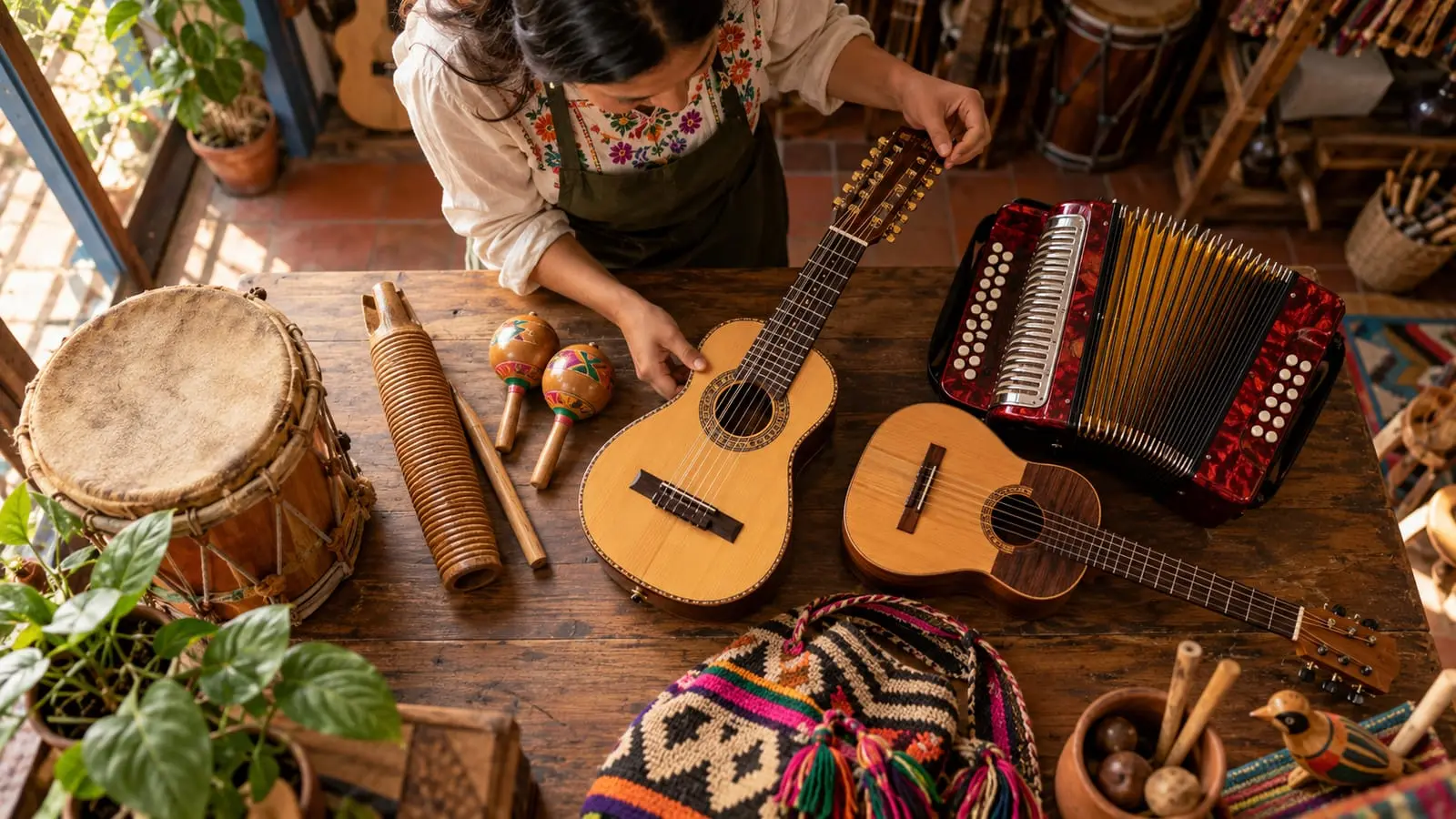
Colombia's traditional instruments vary by region: tiple, bandola, and guitar lead in the Andes; gaitas, drums (alegre, llamador, and tambora), guacharaca, and accordion in the Caribbean; marimba de chonta, cununos, bass drums, and guasá on the Pacific coast; and harp, cuatro, and maracas in the Llanos.
Each region blends Indigenous, African, and European roots in its own way, making every ensemble sound distinct. Here is a regional map of the instruments, their roles, and which ones you can start learning today.
In short
- The tiple is often called Colombia’s national instrument, although every region has its own.
- Amazon: the maguaré and other drums, flutes, and rattles of Indigenous peoples such as the Uitoto accompany rituals and dances.
- Islands (San Andrés and Providencia): calypso, mento, and polka are played on guitar, mandolin, tináfono, quijada de caballo, and maracas.
- Andean region: tiple, bandola, and guitar form the traditional trio that plays bambucos, pasillos, guabinas, and torbellinos.
- Caribbean: gaitas and flauta de millo carry the melody, tambor alegre improvises, llamador keeps the beat, and vallenato is played with accordion, caja, and guacharaca.
- Pacific coast: chonta marimba, cununos, bass drums and guasá accompany currulao singing; in Chocó, you hear chirimía.
- Llanos: harp, cuatro, and maracas are the foundation of joropo.
- You can learn tiple, bandola, guitar, percussion, and wind instruments with a teacher; gaitas, marimba, and harp are usually learned with teachers rooted in the tradition.
A quick map: traditional instruments by region
| Region | Main instruments | Music and rhythms |
|---|---|---|
| Andean | Tiple, Andean bandola, guitar; requinto and small percussion such as spoons, chucho, or esterilla | Bambuco, pasillo, guabina, torbellino, danza, carranga |
| Caribbean | Gaitas, flauta de millo, tambor alegre, llamador, tambora, maracas, guache, accordion, caja, guacharaca; wind bands | Cumbia, gaita, porro, fandango, vallenato |
| Pacific | Marimba de chonta, cununos, bass drums, guasá; chirimía in Chocó | Currulao, bunde, juga, abozao |
| Llanos (Orinoquía) | Llanero harp, cuatro, maracas; in some ensembles, bandola llanera | Joropo: pasajes and golpes |
The boundaries are not rigid. Musicians travel, genres overlap, and today you can hear tiple in fusion music, marimba alongside electric bass, or porro played by an orchestra. Even so, this map helps you place each sound.
Colombia’s national instrument
The tiple is the instrument most often called Colombia’s national instrument because of its central place in Andean music. This is a widespread custom rather than a rule: every region has equally emblematic instruments.
That is why you will also see guitar, harp, accordion, gaitas, or marimba de chonta presented as symbols of the country, depending on the region and the music being discussed.
Andean region: tiple, bandola, and guitar
In the country's central mountains, the signature ensemble is the Andean trio: bandola carries the melody, tiple supports harmony and rhythm, and guitar provides the bass lines. It plays bambucos, pasillos, guabinas, torbellinos, and danzas at serenades, family gatherings, and in school and university estudiantinas.
The tiple
It has 12 metal strings arranged in four courses of three, a smaller body than a guitar, and a bright sound rich in overtones. Many consider it the national instrument. Its tuning relates to the guitar's four highest strings, giving guitarists a head start. If it interests you, explore tiple lessons.
The Andean bandola
It is the trio's melodic voice. A pick is used to play courses of metal strings, and its signature technique is tremolo: repeating the same note very quickly so it sounds sustained, almost sung. Learn more in Andean bandola lessons.
Guitar and its relatives
In Andean music, guitar plays bass lines that move between chords and completes the harmony. In Boyacá and Santander, carranga adds the requinto, from the tiple family, and guacharaca; torbellino features simple percussion such as spoons, chucho, and esterilla. Learn the first steps in our beginner's guide to Colombian Andean music.
We explain this in detail in instruments of Colombia’s Andean region.
Caribbean: gaitas, drums, accordion, and bands
Gaitas and flauta de millo
Gaitas are long flutes of Indigenous origin, traditionally made from the stem of the cardón cactus, a head of beeswax mixed with charcoal, and a feather-quill mouthpiece. They are played in pairs: the gaita hembra carries the melody, and the gaita macho, with fewer finger holes, accompanies it while its player shakes a maraca with the other hand. The flauta de millo is a thin cane played sideways, sounding through a reed cut into the cane itself.
The drums
The tambor alegre improvises and interacts with the dancers; the smaller llamador repeats a fixed stroke that keeps everyone together; and the tambora, a double-headed drum played with sticks, provides the bass tones. Maracas and guache, a seed-filled tube, complete the rhythmic texture of cumbia and gaita music.
Accordion, caja, and guacharaca
These are the three instruments of traditional vallenato. The diatonic accordion carries melody and harmony, the caja (a small hand drum) marks the rhythm, and the guacharaca, a cane scraper played with a fork-like trinche, fills out and drives the pulse.
Wind bands
In the savannas of Córdoba and Sucre, pelayera bands play porros and fandangos with clarinets, trumpets, trombones, euphonium, and percussion. Read more in our guide to instruments of Colombia's Caribbean music.
If you are interested in the accordion, we have a separate guide to vallenato instruments.
Pacific coast: chonta marimba, cununos and guasá
Music of the southern Pacific coast centers on the marimba de chonta: chonta palm wood bars over guadua bamboo resonators, played with mallets. It is accompanied by cununos, single-headed conical hand drums played in pairs (macho and hembra); double-headed bass drums, known as golpeador and arrullador; and guasá, a guadua tube filled with seeds, usually played by the cantaoras.
Call-and-response singing is just as central as the instruments in currulao, bunde, and juga. The marimba music and traditional songs of Colombia's southern Pacific region are recognized by UNESCO as intangible cultural heritage.
Chocó's chirimía
On the northern Pacific coast, chirimía replaces marimba with winds and percussion: clarinet, euphonium, snare drum, tambora, and cymbals. This is festive street music, featuring styles such as abozao, and a good reason to explore clarinet if you enjoy this sound.
We explain this in detail in instruments of Colombia’s Pacific region.
Llanos: harp, cuatro, and maracas
Joropo, shared by Colombia and Venezuela, rests on three instruments. The llanero harp carries melody and bass; the cuatro, a small four-string nylon guitar, is the rhythmic and harmonic engine with its crisp, fast strumming; and maracas define the style with fast, precise patterns. In some ensembles, bandola llanera takes the harp's melodic role.
Over this foundation comes the strong, breath-driven llanero voice, in the more lyrical pasajes and the more energetic golpes. If you already play guitar, your harmonic ear will help with cuatro, but its tuning and strumming technique are distinct and should be learned from scratch.
We explain this in detail in llanera music: instruments and rhythms.
Instruments of the Colombian Amazon
In the Colombian Amazon, music is tied to Indigenous peoples, and their instruments are used mainly in rituals, dances, and ceremonies. Some of the best known are the maguaré, drums, flutes, and rattles.
- Maguaré (or manguaré): a pair of hollow-log drums associated with peoples such as the Uitoto (Murui). They have been used to communicate messages over long distances and accompany dances.
- Flutes: made from cane, bone, or other materials from the rainforest, they accompany songs and dances.
- Rattles and maracas: made from seeds and fruit, they keep the rhythm during ceremonies and dances.
Instruments, materials, and uses vary from one people to another, and many have a ritual significance that cannot be summed up in a list. If you explore this music, do so respectfully and through the people who carry on these traditions.
Instruments of the island region: San Andrés, Providencia y Santa Catalina
The music of the San Andrés, Providencia y Santa Catalina archipelago reflects Raizal culture: calypso, mento, schottische, and polka, with instruments such as guitar, mandolin, tináfono, quijada de caballo, and maracas.
- Guitar and mandolin: provide the harmony and melody in calypsos, polkas, and schottisches.
- Tináfono: a bass instrument made from a metal tub, a string, and a stick that plays the bass notes.
- Quijada de caballo: a dried jawbone whose teeth are scraped or struck to produce a percussive sound.
- Maracas: round out the rhythm.
European genres such as polka and schottische reached the Caribbean islands and blended with Afro-Caribbean rhythms such as calypso and mento. The lyrics are usually sung in San Andrés Creole, English, or Spanish.
Which instrument can you start learning?
| If you are drawn to… | Start with… | Why |
|---|---|---|
| Accompanying bambucos and pasillos | Tiple | Strumming and chords from the start; if you already play guitar, you progress quickly. |
| Playing Andean melodies | Andean bandola | Picking and tremolo; the trio's lead voice. |
| A foundation that works across styles | Acoustic guitar | Works in Andean music, llanero music, and almost any genre. |
| The drums of the Caribbean and Pacific regions | Percussion | Pulse, coordination, and independence: the foundation for any traditional drum. |
| Porro bands and chirimía | Clarinet or trumpet | They are central voices in Colombian wind bands. |
Gaitas, chonta marimba, llanero harp and vallenato accordion are mainly learned from traditional musicians, in cultural centers and traditional music schools, and through plenty of listening. A foundation in rhythm and ear training helps with any of them.
Gissi has teachers of tiple, bandola, guitar, percussion and wind instruments, with lessons online or at home in Bogotá. Before playing, it helps to understand the feel of these styles: we explain it in Colombian rhythms: bambuco, pasillo and cumbia.
Frequently asked questions
What instruments are played in Colombia’s island region?
In San Andrés, Providencia y Santa Catalina, calypso, mento, schottische, and polka are played on guitar, mandolin, tináfono, quijada de caballo, and maracas.
What are the instruments of the Colombian Amazon?
Some of the best known are the maguaré, drums, flutes, and rattles of Indigenous peoples such as the Uitoto. Their use is often ritual and varies from one people to another.
What is Colombia's national instrument?
Tiple is often considered the country's most representative instrument because of its central place in Andean music. Still, Colombia cannot be captured in a single instrument: accordion, gaitas, marimba de chonta, and llanero harp are just as emblematic in their regions.
What instruments are used in cumbia?
Traditionally, gaitas or flauta de millo provide the melody, and tambor alegre, llamador, tambora, and maracas or guache provide the rhythm. Over time, cumbia also moved to accordion, wind bands, and orchestras.
What are vallenato's three instruments?
Accordion, caja, and guacharaca. They are often described as bringing together three roots: accordion came from Europe, caja evokes drums of African origin, and guacharaca recalls Indigenous scrapers.
Is it hard to learn a traditional Colombian instrument if I have never played?
No harder than any other instrument. You can start tiple, bandola, or percussion from scratch with a teacher who knows the style. The hardest part at first is not the technique but each style's rhythm, which you can develop by listening a lot and counting aloud.
Sources
We checked the facts in this article against these sources on October 22, 2026.
- UNESCO: marimba music, traditional songs and dances of Colombia’s southern Pacific region and Esmeraldas (Ecuador)
- Cancillería de Colombia: marimba music, Intangible Cultural Heritage of Humanity
- UNESCO: traditional vallenato music of the Colombian Caribbean
- El Universal: gaitas and drums, the sound of a community (San Jacinto)
- Revista Maguaré (Universidad Nacional de Colombia): notes on the maguaré of the Múrui-Muinane
- Wikipedia: Colombian tiple