
How do you choose your first saxophone? What to check before buying
A first saxophone is almost always an alto. Here's what it should come with, which reeds to buy and what to check on a used one so you don't bring home a problem.
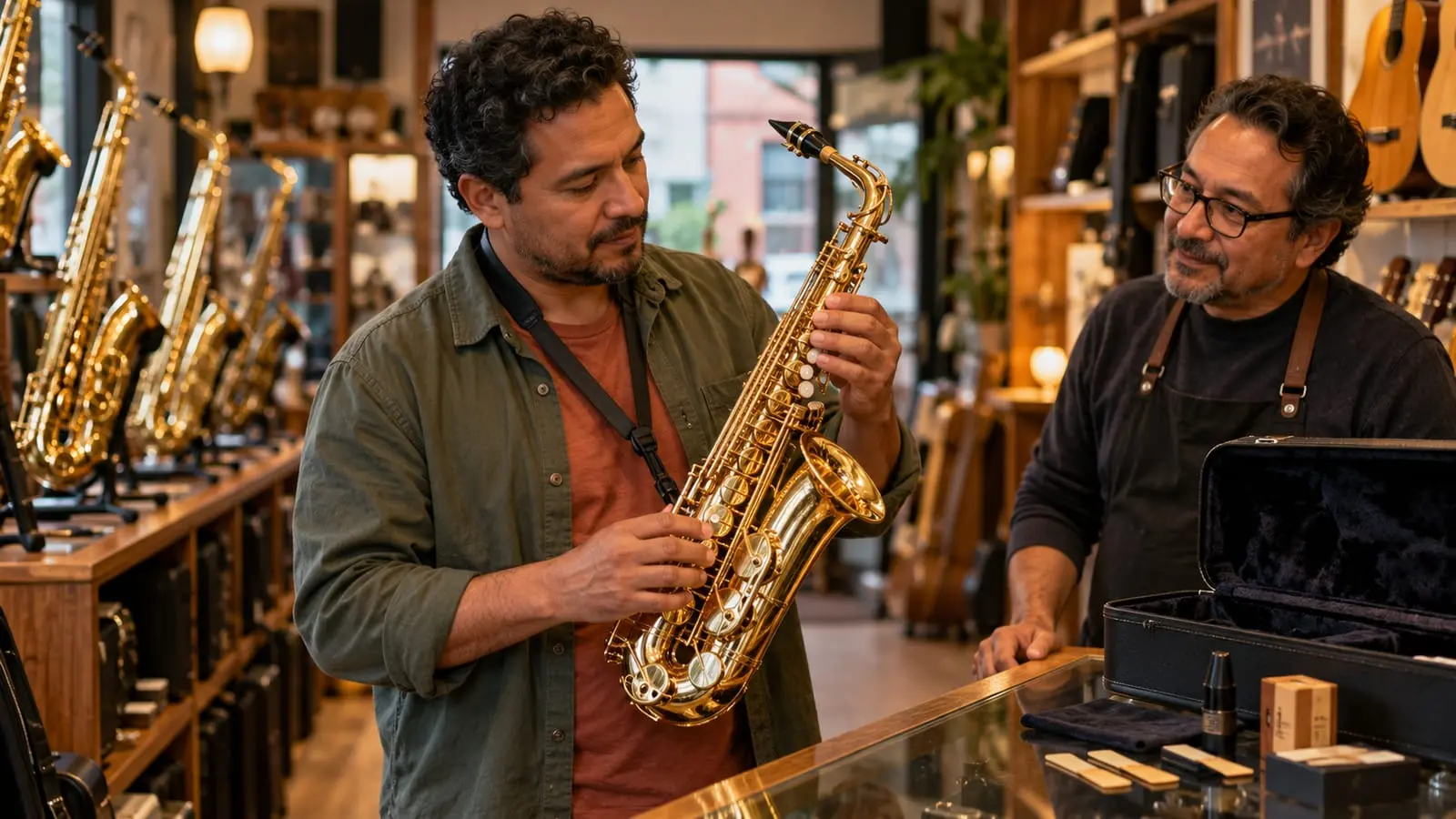
For most beginners, the first saxophone should be a student-model E flat alto saxophone: it's lighter and more compact than a tenor, the keys are closer to your fingers, and almost all beginner methods are written for it. More than the finish or color, what makes a good first saxophone is pads that seal, a neck in good condition, and a mechanism that works without unwanted noise or play.
In this guide, we explain what to check on a new or used instrument, which mouthpiece and reeds you need to get started, and which signs should make you wary.
In short
- The E flat alto saxophone is the most common starting point for children, teenagers, and adults.
- A saxophone that doesn't seal properly won't produce low notes, and a beginner may end up thinking they're the problem.
- On a used instrument, check the pads, neck, octave key, and mechanism for play and impact damage.
- Start with soft reeds, usually strength 2 or 2½, and buy several: they aren't all the same.
- Before paying, ask your teacher or a wind instrument technician to play and inspect it.
Alto or tenor: which is better for starting out
Alto is the most recommended starting point, but it's not the only one. This table summarizes what matters when buying:
| Type | Tuning | Size and weight | For a beginner? |
|---|---|---|---|
| Alto | E flat | Medium-sized; supported by a neck strap | Yes, the most common choice for children who can reach the keys, teenagers, and adults |
| Tenor | B flat | Larger and heavier; larger mouthpiece and reeds | Yes, for teenagers and adults with the build to support it who want that sound |
| Soprano | B flat | Small, usually straight | Not usually recommended: its size makes it look easy, but intonation is harder to control |
| Baritone | E flat | Very large; needs a harness or support | Not as a first instrument, unless a band lends one |
For children, the deciding factor isn't just age but physical fit: they need to support the weight with a strap, reach the right-hand keys with their fingers, and reach the low-note keys with their left little finger without twisting the wrist. If you're deciding between the two sizes, alto or tenor saxophone for beginners compares sound, breath demands, and genres in more detail.
What a student saxophone should include
A new student saxophone should come ready to play. Check that it includes:
- Body and neck (the curved tube that holds the mouthpiece), with its tightening screw.
- Mouthpiece, ligature, and mouthpiece cap.
- Strap or harness. For children and anyone with neck discomfort, a harness spreads the weight across the shoulders.
- Hard or semi-rigid case with dedicated spaces for the neck and mouthpiece.
- At least one reed, though you'll need more.
Only a few specifications matter to a beginner: a comfortable right thumb rest, left-hand palm keys within easy reach, and a range extending to high F. Many modern altos also have a high F sharp key; it's useful but not essential. The finish—gold, silver, black—says nothing about the quality of a student instrument.
Accessories worth adding
- A swab for the body and another for the neck, used after every practice session. We explain how in how to clean a saxophone.
- Cork grease for the neck, so the mouthpiece fits without force.
- A stand to keep it safe during breaks: many dents happen when a sax is left lying on a chair or bed.
- A reed case that keeps the reeds flat and separate.
Mouthpiece and reeds for getting started
The mouthpiece supplied with a student saxophone is usually enough for the first few months, as long as it's undamaged. In good light, check the tip and rails—the edges against which the reed rests: a small chip or worn edge lets air escape and causes squeaks that no exercise can fix.
The ligature should hold the reed evenly, with no stripped screws or bent parts. If the saxophone is used, buy a new mouthpiece or disinfect it thoroughly before use: mouthpieces and reeds are personal items.
Which reeds to buy
- The right size: alto, tenor, and clarinet reeds are different and aren't interchangeable.
- Soft: most beginners start with 2 or 2½. A hard reed doesn't give you a better sound; it gives you fatigue, notes that won't speak, and the habit of biting the mouthpiece.
- Several at once: natural cane reeds vary, even within the same box. With three or four, you can rotate them and avoid running out before a lesson.
- Synthetic, optional: they last longer and don't need moistening, but they feel different. Ask your teacher before switching.
The numbering varies from one manufacturer to another, so one brand's 2½ may feel like another's 3. When you finish the first box, take a used reed to your lesson and ask your teacher whether to move up or down in strength.
What to check on a used saxophone
A used saxophone can be an excellent buy or a long repair job. The most important details rarely show in photos, so inspect it in person, ideally with someone who plays.
Pads
These are the leather-covered discs that close the tone holes. Look for pads that are torn, dried out, misshapen, or have peeling leather. If they sound like chewing gum being pulled away when they open, they're sticky; this is common with the G sharp key. Replacing a few is straightforward; if almost all are bad, the saxophone needs a complete repad, which is a major job.
Neck
Check for dents and downward bending—this can happen when the saxophone falls and the neck takes the impact—and make sure it fits firmly into the body without wobbling before you tighten the screw. Check its octave key, too: it should close completely and open only when it's supposed to.
Body and mechanism
- Dents near the tone holes or on the bottom bow, the U-shaped bend where the tube changes direction.
- Bent rods or keys with lateral play: a key that moves from side to side doesn't close consistently.
- Missing corks and felts, causing metallic clacking when you play.
- Springs that return each key quickly and with even force.
A simple test is to play down into the low register: if low B flat won't speak, or only speaks when you blow very hard, there's almost always a leak. A technician can confirm it with a leak light, a slim lamp inserted into the body to show where light escapes.
| What you notice | What it may indicate | A reason not to buy? |
|---|---|---|
| Low notes won't speak | Pads that don't seal or keys out of adjustment | Not necessarily; request an inspection and a repair quote |
| Bent or dented neck | A fall or poor transport | Depends on the damage; have a technician inspect it |
| Many torn or dried-out pads | Needs a complete repad | Only if the repair fits your budget |
| Green spots or corrosion on the keys | Damp storage and insufficient cleaning | Check whether the springs and rods are affected, too |
| Loose solder joints or shifted key posts | A hard impact | Usually a sign to look for another instrument |
Warning signs on new and used instruments
- A new saxophone with stiff keys, pads that don't seal, or metal that bends easily straight out of the box.
- A seller who won't let you try it or only shows front-view photos without the neck or pads.
- The phrase “it only needs pads”: it may be true, but it's a major repair you should get a quote for before paying.
- An instrument whose only selling point is its color or price. A striking finish says nothing about the mechanism.
- A manufacturer no technician in your city knows: without spare parts, even minor damage becomes a problem.
If the saxophone spent a long time in a damp place, for example in a hot region without a closed case, take extra care checking the pads and springs: prolonged humidity speeds up leather deterioration and corrosion.
Before paying: have your teacher try it
Even if you know what to look for, a beginner can't tell whether a saxophone responds well because their embouchure isn't stable yet. That's why it's worth having your teacher play it for a few minutes: long tones, low notes, and the move to the upper register with the octave key quickly reveal whether the instrument helps or hinders you.
- Ask for clear photos of the neck, pads, and bottom bow before going to see it.
- Ask when it was last checked at a wind instrument repair shop and what work was done.
- Play, or ask someone to play, full scales from low to high with a tuner nearby.
- Check the case: working fastenings and a space that holds the neck securely.
- If it's for a child, test the strap and posture both standing and sitting before deciding.
If you don't have a teacher yet, you can find one in the teacher directory or learn about saxophone lessons before buying; many students start with a borrowed instrument while they decide. And if you're comparing several secondhand instruments, our new or used instrument guide helps with the overall decision.
Frequently asked questions
What saxophone is best for a child?
Almost always an alto. What matters is that the child can support it with a harness and reach the keys without straining their hands. Many manage well around nine or ten years old; others need to wait a little or start on another wind instrument. A teacher can assess this in a lesson.
What reed strength should I use if I've never played?
A soft reed, usually 2 or 2½ depending on the manufacturer. As your embouchure strengthens, your teacher will tell you whether to move up; doing it too soon only makes producing a sound harder.
Is buying a used saxophone worth it?
Yes, if someone knowledgeable checks it and you factor in the cost of having a repair shop put it in good playing condition. A used student saxophone that's properly adjusted often plays better than a very low-quality new one.
Is soprano saxophone easier because it's smaller?
No. It's lighter, but it demands more embouchure control, and its intonation is more sensitive. That's why most teachers recommend starting on alto or tenor and leaving soprano for later.
How often should a saxophone go to a technician?
As a guideline, many teachers suggest a yearly checkup if you play regularly. And don't wait if a note that used to come easily becomes difficult: it's often a pad that no longer seals.
Sources
We checked the facts in this article against these sources on October 22, 2026.