
How long does it take to learn to play guitar?
Your first songs can come within a couple of months; barre chords, somewhere between month four and the end of year one. These are the real stages of learning guitar.
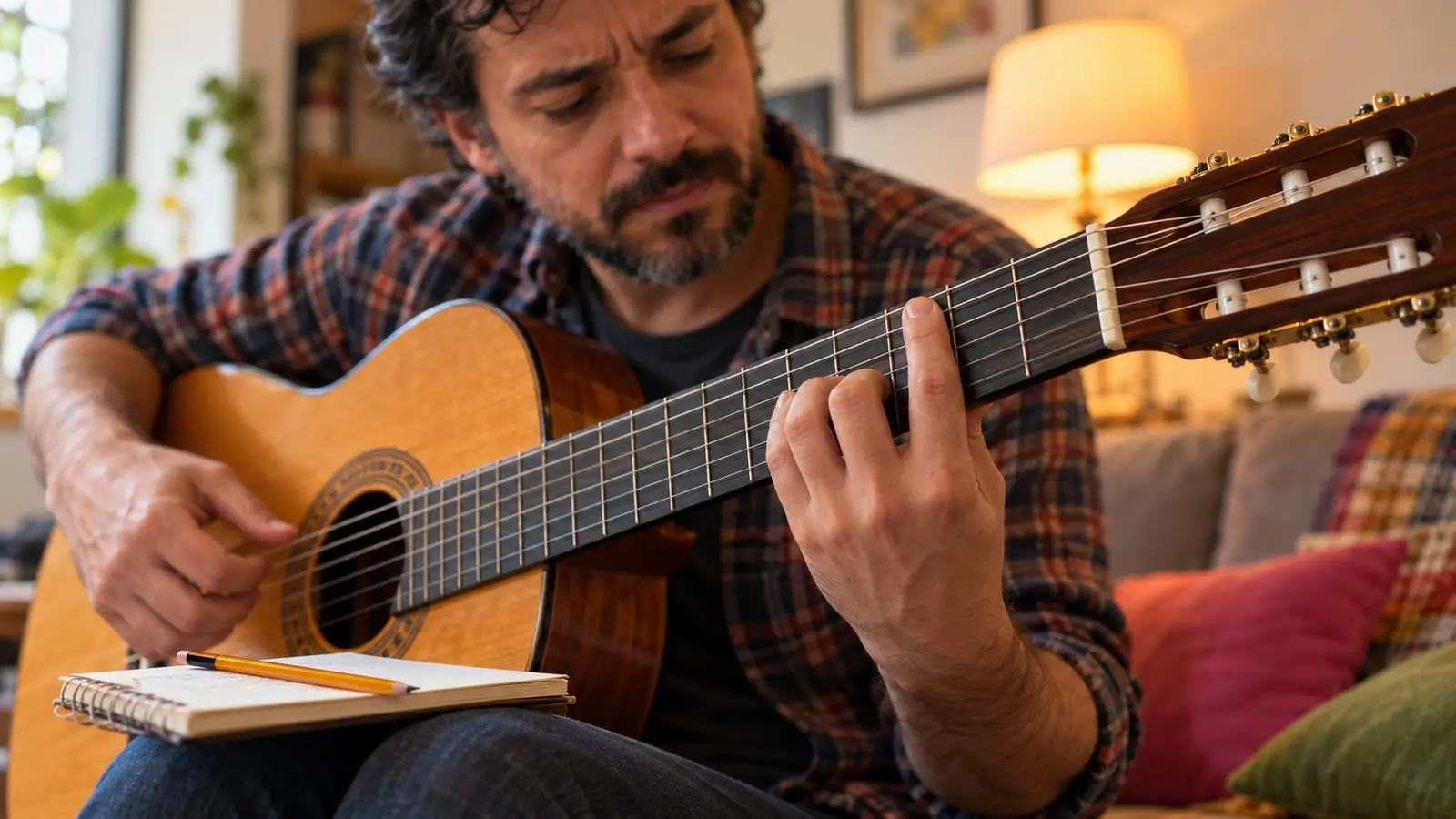
With regular practice, 20 to 30 minutes almost every day, you can switch between three or four open chords and accompany a simple song in one to three months; barre chords usually sound clean somewhere between the fourth month and the first year, and playing songs comfortably with varied strumming patterns and some single-note picking takes one to two years. Fingertip pain, which scares so many people away, generally lasts only the first few weeks, until calluses form, which usually takes about a month.
These are rough timelines: they vary with how often you practice, your age, the type of guitar, and what you want to play. Accompanying songs with friends is a different goal from playing classical guitar or rock solos.
In short
- Fingertip pain is normal and usually goes away within a few weeks as calluses develop, which typically takes about a month.
- With practice almost every day, switching smoothly between three or four open chords takes one to three months.
- Barre chords are the big hurdle: they usually sound clean between your fourth month and the end of your first year, and technique matters more than strength.
- Short, frequent sessions build calluses and muscle memory better than one long practice session a week.
- A guitar with very high string action or a poor setup makes everything feel harder than it is.
From your first chords to playing comfortably
On guitar, one hand forms chords while the other keeps the rhythm. Each develops at its own pace, and much of the learning process is getting them to work together without stopping the song.
| Stage | What you achieve | Approximate time with regular practice |
|---|---|---|
| Fingers and first chords | Posture, tuning, and your first open chords: E minor, A minor, D, C, and G. Your fingertips will be a little sore. | 2 to 6 weeks |
| Smooth chord changes | Switching between three or four chords at a slow tempo without stopping the rhythm; your first complete song. | 1 to 3 months |
| Purposeful strumming | Patterns with accents and muted strums, playing while singing, and simple ballad, pop, or Latin rhythms. | 3 to 6 months |
| Barre | Clean F and B minor chords, and movable barre chords up and down the neck. | 4 to 12 months |
| Single-note picking and arpeggios | Fingerpicked arpeggios, the pentatonic scale, riffs, and simple melodies. | 6 months to 1 year |
| Intermediate level | Varied repertoire, short solos, learning songs by ear, and playing with other musicians. | 1 to 3 years |
Notice that barre chords and single-note picking overlap in the timeline. Your teacher will usually work on them in parallel so you don't spend months stuck on a single challenge. As an outside reference for how long formal preparation takes, ABRSM estimates that a Grade 1 exam requires about 60 hours of lessons and independent practice combined, and a Grade 8 exam about 320 (ABRSM does not offer guitar exams; its figures are averages for other instruments and vary from person to person).
Finger pain and calluses: what's normal and how long it lasts
During the first few weeks, the fingertips on your fretting hand become tender, show string marks, and may sting a little at the end of practice. That's your skin adapting. With frequent practice, it toughens and forms small calluses that make pressing the strings comfortable, generally within the first month, though this depends on the person and how often you practice.
- Practice in short sessions of 15 to 20 minutes almost every day. Calluses form through repetition, rather than one long session that leaves your fingers raw.
- Nylon strings make the process gentler; steel strings on an acoustic guitar are thinner and under more tension, so they leave deeper marks at first.
- Don't play right after washing dishes, bathing, or swimming: damp skin softens and is easily injured.
- Don't pick at or bite your calluses. If they lift, file them gently.
- Press only as hard as needed. Many beginners use twice the pressure a string needs to sound clean.
Why changing chords is harder than learning a chord
Forming a chord at your own pace is relatively easy. The hard part is moving to the next one without breaking the rhythm. That's why many people get discouraged in the second month: they know the chords, but the song sounds choppy. These strategies shorten that stage:
- Look for guide fingers. Between C and A minor, fingers 1 and 2 stay in place: only finger 3 moves. Between A minor and E major, the whole shape shifts one string toward the bass strings.
- Move your fingers together, as a unit, instead of placing them one by one.
- Try the one-minute exercise: use a stopwatch to count how many times you switch between two chords in 60 seconds. Write it down and repeat daily; you'll see the number rise.
- Arrive on time even if the chord is incomplete. Keeping the strumming going is better than stopping to position every finger.
- Practice with a slow metronome and increase the tempo only once the change sounds clean.
The order in which you learn chords also helps. Basic guitar chords for beginners explains your first chords one by one.
Barre chords: the big hurdle and how to get past it
In a barre chord, your index finger presses all the strings at the same fret. This is where many people give up guitar, usually because they're trying to solve it with brute force. Barre chords depend more on technique than muscle:
- Start with a partial barre: a small F chord, pressing only the two or three highest strings with your index finger.
- Practice a full barre at fret 5 or 7 first, where it's usually easier than at the first fret, then gradually move toward the headstock.
- Roll your index finger slightly onto its firmer side instead of pressing with the flat pad.
- Let your arm's weight pull back slightly instead of squeezing with your thumb like a clamp.
- Play each string separately to find the one that isn't sounding, and correct just that spot.
If you still can't manage a barre at any fret after several months, have a luthier check the string action. A poorly set-up guitar can make barre chords almost impossible for a beginner.
Does learning time vary with the guitar and style?
| Guitar type or style | What comes more easily | What takes longer |
|---|---|---|
| Nylon-string acoustic (classical) | Strings that are gentle on the fingers; ideal for children and for Andean music, bossa nova, or classical music. | The neck is wider, so barre chords require more stretching. |
| Steel-string acoustic | A bright sound for accompanying pop, rock, or ballads. | The strings leave deeper marks on your fingertips in the first few weeks. |
| Electric | Thin strings and low action: barre chords and single-note picking come sooner. | Managing the amplifier and volume, and properly muting strings you aren't playing. |
| Accompanying songs | Five or six chords and two strumming patterns already open up plenty of repertoire. | Playing and singing at the same time without losing the rhythm. |
| Classical guitar | A solid foundation in reading and right-hand technique. | Reading sheet music and developing repertoire, which usually take several years. |
If you're still deciding, acoustic or electric guitar: which should you learn first? compares the two in more detail.
What helps or slows your progress
What helps
- Tune before every practice session. An out-of-tune guitar trains your ear poorly; you can use the online guitar tuner.
- Practice songs you really want to play alongside exercises.
- Play with a metronome or the original recording so your rhythm doesn't falter during chord changes.
- Have a teacher correct your thumb position behind the neck, your wrist, and your strumming hand from the start.
What slows progress
- Old or rusty strings that sound dull and don't stay in tune.
- Learning only from tutorials that show chords but not rhythm: you know the shapes, but the song doesn't come together.
- Trying to play a song at its original speed from day one.
- Taking several weeks off: your skin loses its calluses and needs to toughen up again.
If you're starting as an adult with limited time, learning guitar as an adult shows you how to make the most of each practice session.
Frequently asked questions
How long does it take to develop calluses from playing guitar?
They usually form in about a month if you practice in short sessions almost every day, though this varies from person to person. If you stop playing for a while, the calluses gradually fade.
Can you learn guitar in a month?
In a month of regular practice, you can learn four or five open chords, a basic strumming pattern, and a simple song at a slow tempo. Playing fluently, including barre chords and single-note picking, is a one- to two-year process.
Is it normal to struggle with barre chords after several months?
Yes, it's very common. Check your technique first, especially the angle of your index finger and how you use your arm's weight, then the instrument: very high string action makes it much harder. Meanwhile, keep working on other skills so you don't get stuck.
Do I need to read sheet music to learn guitar?
It isn't essential for accompanying songs: you can learn a lot with chord symbols and tabs. For classical guitar or professional music study, it is. In our acoustic guitar and electric guitar lessons, your teacher adapts the reading work to your goals.
Sources
We checked the facts in this article against these sources on October 22, 2026.
- Royal Conservatory of Music: classical guitar syllabus (Preparatory through Level 10 and ARCT)
- ABRSM: estimated preparation hours by grade (general reference for practical exams)
- Wikipedia: classical guitar (nylon strings, strings, tuning, and neck)
- MusicianWave: how long it takes to develop calluses from playing guitar