
How do you tune a cello? C, G, D and A
The cello's strings are C, G, D and A, tuned in fifths. Here's how to tune it with a tuner, by fifths and with harmonics, plus the tricks that come with a big instrument.
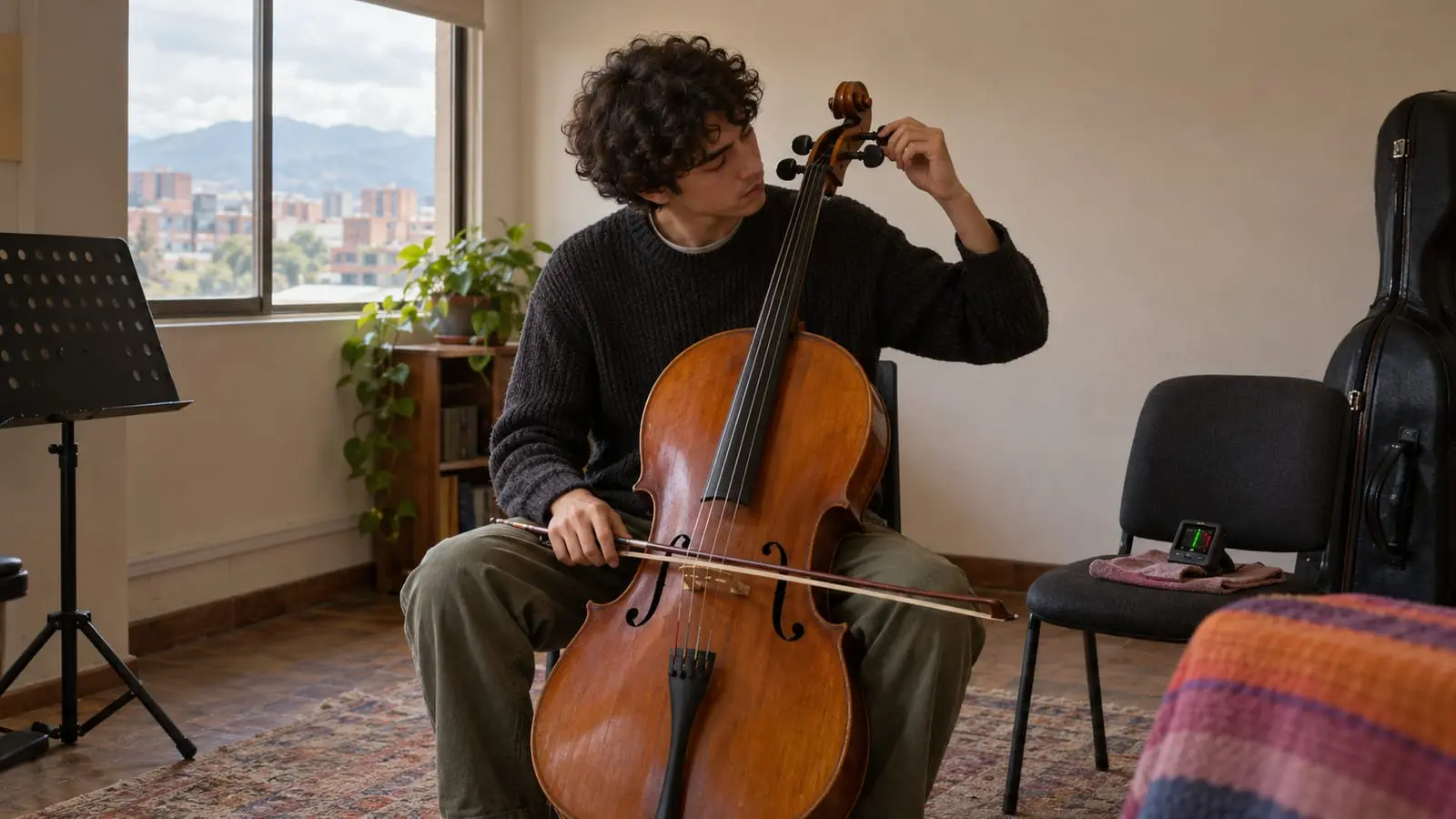
The cello is tuned in fifths. From thickest to thinnest string, its notes are C, G, D and A (C2, G2, D3 and A3), an octave below the viola. Tune A first, which sounds at 220 Hz with the usual reference of A = 440 Hz, then D, G and C in that order. Use fine tuners for small adjustments; use pegs only when a string is far from its target pitch.
The process is similar to tuning a violin, but the size changes a few things: the low strings take longer to settle, a phone tuner may struggle to read C, and the taller bridge leans more easily. Here's the step-by-step process and two ways to tune by ear: in fifths and with harmonics.
In short
- Cello strings, low to high: C (C2), G (G2), D (D3) and A (A3).
- The cello's A sounds at 220 Hz: it's the 440 Hz A, an octave lower.
- Tune seated in playing position, starting with A and working down one string at a time.
- If the tuner struggles to read C, bow it with a firm sound, or compare its harmonic with the G string.
- When tuning in pure fifths from A, C ends up about 6 cents lower than a tuner's reading; with piano, slightly narrower fifths work better.
Cello string notes
| String | Note | Symbol | Frequency |
|---|---|---|---|
| 4th (thickest) | C | C2 | 65.41 Hz |
| 3rd | G | G2 | 98 Hz |
| 2nd | D | D3 | 146.83 Hz |
| 1st (thinnest) | A | A3 | 220 Hz |
The notes are the same on every size, from a 1/4 cello for children to a full-size instrument. The fourth string's C is two octaves below middle C on the piano. Since cello music is mainly in bass clef, how to read bass clef can help if you're still having trouble finding those notes on the staff.
Pegs and fine tuners on the cello
The principle is the same as for violin, explained in detail in how to tune a violin: fine tuners for small adjustments, pegs for larger changes. On the cello, there are three differences worth knowing:
- The pegs are bigger and the strings have more tension. A tiny turn changes the pitch a lot. Push the peg into the pegbox as you turn so it doesn't slip back.
- Several fine tuners are common, sometimes built into the tailpiece. Advanced violinists often keep just one, on the E string; many cellists keep more.
- The fine tuner's lever can touch the top. If the screw is all the way in, loosen it to the middle of its range and bring the string back to pitch with the peg.
To use a peg, sit with the cello in playing position: reach the pegbox with your left hand and pluck the string pizzicato with your right, near the end of the fingerboard. Go slightly below the target pitch, then tune up to it. Check the bridge from the side afterward: each turn of a peg pulls the strings and bridge toward the fingerboard. How to care for a cello explains how to check it.
Step by step with a tuner
- Sit in playing position, with the endpin secured and the cello stable, in a quiet place.
- Attach a clip-on tuner to the bridge or open the online cello tuner, which uses your phone or computer microphone.
- Bow A with a long, even sound at medium volume. Adjust the fine tuner: clockwise raises the pitch; counterclockwise lowers it.
- If the tuner shows another note, such as G♯ or A♯, the string is far off: use the peg first.
- Continue with D, G and C, in that order.
- Make a second pass: changing one string's tension shifts the others slightly.
If the tuner can't read C: many phone microphones struggle with very low frequencies, and the tuner may jump between notes or show G, a strong harmonic of that string. Bow it with a firm sound rather than using pizzicato; move the phone closer to the f-holes, or use a clip-on tuner that reads vibrations directly. You can also tune it against the G string using the harmonics explained below.
Tuning by ear, in fifths
This is how orchestras tune: take A from the oboe or piano, then tune the other strings by playing them in pairs. On the cello, low fifths sound slower and less clear than on the violin, so use a slow bow, distribute the weight between both strings and take your time.
| Step | Strings you play together | Which string to adjust |
|---|---|---|
| 1 | A alone, against the reference | A |
| 2 | D + A | D |
| 3 | G + D | G |
| 4 | C + G | C |
Listen for beats: a pulsing “wah-wah-wah” that slows as you get closer. When it disappears and the fifth sounds steady, it's pure. Beats are harder to hear on G and C; if you can't hear them, get close with the tuner first, then confirm by ear.
A detail for cellists: pure fifths are slightly wider than piano fifths. If you tune perfectly by ear from A, D ends up about 2 cents below the tuner, G about 4 and C about 6. That's fine when playing solo or in a quartet; with piano, that C is noticeable, which is why many cellists narrow the low fifths slightly.
Tuning with harmonics
A harmonic is produced by touching the string very lightly at a precise point without pressing it against the fingerboard: at the halfway point, you hear an octave; at one third of the string, an octave plus a fifth. Harmonics are clear and sustained, making beats easier to hear than on low open strings.
The one-third point is around fourth position, exactly where a stopped note would sound a fifth above the open string. On the D string, for example, this harmonic gives a high A that should match the A string.
| String you're tuning | Harmonic at one third of the string | Compare with |
|---|---|---|
| D | A (A4) | Open A (an octave apart) or the harmonic halfway along the A string (in unison) |
| G | D (D4) | Open D (an octave apart) or the harmonic halfway along the D string (in unison) |
| C | G (G3) | Open G (an octave apart) or the harmonic halfway along the G string (in unison) |
- Touch the string as lightly as a feather, and use a fast, light bow slightly closer to the bridge than usual.
- The easiest method: play the harmonic on the lower string and the neighboring open string at the same time. If the octave pulses, adjust the lower string.
- Harmonics produce pure intervals, so the result is the same as tuning in fifths by ear. With piano, a tuner is still the best reference.
Why it goes out of tune and when to ask for help
- New strings: they drop in pitch several times during the first few days. C, the thickest string, usually takes the longest to settle.
- Climate changes: when moving from Bogotá's dry cold to a hot region, the wood and pegs react. After traveling, leave the cello in its case for a while before opening it and tuning.
- Pegs that slip back: if a peg slips even when you push it in, a luthier can adjust it or treat it with peg compound.
- Fine tuners at their limit: if there's no travel left, bring the string back to pitch with the peg; don't force the screw.
For young children, the safest approach at home is to use only fine tuners and leave peg adjustments for the lesson. In cello lessons, tuning is part of the first few minutes of every session until you can do it independently and confidently.
Frequently asked questions
Is a cello tuned the same way as a violin?
Both are tuned in fifths, following the same process and starting with A. The notes differ: violin strings are G, D, A, E, while cello strings are C, G, D, A, much lower. The viola has the same notes as the cello, an octave higher.
How often should you tune a cello?
Every time you play. Usually, a small adjustment with the fine tuners is enough; if the cello has been stored for days or moved to a different climate, you may need the pegs.
Can you tune a cello pizzicato?
Yes, especially at first or while turning a peg. But pizzicato on low strings fades quickly and is harder for a tuner to read; once you can handle the bow, tune with it for a steadier reading.
What should I do if the bridge leans while tuning?
Don't keep increasing the tension. If the bridge is leaning toward the fingerboard, ask your teacher or a luthier to straighten it or show you how. With such a tall bridge, one wrong movement can knock it over.
Sources
We checked the facts in this article against these sources on October 22, 2026.