
Guitar for kids: size, strings and first songs
A guide for parents on their child's first guitar: size, nylon strings, sore fingers and the first songs they can actually play.
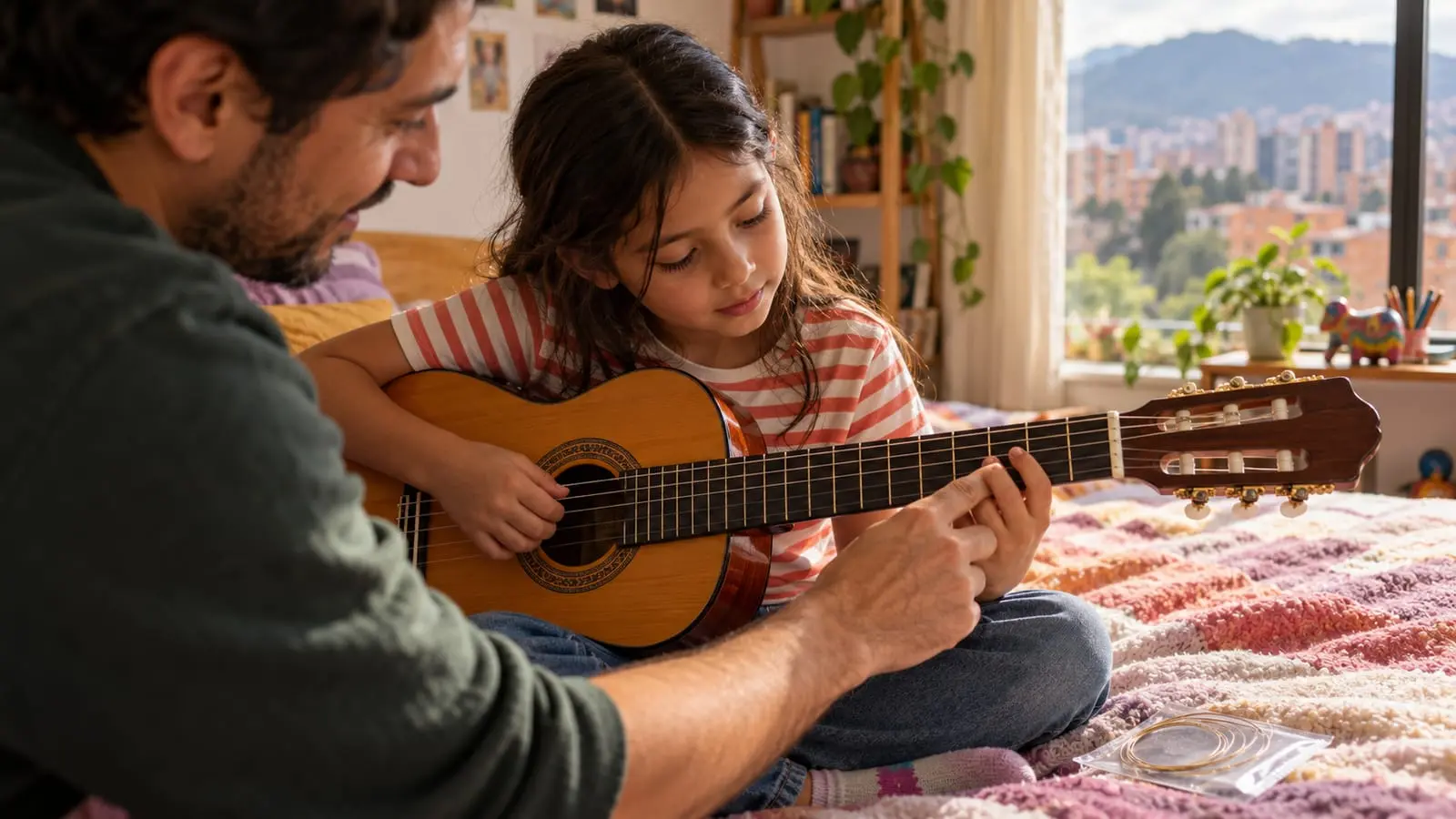
Guitar works very well as a first instrument for children from ages 6 or 7, on two conditions: it fits them (usually 1/2 or 3/4 size at that age) and has nylon strings. That makes it gentler on their fingers, allows a comfortable posture, and helps them play their first songs sooner.
Here you will learn how to choose the size, what finger discomfort is normal, which songs children usually learn first, and how to support practice at home.
In short
- Many children can start guitar between ages 6 and 7, with an instrument that fits them.
- Choose the size based on height and arm reach: 1/4, 1/2, 3/4, or 4/4.
- Nylon strings are gentler on fingers than metal strings: ideal for starting out.
- Mild fingertip discomfort in the first few weeks is normal; severe pain is not.
- The first songs use one or two strings, or simplified chords played with one or two fingers.
At what age can a child learn guitar?
Around ages 6 or 7, many children have the finger strength, coordination, and patience needed to start guitar. Starting younger is possible, but small hands tire quickly when pressing strings, and combining the instrument with rhythm and singing games usually works better.
Signs your child is ready:
- They ask to play and show interest in guitars they see at home, at school, or in videos.
- They can stay focused on a guided activity for 20 to 30 minutes.
- They have enough strength to press a string against a fret and produce a clear note.
What guitar size does your child need?
Children's guitars come in fractional sizes. This table is a guide; what matters most is how the child feels holding the instrument.
| Size | Approximate age | How to tell if it fits |
|---|---|---|
| 1/4 | 4 to 6 years | Less common; useful for very young or shorter children. |
| 1/2 | Ages 5 to 8 | The child's right arm reaches around the body without raising the shoulder. |
| 3/4 | 8 to 11 years | They can reach the first fret without fully extending the arm. |
| 4/4 | From ages 11 or 12 | Full-size; depends more on height than age. |
Trying it in person
- When seated with feet on the floor or a small stool, the guitar should not hide the child's face or make them hunch over.
- The right arm rests on the body, and the hand reaches the sound hole comfortably.
- The left hand reaches the first fret with the elbow slightly bent.
If your child is between sizes, the smaller one is almost always better. Learn more in how to choose your first acoustic guitar.
Why start with nylon strings?
Classical guitars use nylon strings, which are softer and have less tension than the metal strings on folk or pop acoustic guitars. For a child, that means less fingertip pain, a warmer sound, and less temptation to give up in the first few weeks.
- Check the string height. If the strings sit too far above the fretboard, more pressure is needed. A luthier can lower the action with a simple adjustment, one of the best investments you can make in an inexpensive guitar.
- Avoid toy guitars with metal strings: they are often hard to tune and hurt fingers.
- Change the strings when they sound dull or will not stay in tune; old strings can make even a good guitar sound bad. See how to change guitar strings.
A classical guitar's neck is slightly wider than a steel-string acoustic's; at 1/2 and 3/4 sizes, this is rarely a problem. If your child later wants to move to steel strings or electric guitar, the foundation they have built still applies.
Fingers, nails, and pain: what is normal?
In the first few weeks, the left-hand fingertips feel sensitive and may show string marks. This is normal: practice toughens the skin, forming those familiar calluses. Severe, sharp pain or pain that lasts into the next day is not normal.
- Keep sessions short, 10 to 15 minutes, with breaks while fingers adjust.
- Use only enough pressure for a clear note, close to the fret rather than halfway between frets.
- Keep the left thumb relaxed behind the neck, without squeezing like a clamp.
- Keep left-hand nails short; otherwise the fingertips cannot reach the strings properly.
- Keep shoulders and wrists relaxed: if your child clenches their jaw or raises a shoulder, it is time for a break.
First songs: from one string to your first chords
Children need to play real music early on, even if it is simple. A common path is:
- Melodies on one or two strings. “Estrellita, ¿dónde estás?”, “Cumpleaños feliz”, or a Christmas carol, one note at a time.
- Simplified chords. One- or two-finger versions of E minor or C, with downward thumb strums.
- Two-chord songs. Children's songs such as “Los pollitos dicen” can be accompanied with just two chords: a first major achievement.
- The first full chords. E minor, A minor, D, G, and C open the door to countless songs.
- Rhythmic strumming. Simple down-and-up patterns and, later, rhythms such as ballads or bambuco.
Let your child suggest songs: one from a favorite show, one they sing at school, or one you play at home. The teacher can simplify it to their level. See the chords in basic guitar chords for beginners.
How to support practice at home
- Tune it yourself at first. A child cannot tune independently in the first few months; the site's guitar tuner makes it a matter of a couple of minutes.
- Keep the guitar visible, on a stand or hanging on the wall, rather than in its case in a closet.
- Play together. You sing while your child strums: the most fun way to practice chord changes.
- One goal per session: a chord change, a song excerpt, or a strumming pattern.
- Ask instead of correcting everything. “What did your teacher say about your right hand?” works better than pointing out every mistake.
Online videos are a useful supplement, but a teacher can spot posture, guitar size, and hand habits that no video can correct. If you are looking for a teacher, see how to get started with acoustic guitar lessons.
Frequently asked questions
What guitar should I buy for a 7-year-old?
Usually a 1/2 or 3/4-size classical guitar with nylon strings, depending on height. Try it with the child seated and, if possible, ask the teacher to check the action before buying.
Is it better for a child to start on electric guitar?
It can work if the child loves rock: electric guitar strings are thin and the neck is narrow. But it needs an amp and cable, and there are fewer child-size options. For most young children, a nylon-string classical guitar is the simplest starting point.
Does my child need to learn to read sheet music to play guitar?
It is not required to start: many songs can be learned with chords and tablature. But reading sheet music greatly expands what your child can play, especially on classical guitar, and the teacher can introduce it gradually.
Why does my child's guitar go out of tune so often?
New strings stretch during the first few days and often go out of tune; this is normal. Temperature changes, bumps, and worn tuning machines also affect tuning. If it still keeps going out of tune a week after changing the strings, have it checked.
Sources
We checked the facts in this article against these sources on October 22, 2026.