
Flute or clarinet? Which to choose as a beginner
Both are woodwinds, but they feel very different: one is reedless and held to the side, the other has a reed and is held in front. We compare embouchure, fingering, sound and bands.
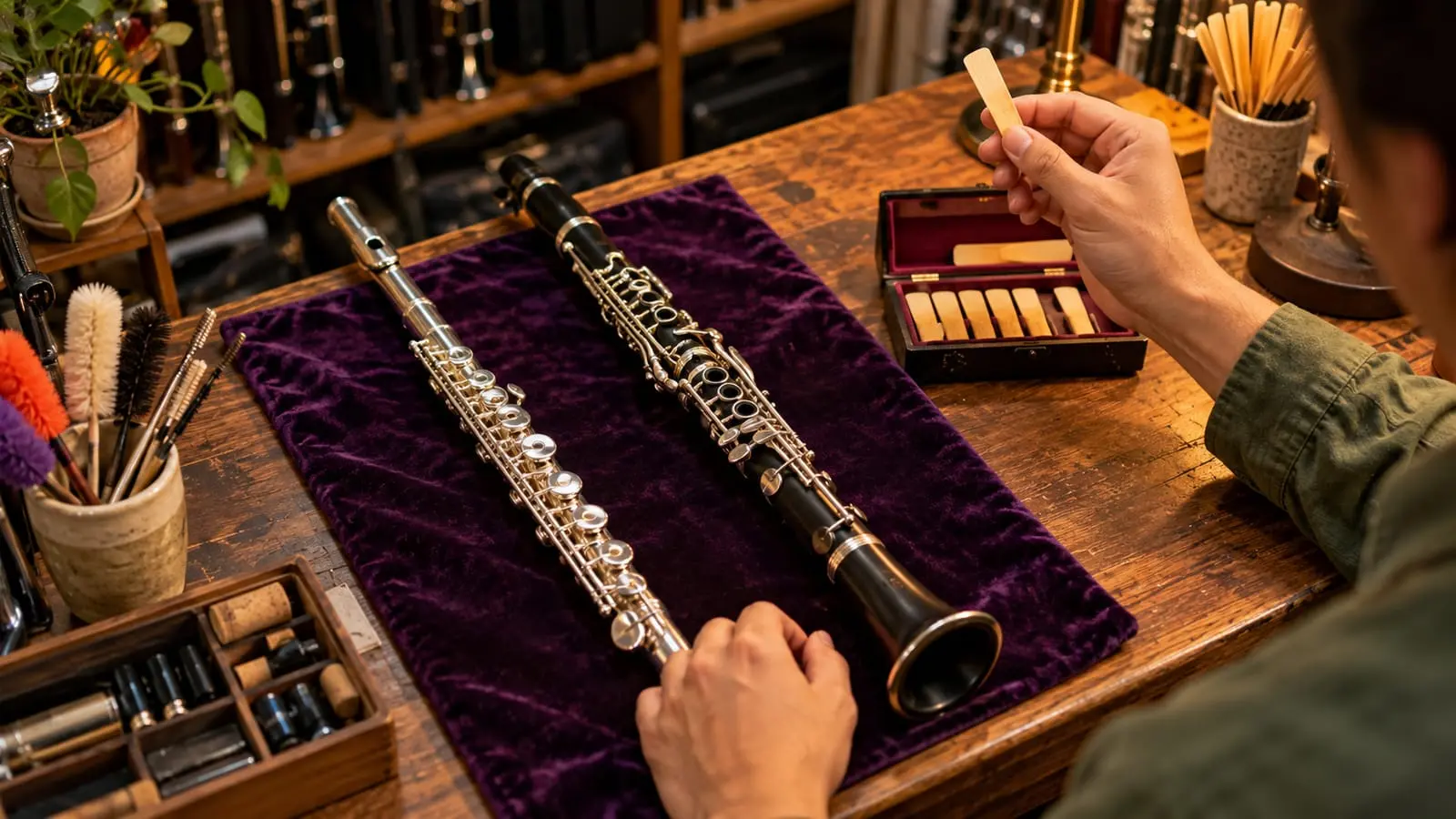
It depends on the sound you love and where you picture yourself playing. If you love an airy, bright sound and see yourself in an orchestra, a chamber group or playing Latin jazz and bossa nova, choose the flute. If you prefer a warm, versatile sound and want to play in wind bands or perform porros, fandangos or traditional jazz, choose the clarinet.
They are similar in difficulty, but the challenges come at different stages. On flute, the hard part is producing your first steady sound. On clarinet, the sound comes sooner, but you then need to master the reed and cross the register break.
In short
- The flute has no reed: sound is produced by blowing across the edge of the embouchure hole.
- The clarinet uses a single reed; the first sound comes quickly, but squeaks are common at first.
- On flute, octaves are produced mainly through air control; on clarinet, the register key changes the fingerings.
- The flute is in C; the most common clarinet is in B flat and is a transposing instrument.
- Students often start either instrument around age 8 or 9, and recorder is excellent preparation for both.
Flute vs. clarinet: a comparison table
| Aspect | Flute | Clarinet |
|---|---|---|
| How sound is produced | Open embouchure: you blow across the edge of the hole, without a reed. | A single reed vibrates against the mouthpiece. |
| First sound | It may take a few days to get a steady sound; a lot of air is wasted at first. | Comes quickly, but squeaks are common while you adjust your embouchure. |
| Posture | Held sideways, with your arms raised to the right. | Held vertically in front of you; the weight rests on your right thumb. |
| Fingering | Keys cover the tone holes; octaves are produced mainly through air control. | Tone holes covered by your fingertips, plus keys; the register key changes the fingerings. |
| Instrument pitch | In C: written notes sound at the pitch you read. | Usually in B flat: a transposing instrument. |
| Sound | Bright, light and agile in the upper register. | Wide range: dark, warm low notes and bright high notes. |
| Consumables | No reeds needed. | Reeds that wear out and need replacing; cork grease. |
| Where you hear it | Orchestra, chamber music, charanga, Latin jazz, bossa nova. | Wind bands, porro and fandango, orchestra, traditional jazz. |
| Suggested starting age | Around age 8 or 9; a little earlier with a curved headjoint. | Between ages 8 and 9, with permanent front teeth. |
Open embouchure or reed: the biggest difference
On flute, nothing vibrates inside your mouth. Your lips form a small opening and direct air across the edge of the embouchure hole, as when you blow across the top of a bottle. Finding the right angle and air speed takes a few days, and it is normal to feel a little dizzy from blowing so much during your first lessons: rest briefly, then continue.
On clarinet, your lower lip lightly covers your lower teeth, your upper teeth rest on the mouthpiece and the corners of your mouth maintain the seal. The reed does much of the work, so sound comes almost immediately. Controlling it is the challenge: biting too hard causes squeaks, and a reed that is too hard or worn out makes everything harder. Learning to moisten, rotate and replace reeds is part of playing the instrument.
Fingering and register changes
On flute, many second-octave notes use the same fingering as in the first octave: what changes is the direction and speed of the air. This makes the fingering patterns easy to follow, although the third register brings new fingerings.
The clarinet overblows at the twelfth rather than the octave. Pressing the register key makes the same fingering produce a note an octave and a fifth higher, so the middle register has its own fingerings. The famous “break” between the throat tones and the upper register requires you to cover all the holes precisely at once. A teacher's tip: practice throat tones with your right-hand fingers down to make the transition smoother.
That passage, known as the break, is one of the big milestones of the first year; we explain it in how long it takes to learn the clarinet.
Sound, bands and Colombian music
The clarinet has a special place in Colombia. It takes a leading role in Caribbean wind bands, carrying the melodies of porros and fandangos, and in the orchestras that brought that music to dance halls. School and municipal bands often have large clarinet sections, so the instrument opens many doors. If that is your goal, read about wind bands in Colombia.
The flute shines in symphony orchestras, chamber music and Latin music: Cuban charanga, Latin jazz and bossa nova owe much to it. It also appears in Colombian Andean music ensembles, carrying the melodies of bambucos and pasillos.
If the flute is calling you, why learn the flute covers what it trains and where you can play it in Colombia.
Choose flute if… / choose clarinet if…
Choose the flute if…
- You like an airy, bright and agile sound.
- You prefer not to depend on reeds or their upkeep.
- You picture yourself in an orchestra, a chamber group or playing Latin music.
- You do not mind holding the instrument sideways with your arms raised.
Choose the clarinet if…
- You want to play in a wind band or your school band.
- You love porro, fandango, traditional jazz or the warm sound of the low register.
- You would find it frustrating to spend days without producing a sound and want to get a sound sooner.
- You would like to move on to saxophone later.
See what you work on in flute lessons and clarinet lessons. For buying advice, see how to choose your first clarinet.
If you later want to switch or add another instrument
Flute and clarinet embouchures are completely different, but treble clef reading, air control, breathing and much of the keywork logic carry over. Many wind players end up playing two or three instruments.
- Moving from clarinet to saxophone is one of the most common transitions, thanks to the single reed and similar embouchure.
- Moving from flute to saxophone is also natural: both overblow at the octave and have similar fingering patterns.
- If your child is still young, recorder builds breathing, reading and finger skills for either instrument.
Frequently asked questions
Which is easier, flute or clarinet?
Neither is easier overall. Producing your first sound is harder on flute; on clarinet, sound comes quickly, but controlling the reed and crossing into the upper register takes time.
Is it normal to feel dizzy when playing flute?
Yes, it is common in the first few weeks because you blow a lot of air that does not enter the instrument. Rest for a few seconds when it happens and let your teacher adjust your embouchure to use the air more efficiently.
How often should you replace a clarinet reed?
It depends on how much you practice and how you care for them. It is best to rotate several reeds and replace any that sound dull, are chipped or no longer respond.
Can I move from clarinet to saxophone?
Yes, it is a very common path. Both use a single reed, so embouchure and air control adapt quickly; the new elements are the fingerings and instrument size.
Sources
We checked the facts in this article against these sources on October 22, 2026.