
How to choose your first flute
Closed-hole keys, offset G, C foot and pads that seal: the most comfortable setup for learning, and when a curved headjoint makes sense.
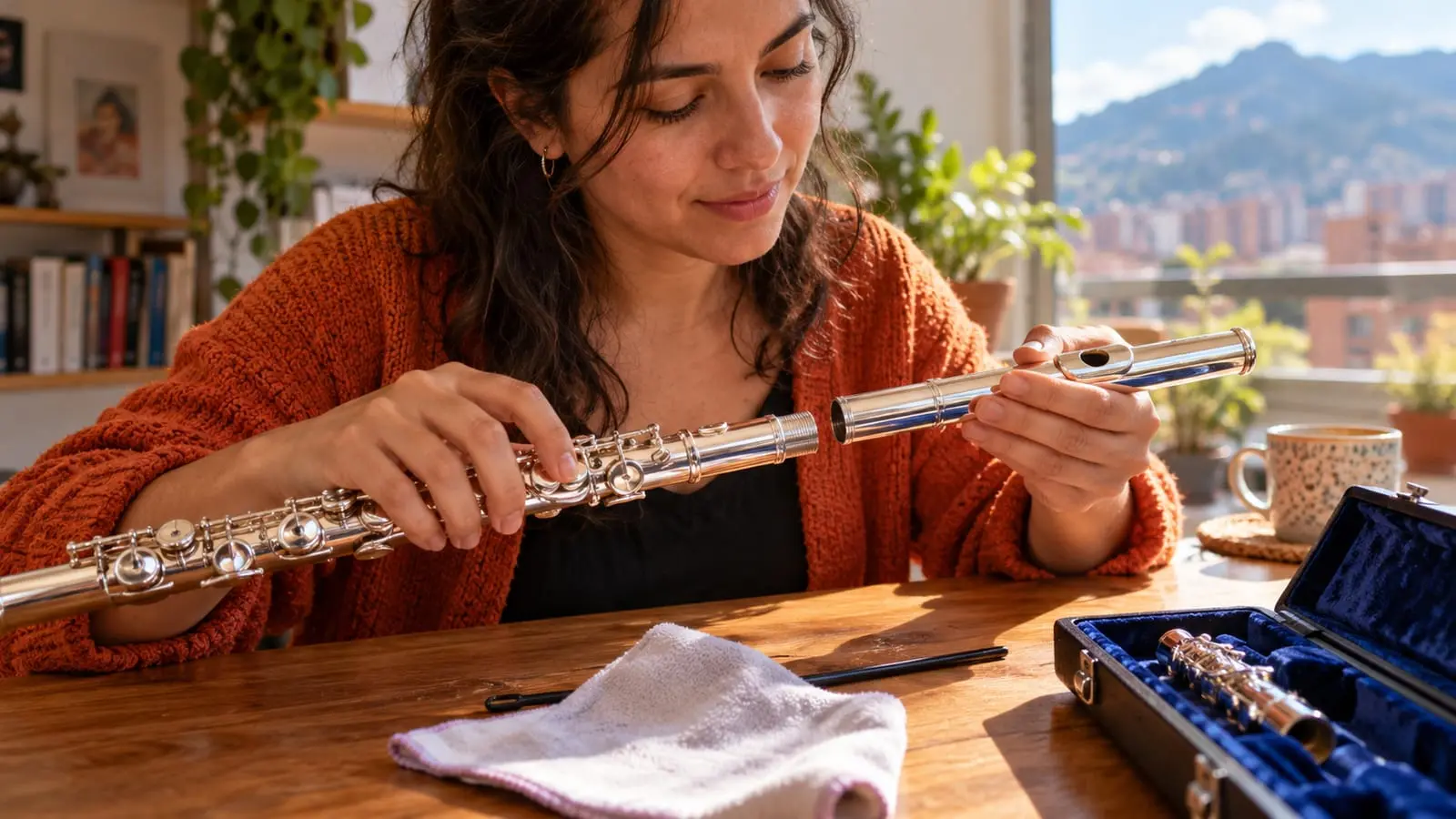
A good first flute has closed-hole keys, an offset G, a C footjoint, and a silver-plated body—and, above all, pads that seal properly. This is the most comfortable, easy-to-maintain combination for learning. If the student is a child whose arms cannot yet reach the keys, a curved headjoint solves the problem during the early years.
Advanced options—open-hole keys, a B footjoint, a solid-silver headjoint—make sense later on. They either require greater precision or do not yet offer a benefit. Here is what each option means and what to check before buying.
In short
- For beginners: closed-hole keys, offset G, a C footjoint, and a silver-plated nickel-silver body.
- A curved headjoint shortens the flute so a child can play with relaxed arms; switch to a straight one as the child grows.
- Open-hole keys require precise finger coverage: they are an option for developing players, rather than a requirement.
- A flute with pads that do not seal will not sound good at any level; check this first.
- A dent in the headjoint affects the sound much more than a scratch on the body.
A suitable configuration for beginners
| Feature | For beginners | For later on |
|---|---|---|
| Keys | Closed | Open-hole, with rings |
| G key | Offset, more comfortable for the left hand | Inline, if it suits your hand |
| Footjoint | In C | B footjoint |
| Split E mechanism | Useful, but not essential | Common on intermediate flutes |
| Material | Silver-plated nickel silver | Solid-silver headjoint or body |
| Headjoint | Curved for young children; straight for everyone else | Straight |
Nickel silver, also called German silver, is an alloy of copper, nickel, and zinc: despite the name, it contains no silver. Most student flutes use this material, coated with a layer of silver or nickel.
Offset or inline G
With an offset G, the key for the left ring finger sits slightly farther out. For most hands, especially small ones, this feels more natural and relaxes the wrist. An inline G does not sound different: it is a matter of comfort.
Curved headjoint for children
A standard flute is long for a child aged 6, 7, or 8. Reaching the right-hand keys requires stretching the arms and twisting the torso, and that tension can become a habit. A curved headjoint bends the tube into a U near the embouchure hole, bringing the keys closer to the body.
- It is used until the arms can reach a comfortable position with a straight headjoint; when to switch depends on each child.
- Some kits include both curved and straight headjoints, so you can keep using the same body later.
- The fingering is the same; only the reach changes.
- Shorter, lighter beginner flutes are also available for very young children. Ask your teacher whether they are a suitable introduction.
How can you tell whether a curved headjoint is needed? With the flute in playing position, the child should have relaxed elbows, lowered shoulders, and the right pinky resting on its key without stretching. If the child leans, raises the shoulders, or turns the neck to reach, the flute is too long.
Closed-hole or open-hole keys
| Closed-hole keys | Open-hole keys (with rings) | |
|---|---|---|
| What they look like | Solid key cups that cover the tone hole | Five keys have a hole in the center that the finger must cover |
| Demands | Allow less precise finger placement | Require the fingertip to land exactly in the center |
| Possibilities | All beginner repertoire | Glissandos, microtones, and some intonation adjustments |
| Who it is for | Beginners and children | Developing students or those preparing for formal study |
If you buy an open-hole flute to use for many years, silicone plugs can close the holes while you learn; remove them one at a time when your teacher recommends it.
C or B footjoint, silver-plated or solid silver
The footjoint
A C footjoint is shorter and lighter, and reaches low C, enough for almost everything you will play in your first few years. A B footjoint adds low B and a small lever that helps with the highest C, but makes the flute longer and a little heavier. It makes sense for advanced students.
The material
- Silver-plated: the most common finish on student flutes. It naturally darkens over time.
- Nickel-plated: very durable, and found on some beginner models. If the student has a nickel allergy, mention it when choosing and opt for a silver-plated finish.
- Solid-silver headjoint: the typical next step as a student progresses; it mainly changes response and tone color.
- All solid silver: an advanced or professional instrument.
For a beginner, the material matters less than you might think: a well-adjusted nickel-silver flute sounds better than a silver one with leaks.
What to check in the shop or on a used flute
- Pads: they should look flat, intact, and free of tears. If the low notes do not speak or sound very airy, there may be leaks.
- Mechanism: no key should stick or have sideways play. The springs should return each key quickly.
- Headjoint: look for dents, especially near the embouchure hole, and check that the lip plate is not damaged.
- Headjoint cork: insert the cleaning rod into the headjoint; the mark on the rod should appear centered in the embouchure hole. If it is off-center, the high register will be out of tune.
- Joints: the headjoint and footjoint should fit with gentle pressure, without being loose or requiring force.
- Rods: look at them from the side; they should not be bent.
- Sound test: ask someone who can play, ideally your teacher, to play a scale from low C into the second octave. Low notes reveal leaks most clearly.
What comes in the case and what is missing
- A hard case and, ideally, an outer cover with a carrying strap.
- A cleaning rod and a lint-free cotton or microfiber cloth.
- A separate cloth for the outside; no liquid silver polish.
- A music stand and tuner: you can use our online tuner to check your intonation as you play.
- A stand to keep it safe between sessions; never lay it on its keys.
Cleaning after each practice session has its own guide: how to clean a flute.
Frequently asked questions
At what age can a child start playing flute?
With a curved headjoint, some children start around age 7 or 8, depending on their size. Before that, the recorder is excellent preparation. More than age, what matters is that their arms and right hand can reach comfortably and that they are eager to work on their sound.
Is it hard to get a sound out of the flute?
At first it takes some effort, because you produce sound by directing air at the edge of the embouchure hole, without a reed or mouthpiece. Many students start with just the headjoint before assembling the whole flute. If you are deciding between flute and clarinet, read flute or clarinet.
My silver-plated flute has darkened. Is it damaged?
No. Silver tarnishes with exposure to air and contact with skin, darkening without affecting the sound. Wipe the outside with a dry microfiber cloth and avoid chemicals and liquid silver cleaners, which damage the pads.
Do I need a flute with a split E mechanism?
Not as a beginner. It makes third-octave E easier, a note you will reach after you have been playing for a while. If the flute you find has it, fine; if not, do not worry.
Sources
We checked the facts in this article against these sources on October 22, 2026.