
How to choose your first clarinet and reeds
B-flat, resin or wood, mouthpiece, ligature and reeds: what your first clarinet needs to sound good and what to check before you pay, new or used.
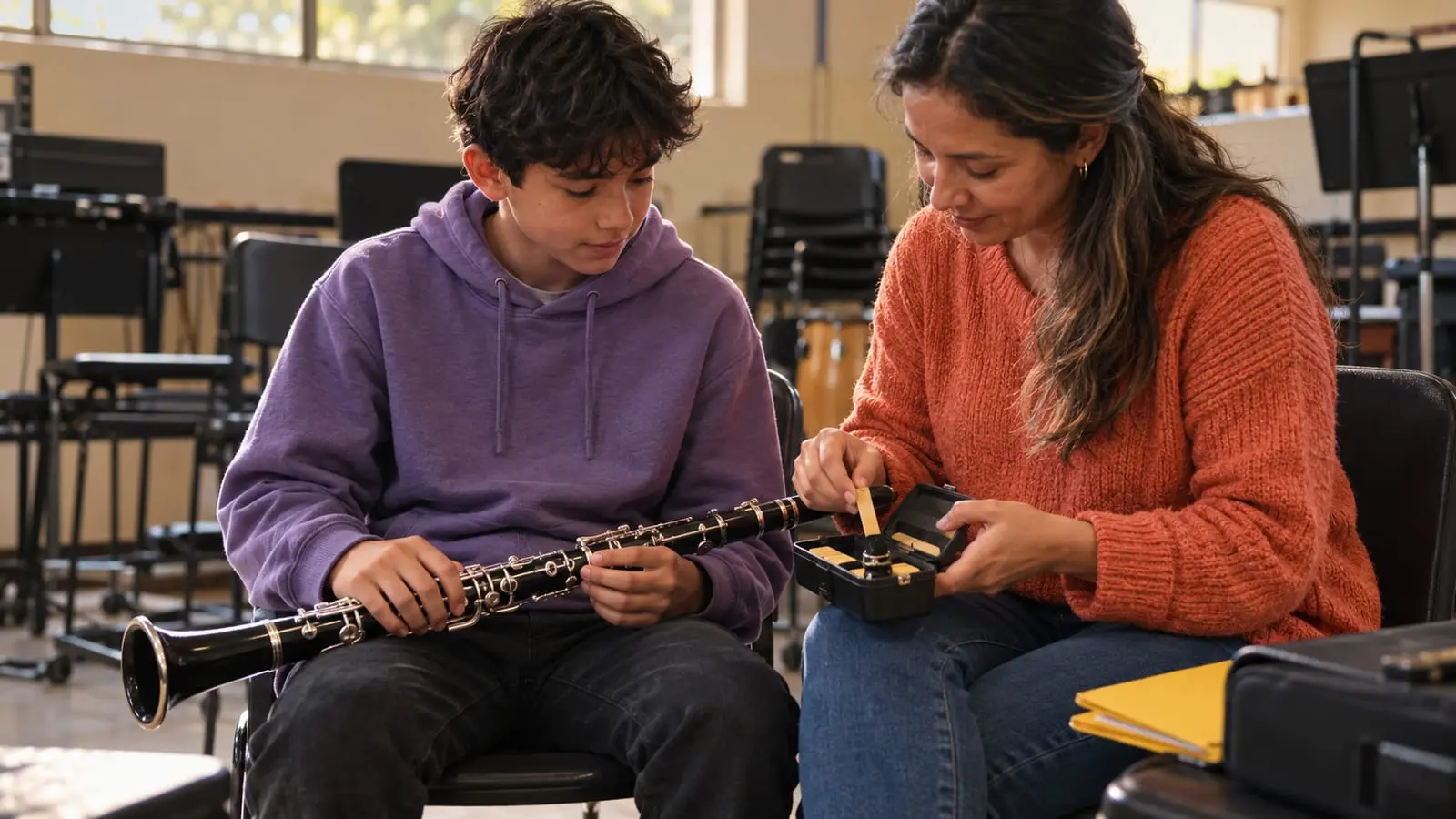
To start, the best choice is a B-flat soprano clarinet with a Boehm system, a resin body, a decent student mouthpiece, and soft to medium reeds (1½ to 2½, depending on your teacher and mouthpiece). It's the clarinet used in bands and orchestras, withstands changes in weather, and won't crack.
Next come the details that make a difference to a beginner's sound: the mouthpiece, ligature, reeds, and pads that seal properly. Let's take them one at a time.
In short
- A first clarinet is almost always a B flat soprano with the Boehm system.
- Resin is durable and stable; wood sounds warmer but can crack with sudden temperature changes.
- For a beginner, the mouthpiece affects the sound as much as, or more than, the clarinet's body.
- To start, use soft reeds (between 1½ and 2½, depending on your teacher and mouthpiece); strength numbers vary by manufacturer.
- A used clarinet should be checked by a technician: inspect pads, corks, and cracks before paying.
B flat and the Boehm system: the basics
The B flat soprano clarinet is the one used for learning, and the one you'll find in school bands, wind bands, and orchestras. Other types come later, almost always at the recommendation of your teacher or ensemble.
| Clarinet | Use | For a beginner? |
|---|---|---|
| B flat soprano | Bands, orchestras, popular music, jazz | Yes, it's the standard |
| C soprano | Introducing young children to the instrument, and some scores | Sometimes, because it's shorter and lighter |
| In A | Orchestral and chamber repertoire | No; added as the student advances |
| E flat soprano clarinet | Bands and orchestras, high register | No |
| Bass clarinet | Bands, orchestras, and ensembles | No, unless the ensemble needs it |
Check the key system, too. In Colombia, as in most of the world, the Boehm system is used. The German system (Oehler) has different mechanics and fingerings; it occasionally turns up among used instruments and doesn't work with the usual method books.
Is your child old enough for a B flat clarinet? It's usually manageable once their hands can cover the tone holes without leaks and their right little finger can reach its keys, which often happens around age 8 or 9. Your teacher can check this in a lesson.
Resin or wood
| Resin | Wood (grenadilla) | |
|---|---|---|
| Sound | Clear and stable; perfectly suitable for learning | Warmer, darker, and more nuanced |
| Risk of cracks | Virtually none | Present, especially with sudden temperature and humidity changes |
| Climate | Ideal for parades, hot climates, and travel | Needs to acclimate and warm up before playing in cold conditions |
| Maintenance | Simple | Initial break-in period and technician checkups |
| Who it is for | Beginners, children, school bands | Advancing students who can take care of it |
Wood cracks when warm, moist breath enters a cold tube. On a cold Bogotá morning, or when moving from an air-conditioned car into the coastal heat, that shock is real. That's why wooden clarinets are warmed with the hands before playing; we explain this in how to clean and care for a clarinet.
There are also clarinets made from composites of wood powder and resin, designed to offer a warmer sound without the risk of cracks. They can be a good intermediate step later on.
Mouthpiece and ligature: the sound starts here
The mouthpiece supplied with many student clarinets is the weakest part of the kit. Replacing it with a good-quality student mouthpiece is often the biggest improvement a beginner can make. Ask your teacher for guidance on tip opening.
What to check on the mouthpiece
- Tip and rails: inspect the tip edge and side rails in good light. They should have no chips or scratches.
- Table: the flat surface where the reed rests should be smooth and unmarked.
- Tip opening: a medium or medium-close opening usually works best with softer reeds for a beginner.
- Mouthpiece patch: a small rubber pad on the mouthpiece protects it from your teeth and prevents slipping.
The ligature
It holds the reed against the mouthpiece. It can be metal, with one or two screws, or fabric or leather. What matters is even pressure: a bent metal ligature leaves one side of the reed loose and interferes with its vibration. Check that the screws turn without stripping, and tighten only enough to keep the reed from moving.
Reeds: which strength to start with
Reeds are numbered by strength: 1½, 2, 2½, 3, 3½, and higher. The higher the number, the harder the reed and the more air and lip firmness it needs.
| Strength | When | How it feels |
|---|---|---|
| 1 to 2 | First few weeks, children | Responds with little air; tone may be open and somewhat flat |
| 2 to 2½ | Many beginners, depending on the mouthpiece and teacher | A balance of ease and control |
| 3 or higher | When the embouchure strengthens and the teacher recommends it | Fuller sound; needs more breath support |
- The numbering isn't universal: one manufacturer's 2½ may feel like another's 3. If you change manufacturers, test again.
- Buy by the box: even within the same box, some reeds are better than others. Number them and rotate three or four.
- Reed too hard: sound is difficult to produce, your mouth tires quickly, and the tone is airy.
- Reed too soft: the tone buzzes, the reed closes up on high notes, and the pitch is flat.
- Not for saxophone: B flat clarinet reeds aren't interchangeable with alto saxophone reeds.
- Synthetic reeds: they last longer and are more consistent; some teachers use them with children. Ask whether they're right for you.
What to check in the store or on a used clarinet
- Pads: they should be intact, with no tears or hardened areas. To test for leaks, cover the lower end of each joint with your palm, close the tone holes and keys, and suck gently at the other end: the vacuum should hold.
- Joint corks: complete and firm; neither worn bare nor so thick that the clarinet is difficult to assemble.
- Cracks: on wooden instruments, check the upper joint especially, around the tone holes and register key. Look inside the bore with a flashlight, too.
- Bridge key: connects the upper and lower joints. If it's bent, certain notes won't work properly.
- Mechanism: no key should have play or stick; the springs should return them quickly.
- Metal rings: the rings at the joints and bell should be secure.
- Sound test: with a working reed, play low notes, throat tones, and the transition to the upper register. If several notes won't speak, there are leaks.
What's in the kit and what to buy separately
A student clarinet usually comes with a case, mouthpiece, ligature, cap, cork grease, and one or two reeds. Complete your setup with:
- A box of reeds in the strength your teacher recommends, and a flat reed holder for storage.
- A pull-through swab to dry the inside after playing.
- A music stand and a tuner; you can use our online tuner.
- A better-quality student mouthpiece if the one in the kit isn't helping.
If you'll be playing in a school or municipal band, ask whether the group lends instruments; in wind bands in Colombia, we explain how they work. And in clarinet lessons, you'll work on assembly, reed placement, and producing a steady sound from the first week.
Frequently asked questions
Is a wooden clarinet better for a beginner?
Not necessarily. Resin is more durable, doesn't crack, and is easier to maintain, making it ideal for learning. Wood makes sense when the student is advancing, practicing regularly, and able to care for the instrument.
How do I know if my reed is too hard or too soft?
If it's very hard to produce a sound and you tire within a few minutes, try a reed half a strength softer. If the tone is open, buzzy, and flat, try one half a strength harder. Over time, as your embouchure strengthens, reed strength tends to increase.
How long does a clarinet reed last?
It depends on use and care. With daily practice and several reeds in rotation, a reed can last a few weeks. Replace it when the tip is chipped, it's warped, or it has lost its sound even when thoroughly moistened.
Clarinet or flute: which is easier at first?
They present different challenges: on clarinet, the reed embouchure and the transition to the upper register; on flute, producing a sound by directing the air. We compare them in flute or clarinet.
Sources
We checked the facts in this article against these sources on October 22, 2026.