
Learning music from YouTube or with a teacher?
Tutorials are great for getting started and working out songs, but they can't see you play. What you can learn on your own, what the risks are and how to combine videos with a teacher.
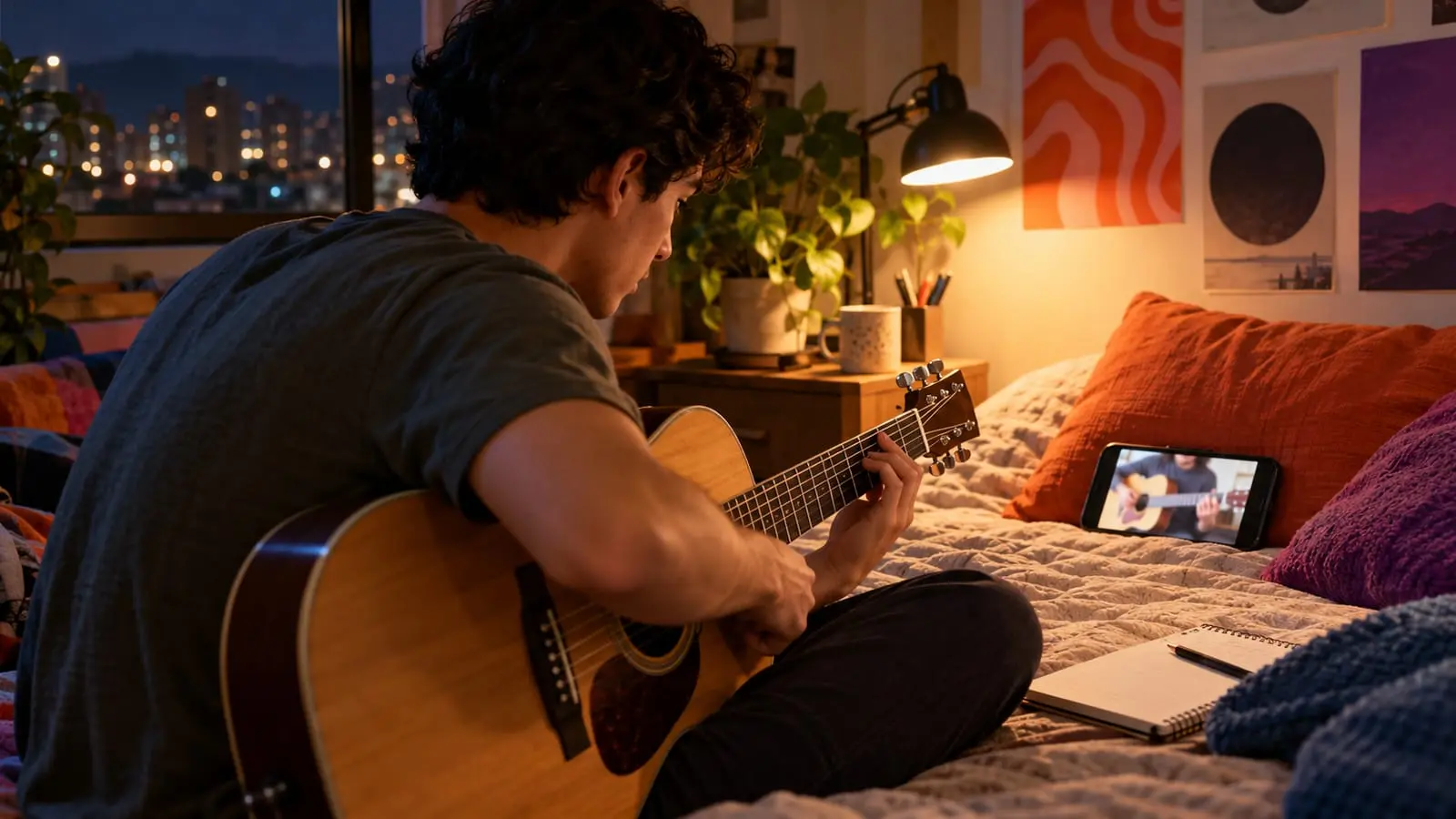
You can learn a lot on YouTube: your first chords, simple songs by copying what you see, basic theory, and plenty of inspiration. What a video cannot do is see or hear you. That is why people learning on their own often progress quickly at first and then get stuck, sometimes with habits affecting their posture or sound that are hard to correct later.
For most people, the best approach is to combine the two: a teacher who assesses your playing, gives you a plan, and corrects mistakes, plus videos to support practice between lessons.
In short
- Tutorials work well for basic chords, strumming, learning songs by imitation, and introductory theory.
- A video cannot see you: it cannot spot tension, awkward posture, poor fingering, or intonation problems.
- Bad habits develop just as quickly as good ones, and unlearning them takes much longer.
- Learning on your own often leads to scattered progress: lots of intros and few complete songs.
- Combining the two works best: your teacher sets the course and corrects mistakes; videos reinforce what you learn between lessons.
What you can learn from videos
Tutorials are excellent tools for certain things, especially on instruments where you can see what the player is doing. On guitar and piano, you can copy finger placement and compare it with what you see on screen.
- Your first chords on guitar, ukulele, or tiple, and basic strumming patterns.
- Simple songs learned by watching the player's hands and copying them.
- Basic theory: note names, note values, and what a scale is.
- Style references: what a bambuco, a bolero, or a blues sounds like, and how different musicians perform it.
- Ideas for warming up, practicing, or varying an existing routine.
For singing and wind instruments, where key aspects of sound production are hidden from view, or violin and cello, where intonation depends entirely on you, videos can teach much less: the most important things are out of sight.
What a video cannot see: common bad habits
The problem is not the tutorial's content, but the fact that no one checks how you are doing it. These are habits teachers correct every day in students who started on their own:
| Instrument | Common habit | Why it matters |
|---|---|---|
| Guitar | Thumb too far above the neck, an excessively bent wrist, and pressing the strings harder than necessary. | Makes barre chords and quick changes harder, and causes hand fatigue or discomfort. |
| Piano | Flat or collapsing fingers, dropped wrists, and different fingering each time. | You cannot speed up the passage, and each new piece takes more effort than it needs to. |
| Singing | Forcing high notes, raising the shoulders when breathing, and tensing the jaw. | The voice tires quickly, sounds strained, and may become hoarse. |
| Violin | A rigid bow hold, a raised shoulder, and playing without a pitch reference. | The sound is scratchy, intonation remains unstable, and tension builds up. |
| Drums | Stiff wrists, striking from the shoulder, and playing without hearing protection. | Limited endurance and speed, and a risk to your hearing. |
None of these habits is noticeable in the first few weeks. They show up when you try something harder and cannot play it, however much you practice.
Other risks of learning on your own
- Scattered progress. The platform suggests the next video, not the next step you need. It is common to know ten intros and no complete songs.
- Thinking you have it down. While playing, you focus on your hands and do not fully listen: the rhythm speeds up, notes get cut short, and you do not notice.
- Dependence on tutorials. Videos with light-up keys or numbers on the strings let you play without reading or understanding, and every new song requires another video.
- Conflicting information. Every channel has its own method and shortcuts; without a way to judge them, it is hard to know which suits you.
- Getting stuck and giving up. Without goals or someone to notice your progress, motivation gradually fades.
What a teacher offers that no video can
- Assessment: your teacher listens and identifies your starting point, rather than assuming you are an average student.
- A clear learning path: what to learn first and what comes next, based on your goal.
- Immediate feedback: your teacher sees the tension, hears the out-of-tune note, and tells you before it becomes a habit.
- Repertoire tailored to you: songs you enjoy that suit your level.
- Consistency: knowing you have a lesson next week gives you a real reason to practice.
You can also work with a teacher online. If you like learning from home on your own schedule, online music lessons give you that flexibility along with feedback. To compare formats, read in-home or online lessons.
How to combine videos and a teacher
- Bring the video to your lesson. If you want to play a song you saw, show it to your teacher: they can adapt it to your level and check how you are playing it.
- Ask for recommendations. Your teacher can suggest channels or videos that fit what you are working on together.
- Slow it down. The player's speed control lets you watch a passage more slowly; repeat it in short sections rather than all at once.
- Practice with reliable references. Work on your pulse with the online metronome, rather than only playing along with a recording, which can hide timing errors.
- Record yourself and compare. Record your version, compare it with the video, and bring any differences you do not understand to your lesson.
- Keep your priorities straight. Your teacher's assignment comes first; the video is a supplement. To organize your time, use this home practice routine.
Signs you need a teacher
- You feel pain, tingling, or tension in your hands, wrists, back, or throat when playing or singing.
- You have stayed at the same level for months despite practicing.
- You struggle to play with others or a backing track without losing the beat.
- You want to read sheet music, understand what you play, or prepare for an audition.
- You dislike your sound and do not know what to change.
Nothing you learned on your own goes to waste. A good teacher builds on it, keeps what works, and corrects what needs attention without starting from scratch.
Frequently asked questions
Can you learn guitar using only YouTube?
You can learn basic chords, strumming, and simple songs. The challenge is making progress without anyone correcting your hand position and rhythm; many self-taught guitarists reach a plateau and seek lessons for that reason.
Is it a bad idea to start on your own and take lessons later?
No. Having some basics is useful, and a good teacher builds on what you already know. Just keep in mind that the first lessons may focus on correcting posture habits: the sooner you get guidance, the less there will be to adjust.
Can piano-learning apps replace a teacher?
They make practicing basic music reading, rhythm, and songs enjoyable. But they cannot see your posture or your hands, so they work better alongside lessons than as a replacement.
Which instruments are harder to learn from tutorials?
Singing, bowed strings such as violin and cello, and wind instruments. In all of them, essentials such as breathing, embouchure, bowing, and intonation are not easily seen in a video and require someone to listen to you.
Sources
We checked the facts in this article against these sources on October 22, 2026.
- ACM CHI 2021: Soloist, guitar tutorials from videos (Wang, Yang, Grossman)
- MERLOT Journal of Online Learning and Teaching: perceptions and success in online and in-person music learning (2010)
- Pasadena Conservatory of Music: injury prevention guide for musicians
- NIOSH (CDC): reducing the risk of hearing disorders among musicians