
How to write a song from scratch, step by step
You don't need advanced theory to write your first song: an idea, four chords, a melody you like and lyrics of your own. We show you the whole process, step by step.
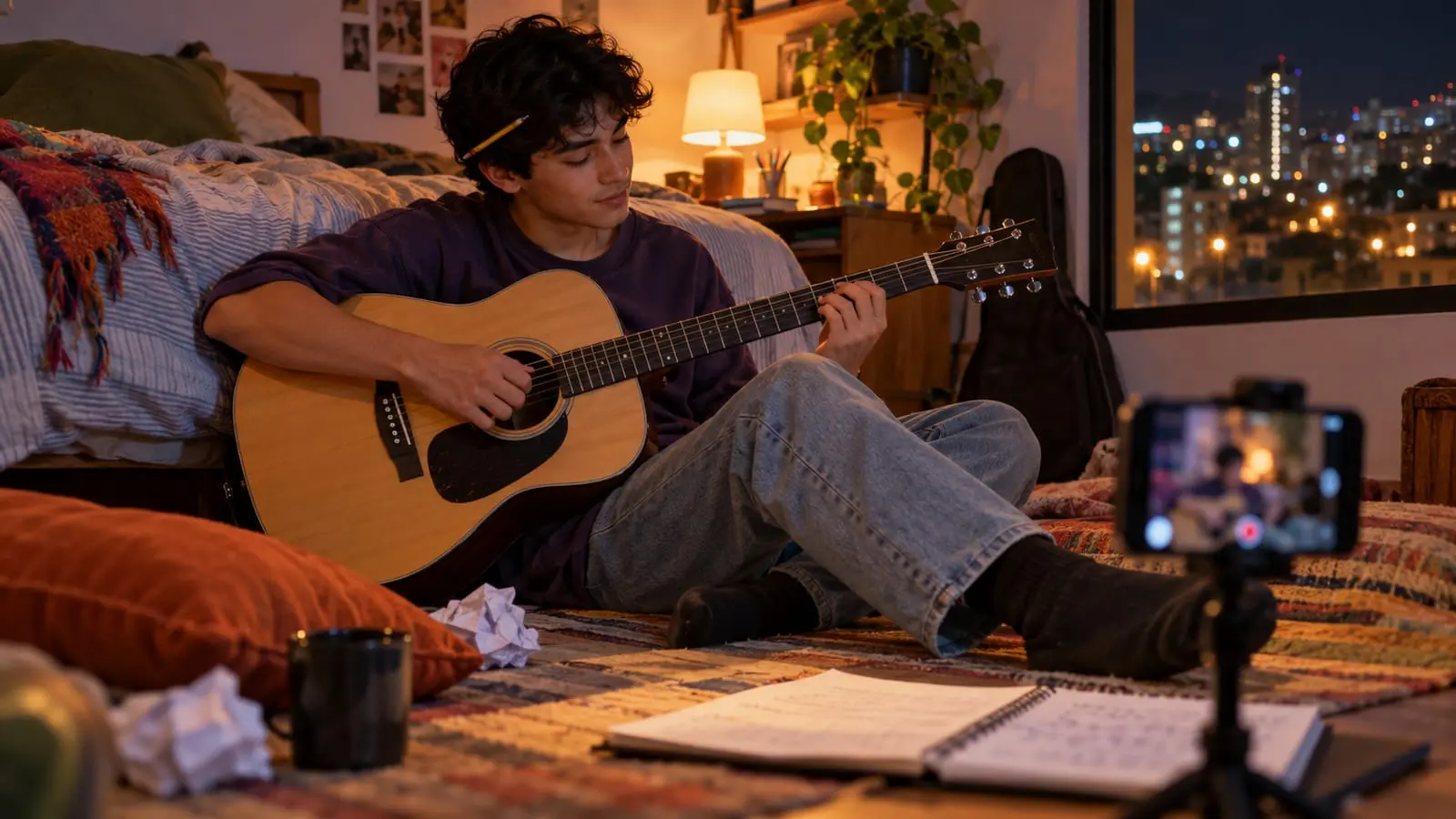
To write a song from scratch, start with a small idea (a phrase, a riff, a rhythm, or four chords) and build a chorus around it. Then arrange the parts into a simple structure, such as verse–chorus–verse–chorus, choose a progression of three or four chords, find the melody by singing over it, write the lyrics with attention to word stress, and record a demo on your phone.
You don't need advanced theory or a studio. You need to finish: one complete, imperfect song teaches you more than ten unfinished ideas saved on your phone.
In short
- Start with the chorus or the phrase you like best; build the rest of the song around it.
- A verse–chorus–verse–chorus–bridge–chorus structure works for most songs.
- Three or four chords are enough; contrast between the verse and chorus matters more than complexity.
- In the lyrics, stressed syllables should fall on the strong beats of the music.
- Record a simple demo with a metronome and listen to it the next day with fresh ears.
Step 1: capture the idea before it slips away
Songs rarely arrive fully formed. They start as a fragment: a phrase that came to you on the bus, a riff you played while warming up, a rhythm that stuck in your head, or a specific emotion. Record everything as voice memos on your phone, with a date and a keyword, and don't judge it on the spot.
Once you have several ideas, choose the one that keeps coming back to you and turn it into the chorus. The chorus is the part people remember; if it works, you can build the rest around it.
Step 2: choose a structure
| Section | Function | Tip |
|---|---|---|
| Intro | Establishes the mood and key | Keep it short: often uses the chords from the chorus or verse |
| Verse | Tells the story and adds details | Change the lyrics in each verse; repeat the music |
| Pre-chorus (optional) | Builds anticipation before the chorus | Build energy or leave a brief pause before the chorus |
| Chorus | Sums up the central idea | Use the same lyrics each time, including the title |
| Bridge | Offers a breather and a contrast | Use different chords and a new perspective in the lyrics |
| Ending | Brings the song to a close | Repeat the chorus or end with the intro |
The most common structure is verse – chorus – verse – chorus – bridge – chorus. Another classic is AABA, used in many twentieth-century standards, where A repeats and B acts as a bridge. For a first song, two verses and a chorus repeated three times are enough.
Step 3: a simple chord progression
First, choose a key that feels comfortable for your voice; if the melody turns out too high or low, you can transpose the song later. These progressions in G use open chords on the guitar and are easy to play on the piano:
| Progression | Chords | Feel |
|---|---|---|
| I – V – vi – IV | G – D – Em – C | Open and upbeat; very common in pop |
| I – vi – IV – V | G – Em – C – D | Nostalgic, with a classic ballad feel |
| vi – IV – I – V | Em – C – G – D | More melancholy, although it uses the same chords as the first progression |
| I – IV – V | G – C – D | Straightforward, with a rock and roll and popular music feel |
| I – IV | G – C | Very simple; lets the melody take center stage |
The secret is contrast: if the verse revolves around vi – IV – I – V, the chorus can start on I for a brighter feel, or change chords more often to build energy. In what is musical harmony, we explain why each chord creates a sense of rest, movement, or tension.
Step 4: find the melody
Record two minutes of your progression on a loop and sing over it using nonsense syllables like “na na” or “la la”. Do this several times without stopping, then listen back: you'll almost always find two or three promising fragments. Save them and develop them.
- Chord tones on strong beats: over a G chord, G, B, and D sound stable; the other notes work as passing tones.
- Register: keep the verse in the middle or lower part of your voice and the chorus a little higher. That rise gives it strength.
- Repetition with variation: repeat a short motif and change only the ending.
- Call and response: end the first phrase on a note that feels unresolved, then bring the second back to the tonic.
- Rhythm: use more syllables and shorter notes in the verses; give the chorus longer notes that are easy to sing together.
Step 5: write your own lyrics
- Sum up what the song is about in a single sentence. If you can't, the idea isn't clear yet.
- Put the title in the chorus, at the beginning or end of the phrase, where it stands out most.
- Use the verses to show concrete details, like the chill before dawn or the last bus, instead of abstract words like “feeling” or “destiny”.
- Pay attention to prosody: the stressed syllable of each word should fall on a strong beat. In Spanish, “canción” is stressed on the last syllable and “música” on the first; if the melody works against those stresses, the words sound mispronounced.
- Let rhymes come naturally. A full rhyme repeats vowels and consonants from the last stressed vowel onward (as in the Spanish words canción and razón); an assonant rhyme repeats only the vowels (casa and alma) and often sounds less forced.
Avoid predictable rhymes, like the Spanish corazón and canción, unless you have a good reason to use them. Read the lyrics aloud without music: if they sound awkward when spoken, they'll probably sound awkward when sung, too.
Step 6: record a simple demo
- Set the tempo with the metronome and write it down.
- Record the instrument first, listening to the click through headphones, in a multitrack recording app (several are free).
- Record the vocals over it, listening to the instrument through headphones so it doesn't bleed into the microphone.
- Find a space without echoes: a closet full of clothes or a room with curtains and blankets sounds better than a bathroom or an empty living room.
- Save each version with a date and listen to it the next day. Note what you'd change.
When you're stuck: ways to get moving again
- Switch instruments: an idea that's going nowhere on guitar may take off on piano, and vice versa.
- Change the rhythm: try the same progression in 6/8, over a cumbia groove, or with the sway of bambuco; Colombian rhythms open up possibilities that pop doesn't.
- Set limits: just three chords, twenty minutes, and a single section.
- Finish it, imperfections and all: a finished song with a weak verse is better than a perfect chorus with no song around it.
- Check that it's yours: if a melody came to you a little too easily, sing it to someone and ask whether it reminds them of another song.
You can also learn songwriting with guidance. A theory, guitar, or piano teacher can help you get past a stuck section, suggest new chords, or show you why a chorus isn't taking off.
Frequently asked questions
Do I need to know music theory to write songs?
Not to get started: many songs are written by ear with just a few chords. But theory helps you get unstuck, understand why something works, and try more options in less time.
Which comes first, the lyrics or the music?
Both approaches work. If you start with the lyrics, read them aloud to discover their natural rhythm. If you start with the music, sing nonsense syllables and let the melody suggest where the important words belong.
How can I tell if my song is too similar to another?
Common chord progressions appear in thousands of songs; what makes a song recognizable is mainly its melody and lyrics. If you suspect a melody isn't yours, sing it to several people, or record it and compare it with what you've listened to recently.
How long should a song be?
There's no rule. Many popular songs last between three and four minutes, but for a first song, what matters is that each section says something and nothing repeats more than it needs to.
Sources
We checked the facts in this article against these sources on October 22, 2026.