
Music teachers for after-school programs: profile, planning and evaluation
Large groups, mixed ages and voluntary attendance: what kind of music teacher works in an after-school program, how to plan sessions and how to evaluate the teacher and the program.
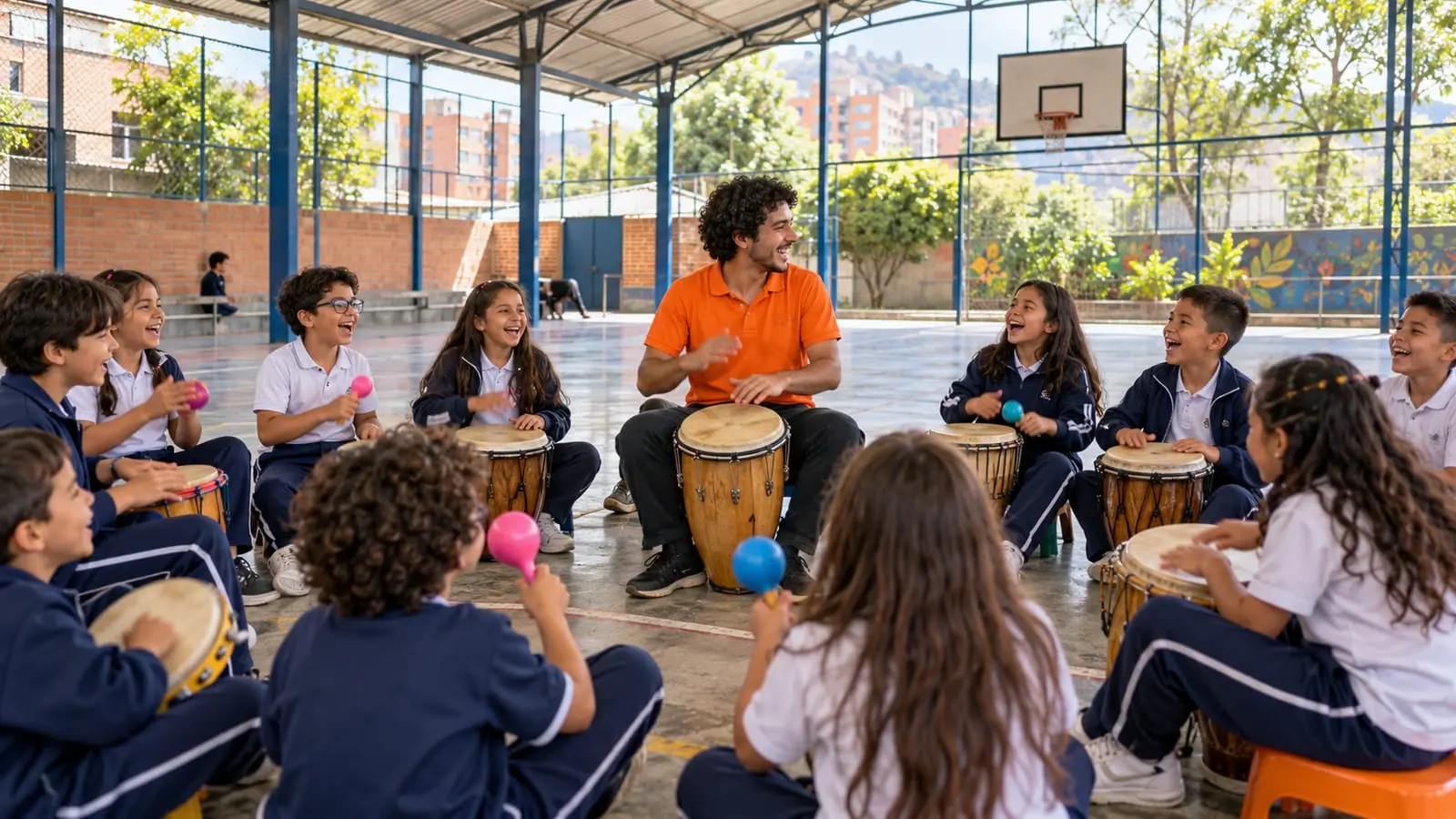
Extracurricular programs work best with a music teacher who can keep large, mixed groups engaged: students of different ages and levels, variable attendance and voluntary participation. More than a great soloist, you need someone with energy, flexible repertoire, arrangements for different levels and clear rules for getting along, who plans in cycles and shows progress at the end of each one.
This guide is for coordinators at schools, family welfare funds and organizations running programs outside regular school hours: what profile to look for, how to plan sessions and how to evaluate the teacher and program.
In short
- An extracurricular music program is more than a group instrument lesson: it is a voluntary, diverse setting with variable attendance.
- The right profile combines large-group management, energy, flexible repertoire and the ability to arrange music for different levels.
- Plan short cycles that end with a showcase, using a repeatable session structure.
- Assess students on their learning process, and teachers through session observations, student retention and the quality of showcases.
- Because the work involves minors, background and legal disqualification checks are part of assessing suitability, not a separate formality.
What makes extracurricular programs different
| Aspect | Curricular lesson | After-school program |
|---|---|---|
| Participation | Required, with a fixed group | Voluntary or by enrollment; you have to give students a reason to keep coming |
| Group | One grade level | Mixed ages and levels |
| Attendance | Stable | Variable: new students join and others miss sessions |
| Space | Assigned classroom | Shared classrooms, courtyards or auditoriums |
| Goal | Subject curriculum and grading | Learning, getting along, constructive use of free time and showcases |
| Reports | School report card | Reports to the program operator: attendance, progress and evidence |
This changes the profile you need. A teacher who excels in individual lessons may struggle with 30 students ages 8 to 14 who arrive tired after their school day, while a musician without a music education degree may shine if they know how to engage and organize a group.
The teacher profile that works
- Large-group management: opening and closing routines, brief instructions and signals for asking for quiet without shouting.
- Energy and presence: in the afternoon, after a full school day, students need someone who engages them from the first minute.
- An instrument for chordal accompaniment: guitar, piano or keyboard, to support the group as they sing or play.
- Arrangements by level: the same song with parts for beginners, developing players and those who already play.
- Flexible repertoire: Colombian music, songs students listen to and rhythm games.
- Teaching students to work together: rules agreed with the group, teamwork and conflict management.
- Administrative organization: attendance lists, reports and evidence submitted on time.
- Safe learning environments: knowing and following the institution's child protection protocol.
Red flags during selection
- They talk a lot about their performing career and little about their students.
- Their demonstration lesson is a lecture rather than an activity where everyone plays.
- They have no strategy for a student who joins halfway through.
- They look down on the music the students listen to.
To identify this profile, design a demonstration lesson with a large, mixed-age group and prepare small challenges: a student arriving late, another unwilling to participate and another well ahead of the rest. In the interview, ask how they start a session with a new group and what they do when half the students do not show up.
How to plan: short cycles and repeatable sessions
Instead of a rigid annual program, plan cycles lasting a few weeks, each with two or three pieces and a showcase at the end. Short cycles sustain motivation, let new students join at the beginning of each one and provide frequent evidence for the school and program operator.
| Moment | Approximate time | What happens |
|---|---|---|
| Opening routine | 5 to 10 minutes | Body and voice warm-up, followed by a rhythm game to establish a shared pulse. |
| Brief technique work | 10 minutes | One focus: a rhythmic pattern, a chord or a phrase from the song. |
| Layered ensemble work | 25 to 30 minutes | Each level learns its part, then everyone plays together. |
| Playing the piece through | 10 minutes | Playing the portion of the piece learned so far from beginning to end. |
| Closing | 5 minutes | What we achieved, what comes next and putting the instruments away. |
Layered arrangements
This is what makes working with different levels possible. A single piece is organized in layers: a pulse or ostinato using body percussion or small percussion instruments; bass or simple chords; melody; and a countermelody or solo for more advanced players. Newcomers join at the first layer and move up when ready, without holding the group back.
Instruments and space
Assign roles for handing out and collecting instruments, keep an inventory for each session and agree with the school on storage. If there are not enough instruments, voice, body percussion and small percussion instruments let everyone make music from day one.
How to assess students without dampening their enthusiasm
In a voluntary program, ranking students by talent empties the room. Assess the learning process using criteria everyone can meet if they participate:
| Criterion | What to watch for | Evidence |
|---|---|---|
| Participation | Attends, joins in and maintains their part | Attendance lists |
| Beat and rhythm | Maintains the pulse with the group | Recording at the beginning and end of the cycle |
| Basic technique | Posture, tone and intonation appropriate to the instrument | Teacher's notes |
| Playing together | Listens, waits their turn and helps others | Teacher's notes |
| Progress | Moves from one layer of the arrangement to another | Record for each cycle |
Recording at the beginning and end of each cycle provides the strongest evidence: students hear how much they have progressed, and the program operator sees concrete results. Obtain the families' permission beforehand.
How to evaluate the teacher and program
- Session observations using a rubric that prioritizes classroom management, atmosphere and participation, at least once per cycle. Here is a teacher evaluation rubric you can adapt.
- Student retention: if students stop attending during the cycle, something needs reviewing.
- Quality of the final showcase, relative to the group's starting point.
- Administrative follow-through: reports, lists and evidence submitted on time.
- Feedback from the host school, students and families.
With this data, the feedback conversation is grounded in facts, and the teacher clearly understands what is expected in the next cycle.
Where to find these teachers
The best candidates for extracurricular programs do not always have the most impressive résumés. Look among music education graduates with school experience, municipal band and choir directors, traditional musicians experienced in community programs and introductory music teachers. Ask for references from group teaching work and always carry out background and legal disqualification checks before hiring.
At Gissi, we handle teacher selection for schools, family welfare funds and extracurricular programs, including a group demonstration lesson; if you already have candidates, we can carry out candidate assessment for you. Your institution hires its chosen candidate directly. Explore all our services for academies and schools.
Frequently asked questions
Is a music education graduate or an experienced musician better?
Either can work. A music education degree usually provides training in teaching and experience with groups; a musician experienced in community programs may manage groups very well without that degree. Decide based on evidence: the group demonstration lesson and references matter more than the diploma.
How many students can one teacher work with in an extracurricular program?
It depends on ages, space, available instruments and the type of activity. With large groups or young children, a second adult or assistant makes a big difference to session quality and safety.
Which instruments work best with large groups?
Voice, body percussion and small percussion instruments let everyone participate from the start. Recorders, barred percussion instruments, ukuleles or guitars add melody and harmony when there are enough instruments and a plan for distributing and caring for them.
How do you include students who join halfway through a cycle?
With a routine they can follow from day one and a simple layer of the arrangement, such as the pulse or an ostinato. Pairing them with someone who already knows the piece helps them feel part of the group quickly.
Sources
We checked the facts in this article against these sources on October 22, 2026.