
The sample lesson: how to evaluate a music teacher with a rubric
A CV tells you where a teacher studied; a well-designed sample lesson tells you how they teach. Here's the format, a rubric and how to score without bias.
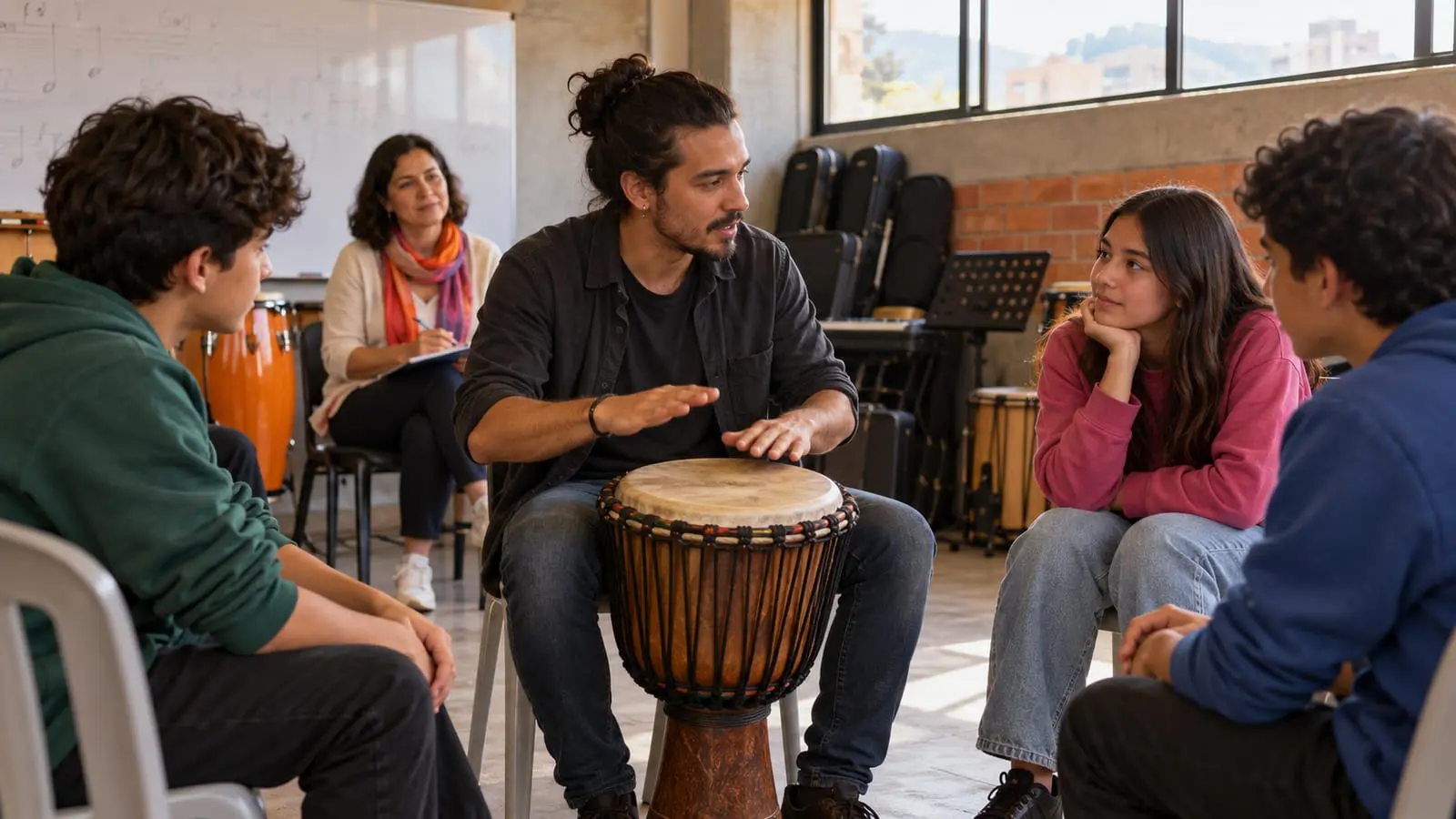
The most reliable way to find out whether someone can teach music is to watch them teach. An 8 to 15-minute demo lesson, with real students or people playing students and scored using a rubric, gives you concrete evidence that an informal interview cannot.
Here, you will find out why it works, how to design it for the role, what to ask for in the audition, a sample rubric with a 1 to 4 scale, and rules for fair scoring that lets you compare candidates.
In short
- Hiring research consistently finds structured interviews among the best predictors of performance; a demo lesson adds direct evidence of how the candidate teaches.
- A good demo lesson lasts between 8 and 15 minutes, is interactive, and involves students at the level the role requires.
- In schools, a demo lesson should test classroom management as well as the ability to explain a topic.
- Score candidates using fixed criteria and clearly defined performance descriptions for each level of the scale.
- For a fair assessment: give everyone the same task, use two evaluators, and have them score independently before discussing.
Why a demo lesson tells you more than an interview
In an unstructured interview, the conversation follows wherever the interviewer and candidate take it. Likeability, confident speech and personal connections carry weight, and each candidate ends up answering different questions. The results are hard to compare and prone to bias.
Hiring research consistently finds that structured interviews, with the same questions and a defined rating scale, are among the best predictors of job performance. A demo lesson takes that logic a step further: rather than asking candidates how they teach, you ask them to teach and observe them against fixed criteria. You see a sample of the actual work, rather than hearing an account of it.
A well-designed demo lesson reveals things no résumé can show:
- How they explain a concept when the student does not understand it the first time.
- Whether they listen before correcting or correct automatically.
- How they respond to a mistake, a distraction or a shy student.
- Whether they adjust the level as they go or stick to a rigid script.
- How they manage time and wrap up the lesson.
How to design a demo lesson
Duration: between 8 and 15 minutes
That is enough time to see a complete sequence (introduce, practice, correct and wrap up) without turning the assessment into a full lesson. Allow a few extra minutes for a short conversation: ask the candidate what went well and what they would do differently. Their ability to reflect on their own teaching is useful information too.
Interactive, rather than a presentation
The task must require candidates to interact with students. A talk about music theory delivered to the evaluators does not show you how they teach.
Real students or people playing students
Ideally, use real students at the level the role requires. If they are minors, obtain their families’ permission and have someone from your team present throughout the lesson. If that is not possible, simulate it: team members play students, with advance instructions to make typical mistakes, get distracted or fail to understand the first time.
A task tailored to the role
The task should resemble the actual job in both content and level. Some examples:
- Music academy, 1:1 guitar: teach an adult beginner two chords and how to switch between them with a simple strumming pattern.
- School, elementary grades: teach a group a body-percussion rhythm and develop it into a two-part canon.
- Secondary school choir: lead a vocal warm-up and teach the opening phrases of a two-part piece.
- Early childhood: a beat-and-movement activity based on a children’s song.
- Bilingual school: any of the above, led in English.
Send all candidates the task with the same amount of notice and the same information: student level, number of students, duration and available resources.
For school roles, test classroom management
A good 1:1 lesson does not guarantee someone can hold a classroom’s attention. For a school role, use a group and plan small disruptions: one student talks, another gets ahead, another does not participate. Watch how the candidate gives instructions, handles transitions and gets everyone involved without losing the lesson’s momentum.
If you're hiring a teacher for an after-school program, also review the warning signs we describe in music teachers for after-school programs.
The audition: what to ask for beyond the lesson
The audition confirms that the candidate plays their instrument at the level the role requires. It need not be long, and its demands should be proportionate: teaching beginners does not require a soloist’s profile, but it does require a reliable example students can follow.
| Component | What it assesses | Suggestion |
|---|---|---|
| Piece of the candidate’s choice | Technique, tone, musicality and control. | A short piece or an excerpt representative of the repertoire they would teach. |
| Sight-reading | Fluent reading, steady beat and ability to respond. | An excerpt at the level of the material they will use with their students. |
| Accompaniment, where relevant | Harmony, steady beat and listening. | Accompany a song or a singer; essential for choir, voice and introductory music roles. |
| Improvisation or transposition (optional) | Musical flexibility. | Useful for popular music, jazz or ensemble roles. |
Sample rubric for evaluating a music teacher
A useful rubric has a few criteria, a short scale and anchored descriptors: statements describing what you observe at each level, so a 3 means the same thing to every evaluator. Here is a starting point with six criteria and a scale from 1 to 4 that you can adapt to your institution:
| Criterion | 1 · Insufficient | 2 · Developing | 3 · Solid | 4 · Outstanding |
|---|---|---|---|---|
| Musicianship | Frequent errors in beat, intonation or technique; their demonstrations are unreliable. | Plays correctly, but with uncertainty or little musicality. | Solid technique and musicality for the role’s level; provides a clear example. | Demonstrates accurately and musically, offering several ways to work through a passage. |
| Clarity of teaching | Confusing or overly long explanations; the student does not know what to do. | Explains clearly, but uses only one approach. | Breaks the task into steps and uses demonstrations and plain language. | Uses a clear sequence and changes strategy (listening, images, movement) when something does not work. |
| Adjusting to the student’s level | Content is far above or below the student’s level. | Makes few adjustments or adjusts too late. | Adjusts the difficulty based on what they observe. | Quickly identifies needs and adjusts pace, difficulty and language as they go. |
| Classroom management / connection with the student | Loses students’ attention or creates tension; does not handle interruptions. | Maintains order intermittently; connection with students is inconsistent. | Holds attention, gives clear instructions and creates a welcoming atmosphere. | Everyone participates, disruptions are resolved without breaking the flow, and the student feels safe. |
| Feedback | Offers no corrections, or corrects vaguely or disparagingly. | Gives general feedback (“very good,” “again”). | Specific, kind feedback on one or two things at a time. | Specific, timely and actionable; acknowledges progress and sets a clear task. |
| Punctuality and professionalism | Arrives late or unprepared; does not follow the task instructions. | Partially meets the requirements; minimal preparation. | Punctual and prepared; respects the instructions and time limit. | All of the above, plus thoughtful reflection on their own lesson. |
How to use it
- Set minimum standards before you start. For example: no criterion scored at 1 and, for a school role, classroom management at 3 or above.
- Weight criteria according to the role. For 1:1 lessons, adapting to the student’s level carries more weight; in a school, classroom management; for ensemble roles, musicianship and accompaniment.
- Record evidence beside each score. A specific sentence is enough: “repeated the instruction three times without changing the explanation.”
- Assess each criterion at the right stage. Musical proficiency shows in the audition and the lesson; punctuality and professionalism show throughout the process.
How to score fairly
A good rubric loses much of its value without a consistent method. These rules make scores comparable across candidates:
- The same task for everyone: identical instructions, duration, student level and conditions.
- At least two evaluators: for example, the academic coordinator and a musician specializing in the instrument.
- Independent scores: each evaluator scores and records their evidence before speaking to the other. If they discuss first, the second score can easily be influenced by the first.
- Evidence-based discussion: when scores differ by more than one point, review what each evaluator saw or heard before agreeing on a final score.
- Watch for bias: the halo effect (one impressive criterion influences the rest), affinity (“they are like me”), and order effects (comparing with the previous candidate rather than the rubric).
- Organized records: keep scores and notes; they help you decide, give candidates feedback and improve the rubric for the next hiring process.
If you record the demo lesson, get the candidate’s permission first and, if minor students take part, their families’ permission too. Restrict access to these recordings as you would any hiring data. Here, we explain checks and data handling when hiring.
From hiring to evaluating your team
The same rubric remains useful after hiring. Apply it during an observed lesson at 90 days to compare actual performance with the demo lesson and refine your hiring process. Use it across your team for a comparable picture of strengths and training needs. That is the approach behind teacher evaluation: an observed lesson, a rubric and a development plan.
At Gissi, we evaluate each teacher through an audition, a demo lesson and an interview before their first lesson. If you already have candidates and want an outside perspective, our candidate evaluation service auditions them and gives you a scored report so you can decide. Explore all our services for music academies and schools or review the full hiring process.
Frequently asked questions
How long should a music teacher’s demo lesson last?
Between 8 and 15 minutes of teaching, plus a few minutes of discussion afterward. That is enough to see a complete sequence without making the process too long for candidates and evaluators.
What if I have no students available for the demo lesson?
Simulate the lesson with team members playing students. Brief them beforehand to behave like the actual students: make typical mistakes, get distracted or fail to understand the first time.
Can a demo lesson be held online?
Yes, and for an online teaching role, that is the recommended option. For in-person roles with large groups, an online version cannot fully assess classroom management, so it is better to hold it in person.
Should I share the rubric with candidates?
Sharing the general criteria is good practice: candidates know what is expected, making the assessment fairer. What matters is that everyone receives the same information.
Can I use the same rubric to evaluate my current teachers?
Yes, with adjustments. When observing lessons taught by your own team, you can add criteria such as planning, tracking student progress and communicating with families.
Sources
We checked the facts in this article against these sources on October 22, 2026.