
How to organize a school's music department: staff profiles, grade levels and ensembles
From assessment to a grade-by-grade plan: how to go from “we have music class” to a department with clear roles, ensembles, well-kept instruments and follow-up.
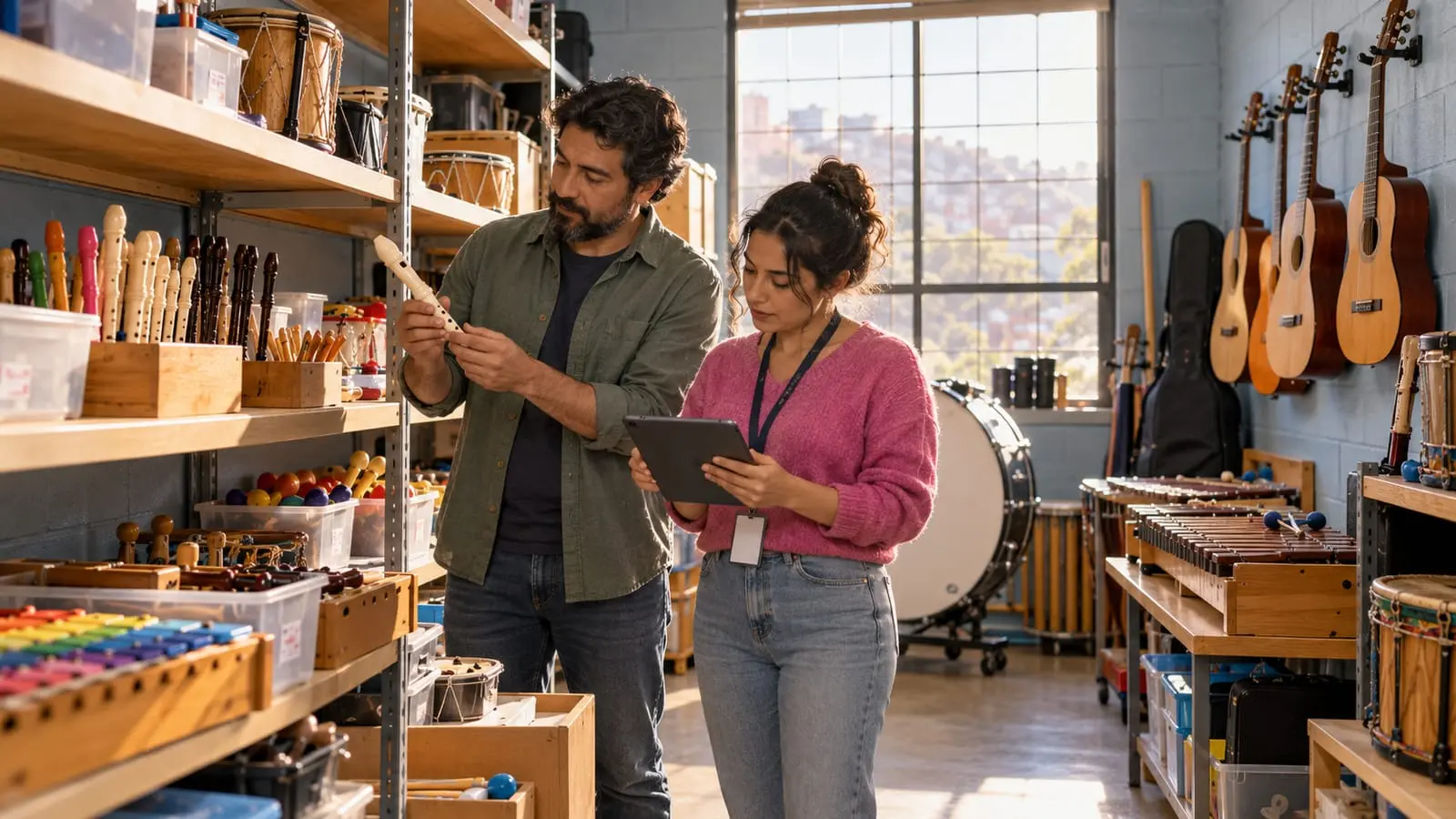
To organize a school's music department, start by assessing what you have (teaching hours, spaces, instruments, and current staff). Define the teaching profiles you need at each stage, build a progression across grades from play and singing to ensembles, and decide what belongs in the curriculum and what belongs in extracurricular activities. Support it all with an instrument management plan and staff follow-up.
This guide is for principals, academic coordinators, and department heads who want to move from “we have music lessons” to a purposeful department with a coherent program from preschool through eleventh grade.
In short
- Start with an honest assessment: hours per grade, classrooms, an instrument inventory, and staff profiles.
- A strong department combines different profiles: early music education for preschool, general music for elementary school, and ensemble leadership for secondary school.
- The progression across grades moves from pulse, singing, and movement to reading music, playing an instrument, and ensemble work.
- Ensembles such as a choir, band, or estudiantina give the department visibility and a sense of purpose.
- Under Ley 2555 de 2025, known as “Artes al Aula,” arts education is being strengthened in schools; follow its implementing regulations with your school leadership team.
Step 1: assess the department
Before hiring or buying anything, look at what you have. Answer these questions with your team:
- How many hours of music does each grade have per week, and how is arts time divided among visual arts, dance, and theater?
- What spaces are available: a music room, suitable noise conditions, instrument storage?
- What instruments do you have, what condition are they in, and who uses them?
- Who is on the team, and what are their profiles, schedules, and strengths?
- What happens outside the curriculum: choir, band, extended-day programs, extracurricular lessons?
- What do the school's institutional education plan (PEI) and families say about the place of the arts in the school?
- When does the department perform during the year: school ceremonies, showcases, concerts?
The result can fit on one page: where the department stands today, what you want to achieve in the coming years, and what's missing to get there.
Step 2: define the teaching profiles you need
| Profile | Where they teach | Skills required |
|---|---|---|
| Early music education teacher | Preschool and early grades | Singing, play, and movement; a chordal instrument for accompaniment; plenty of energy and patience |
| General music teacher | Primary school | Beginning music reading, recorder or percussion, singing in multiple parts, and managing large groups |
| Ensemble director | Choir, band, or estudiantina | Conducting, arrangements for different skill levels, and efficient rehearsals |
| Secondary school music teacher | Lower and upper secondary school | A chordal instrument, creative work, Colombian musical traditions, and projects |
| Instrument teachers | Extracurricular or extended-day programs | Instrument-specific technique, small-group lessons, and preparing soloists |
Few schools have a separate person for every profile, and one person can cover two if hired for that purpose. What doesn't work is expecting one teacher to handle early music education, elementary school, secondary school, band, and choir equally well. Decide which roles are permanent and which are hourly, and use a clear hiring process, such as the one in how to hire music teachers. For activities outside regular school hours, see which profile fits an extended-day program.
Step 3: build a progression across grades
Continuity is the key: what students learn in elementary school should support their learning in secondary school. Here is a suggested progression to adapt to your curriculum:
| Stage | Focus | Sample content | Visible outcome |
|---|---|---|---|
| Preschool | Play, pulse, singing, and movement | Songs with gestures, exploring sounds, keeping a pulse with the body | Songs at school ceremonies and family gatherings |
| Grades 1 to 3 | Rhythm, singing in tune, and beginning music reading | Body percussion, simple rhythmic note values, unison singing, and rounds | A singing and percussion showcase |
| Grades 4 and 5 | Learning a first instrument as a group | Recorder, small percussion instruments, or barred instruments; staff reading; a simple ensemble | Classroom ensemble |
| Grades 6 to 9 | Ensemble work and creation | Guitar or keyboard, Colombian rhythms, arrangements, and songwriting | Group performances |
| Grades 10 and 11 | Advanced work and a project | Electives, production, and a personal music project | Final concert or project |
In the final grades, some students discover that they want to study music. Having a pathway ready for them, such as a music university preparation program, makes the department a real source of support for their future plans.
Step 4: decide which ensembles to offer
Ensembles give the department an identity and motivate students to stay involved. Choose based on your team, spaces, and budget:
- Choir: the smallest investment in instruments; requires a good director and someone to accompany on piano or guitar.
- Concert or marching band: highly visible, but requires investment in instruments and ongoing maintenance.
- Estudiantina or Andean music ensemble: tiples, bandolas, and guitars; connects with Colombian identity.
- Percussion ensemble or Caribbean and Pacific music ensemble: attracts plenty of interest and is accessible to beginners.
- Rock or pop band: engages teenagers; needs amplification and a sound-isolated space.
- String orchestra: a long-term undertaking that requires instrument teachers from the early grades.
Also decide which ensembles meet during lessons and which outside regular hours, whether entry is open or by audition, and how rehearsals fit around school events and assessments.
Step 5: organize the school's instruments
- Inventory: record each instrument's code, condition, location, and responsible person.
- Written loan agreement: signed by the family, recording the instrument's condition and what happens if it is damaged or lost.
- Regular maintenance: have strings and winds checked by a technician or luthier, replace percussion heads, and tune the piano.
- Storage: shelves, cases, and ventilation. Humidity, direct sunlight, and sudden temperature changes damage wood, key pads, and drumheads.
- Hygiene: mouthpieces and recorders for individual use, or a cleaning routine between users.
- Buy according to the plan's priorities, rather than simply taking a deal: start with what the progression across grades requires.
Step 6: align with regulations and monitor progress
The Ley General de Educación (Ley 115 de 1994) includes arts education among the compulsory core subjects. Under Ley 2555 de 2025, known as “Artes al Aula,” arts education is also being strengthened in the country's schools. How each institution applies it depends on implementing regulations and guidance from the Ministerio de Educación and local education authorities, so your leadership team should review it with its adviser and follow developments.
In any case, a department with an assessment, defined staff profiles, a progression across grades, and evidence of learning puts your school in a better position to respond to future regulations.
Monitoring the department
- Specific annual goals for the department, reviewed at the end of the year.
- Lesson observations using a shared rubric; here is a sample teacher evaluation rubric.
- Showcases and concerts as evidence of learning, beyond the event itself.
- Students' and families' views on what works and what's missing.
At Gissi, we help schools select music teachers for each profile and assess their current team through lesson observations; the school hires teachers directly. Explore all our services for academies and schools.
Frequently asked questions
How many hours of music should a school offer?
There is no single number: it depends on the curriculum, the PEI, and how the school divides arts time. What matters is having enough hours to sustain a progression across grades and a teaching load consistent with your goals. Review current guidance with your leadership team too.
Is it better to have one music teacher or several?
One teacher can work in a small school if their profile covers the department's needs. As the program expands, it helps to separate roles: early music education, general music, and ensemble leadership require different skills.
Why do so many schools use the recorder in elementary grades?
Because it's inexpensive, portable, and lets a whole group play melodies while learning to read music. It's not the only option: barred instruments, small percussion instruments, and ukulele work too. If recorders are used, each student should have their own for hygiene.
How do you assess school music without rewarding talent alone?
Assess the learning process using clear criteria: participation, progress from the starting point, ensemble work, and achievement of goals each term. Recordings at the beginning and end of a term provide very useful evidence for students and families.
Sources
We checked the facts in this article against these sources on October 22, 2026.