
Why learn clarinet or oboe? The colors of the woodwinds
The clarinet is the all-rounder of bands and orchestras; the oboe, a rare and highly valued voice. What each one trains and who each suits best.
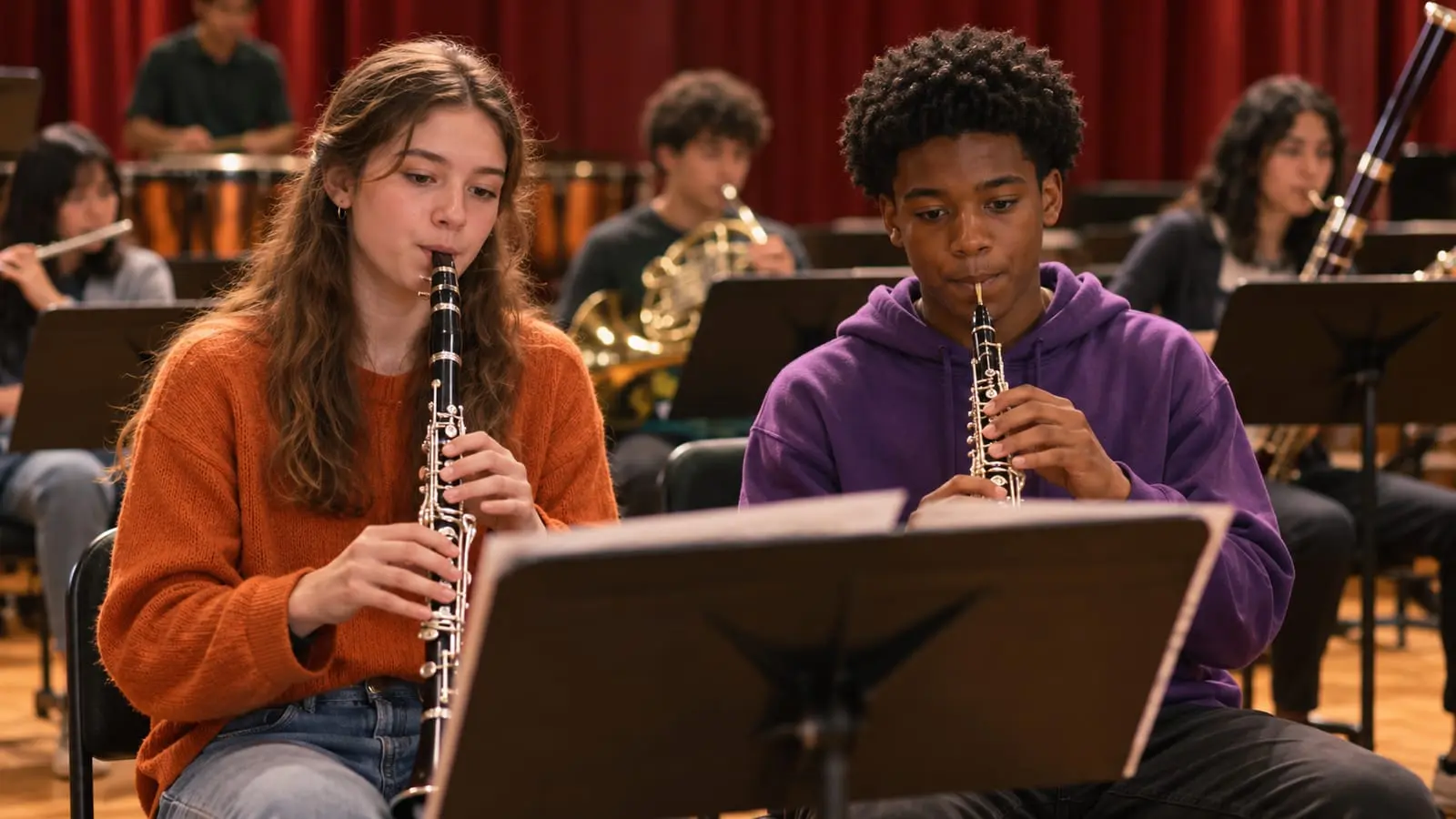
Because they give you two of the most recognizable tone colors in orchestras and bands. Clarinet is an all-rounder: warm in its low register, bright up high, able to whisper or carry the melody in a porro band. Oboe has a unique, clear, penetrating voice, and because there are usually fewer oboists than flutists or clarinetists, a skilled player is very welcome in youth orchestras and chamber groups.
Both use reeds, and that shapes the experience: a highly expressive sound, but also reeds to care for and replace. Here we explain what each offers, where they are played in Colombia, who each instrument suits best, and what challenges to expect.
In short
- Clarinet uses a single reed and is one of the most versatile instruments: bands, orchestras, jazz, and music from Colombia's Caribbean and Pacific regions.
- Oboe uses a double reed, gives the orchestra its tuning A, and has a sound that stands out from all the others.
- There are usually fewer oboists than clarinetists, so a well-prepared oboist is highly valued in orchestras and chamber groups.
- Both develop fine control of air and lips, and an ear that pays close attention to intonation.
- Their challenges: the clarinet's register break, the demands of the oboe's double reed, and care around changes in climate.
Woodwind tone colors: why they sound so different
Flute, oboe, clarinet, and bassoon belong to the same family, but each produces sound differently, which is why composers use them as a palette of colors. In Prokófiev's “Pedro y el lobo”, the bird is the flute, the duck is the oboe, the cat is the clarinet, and the grandfather is the bassoon: four characters, four timbres that a child recognizes on the first try.
Clarinet: a single reed and many characters
Clarinet has a reed that vibrates against the mouthpiece and a nearly cylindrical bore. This shape gives its low register (called the chalumeau) a dark, velvety sound, while the high register is bright and clear. Few instruments change character so much across their range, and few can play so softly: a clarinet pianissimo can be almost a whisper.
Oboe: a double reed and a singing voice
Oboe is played with two blades of cane that vibrate against each other. The result is a focused, slightly nasal, highly expressive sound that carries over the orchestra without needing to be loud. That is why composers entrust it with pastoral, melancholy, or lyrical melodies, and why it traditionally gives the A for the whole orchestra to tune.
Where they are played in Colombia
| Format | Clarinet | Oboe |
|---|---|---|
| Wind band (school, municipal, or symphonic) | The foundation: usually the largest section, carrying much of the melody, like the violins in an orchestra. | Not every band has one; in symphonic bands, it often has prominent solos. |
| Caribbean porro and fandango bands | A leading role, with agile, ornamented melodies. | Uncommon. |
| Symphony or youth orchestra | Two or three per orchestra, with important solos. | Two or three per orchestra; sometimes one also plays English horn. |
| Chamber music | Woodwind quintets, clarinet trios, and clarinet quartets. | Woodwind quintets, trios with piano, and Baroque sonatas. |
| Popular music | Porro and cumbia bands, Pacific chirimía, and traditional jazz. | Film music arrangements, orchestral pop, and fusion. |
Colombia has a very strong clarinet tradition. It played a leading role in the porro and cumbia orchestras of the mid-20th century, with Lucho Bermúdez, himself a clarinetist, as one of its key figures. In the chirimía tradition of Chocó’s Pacific region, clarinets are part of the traditional ensemble alongside saxophones, euphonium, and percussion. And in school and municipal bands, it is almost always the instrument with the most players; if that path interests you, read wind bands in Colombia: how to get started.
Why oboists are scarce and so valued
Youth orchestras, symphonic bands, and chamber groups often have more applicants on flute or clarinet than on oboe. The reasons are familiar: the instrument is more expensive and delicate, a double reed calls for more patience at the start, and few children know it when choosing an instrument.
That has a real upside for anyone willing to try. An oboist with a good tone can usually find a place in an ensemble, has many solos in orchestral repertoire, and, with fewer players, has a greater individual presence in the group. If you like the idea of having your own voice within the orchestra, with repertoire ranging from Baroque concertos to major symphonic solos, oboe offers that.
Skills each instrument develops
With clarinet
- A steady air stream, because uneven air on clarinet leads to squeaks or notes that drop out.
- Agile, coordinated fingers: crossing the famous register break requires several fingers to move together precisely.
- Reading transposed music: on a B flat clarinet, you read one note and hear another, something you learn to handle naturally.
With oboe
- Very fine lip control: tiny embouchure changes affect intonation and tone color.
- Air management that differs from other wind instruments: little air, plenty of pressure, and learning to release leftover air before taking another breath.
- A very attentive ear: because oboe is so audible, any intonation problem is audible too.
- A craftsperson's patience: checking, soaking, and eventually adjusting reeds is part of the work.
Clarinet or oboe? Which suits you better?
| Aspect | Clarinet | Oboe |
|---|---|---|
| First sound | Comes relatively quickly; crossing the register break is the later challenge. | More demanding at first because of the double reed. |
| Reeds | Bought ready-made in boxes and used in rotation. | Bought ready-made and more delicate; over the years, many oboists learn to adjust them. |
| Variety of genres | Very broad: classical, band, jazz, and Colombian music. | Mainly orchestral, chamber, and classical repertoire. |
| Places in ensembles | There are many clarinetists, so there is more competition for a place. | There are fewer oboists; each is highly valued. |
| A good fit if… | You want to play in a band and explore different styles. | You are drawn to orchestral sound and enjoy refining details. |
The clarinet lessons and oboe lessons pages give suggested starting ages and explain what beginners work on. And if you are choosing between clarinet and flute, we compare them in depth in flute or clarinet.
The real challenges (and Colombia's climate)
- The clarinet's register break. This is the first major challenge: notes initially cut out or squeak at the transition, and slow practice helps you get past it.
- The oboe's double reed. Finding a stable sound is hard at first, and the reed has a huge effect on the result. Having several reeds in good condition and a teacher's guidance from day one prevents frustration.
- Reeds wear out and change with the climate. With both instruments, you need to budget for replacements, and with the oboe, it helps to plan ahead for where to get them. They respond differently when the climate changes, such as when you travel from Bogotá to a warmer region.
- Delicate instruments. Oboe has a finely adjusted mechanism that can be knocked out of alignment, and wooden clarinets need care too. Learn to look after them from the start; for oboe, we explain how in how to care for an oboe and its reeds.
Frequently asked questions
Can you switch from clarinet to oboe?
Yes, and it is a common path. Your clarinet reading skills, air control, and several fingerings help, although you learn the double-reed embouchure from scratch. It is best to work with a teacher who can correct your embouchure from day one.
What is the English horn?
It is a relative of the oboe, longer and lower-pitched, with a pear-shaped bell and a darker, more melancholy sound. Oboists normally play it, so learning oboe opens that door too.
B flat or A clarinet?
Start with B flat: it is the most widely used in bands, orchestras, and method books. The A clarinet appears in orchestral and chamber repertoire, and clarinetists following that path add it later.
Sources
We checked the facts in this article against these sources on October 22, 2026.
- Ministerio de Cultura: beginner’s guide to the oboe (Plan Nacional de Música para la Convivencia)
- Philharmonia Orchestra: the clarinet (range, history, and timbre)
- Philharmonia Orchestra: the oboe and English horn (double reed, history, and range)
- Yamaha: why the oboe gives the A for tuning the orchestra
- Cancillería de Colombia: traditional instrumentation of the chirimía chocoana
- Wikipedia: Lucho Bermúdez (clarinetist, bandleader, and orchestral porro)