
Music lessons for teenagers: how to keep them motivated
In the teenage years, music becomes part of who they are. We explain how to turn that passion into real learning, with their own repertoire, bands and goals that matter to them.
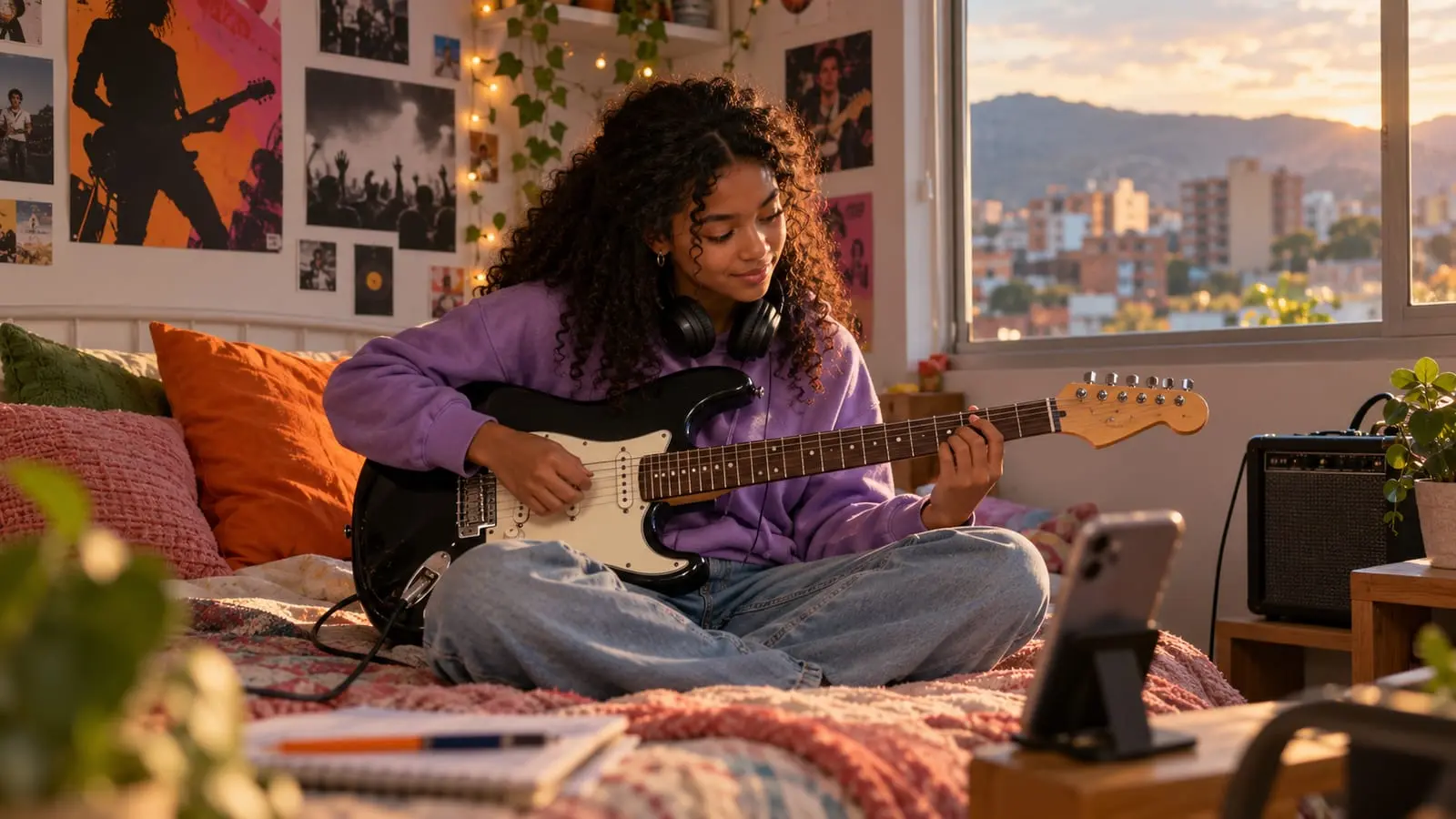
Teenagers learn music when it connects with who they are: the music they listen to, the friends they want to play with, the video they want to post and the band they dream of starting. Lessons that work at this age start with those interests, choose repertoire together and set goals that truly matter to the student.
It is a big change for parents, too: instead of sitting beside your child during practice, you now need to support them without taking control. Here is how, from an electric guitar in the bedroom to the question of studying music at university.
In short
- For teenagers, motivation comes from identity: their music, their friends and their goals.
- The music they enjoy is an excellent starting point for learning technique, music reading and theory.
- Playing with others in a band, choir or ensemble keeps their interest alive more than practicing alone.
- Recording themselves and posting can be motivating, as long as the family agrees on what to share.
- If they plan to study music, it is best to start preparing one or two years in advance.
What teenagers look for in a music lesson
An 8-year-old goes to lessons because their parents signed them up. A teenager keeps going because they want to, and stops when it no longer feels worthwhile. Generally, they want to:
- Sound like the artists they listen to.
- Play with friends and feel part of a group.
- Have a space of their own to express themselves, away from school and grades.
- Show what they can do: at a gig, at school or on social media.
- For some, explore whether music could become a career.
That is why a teacher cannot just correct mistakes. They need to listen, suggest ideas and, above all, connect. If you are looking for one, these questions to help you choose a music teacher can help you work out whether they are right for your child.
Start with the music they enjoy
Rock, reggaeton, trap, indie, pop, salsa, vallenato, K-pop or video game music: almost any genre can help students learn, if the teacher knows what to draw from each song.
| What they want to play | What they learn along the way |
|---|---|
| Their favorite rock band's riffs on electric guitar | Power chords, string muting, alternate picking and reading tablature. |
| The bass line of a funk or salsa song | Groove, subdivision, locking in with the drums and rhythm reading. |
| A reggaeton or rock drum pattern | Hand and foot independence, a steady beat and metronome practice. |
| A cover of a song by their favorite singer | Breathing, singing in tune and adapting a song's key to their own voice. |
| Music from a movie or video game on piano | Music reading, chords and how a piece's harmony is built. |
One approach that works: “a song you choose, an exercise or piece I suggest.” This helps teenagers feel ownership of the lesson while the teacher makes sure their technique develops.
If they sing: watch for voice changes
Boys' voices change noticeably during adolescence, and girls' voices also change, though less obviously. In singing lessons, it is best to work within the vocal range available at each stage, avoid forcing high or low notes and adjust the keys of songs. If there is discomfort or persistent hoarseness, consult a specialist.
Bands, rehearsals and playing with others
For many teenagers, starting a band with friends is the strongest incentive to practice. Lessons can help them prepare by teaching them to:
- Learn their part before rehearsal, so time with the band is spent playing together rather than figuring out songs.
- Count in, start and finish on time—something that seems obvious but is often the hardest part of early rehearsals.
- Listen to everyone else: the electric bass and drums need to lock in together, and the guitar needs to leave room for the vocals.
- Keep the volume under control and protect their hearing, using hearing protection at every rehearsal.
If a band is not an option yet, there are other ways to play with people: a school group, choir, youth orchestra or student ensemble. What matters is that music does not stay confined to the bedroom.
Social media, videos and recording themselves
A phone can be a great ally. Recording yourself lets you hear things you miss while playing, track progress week by week and set a specific goal: “I'll post this cover in a month.” Many teenagers practice more when there is a video to work toward.
It is worth setting a few ground rules, though:
- Discuss as a family what gets posted, on which accounts and with what privacy settings, especially for minors.
- Remember that comments from strangers do not measure their talent or progress.
- Do not turn every practice session into content: real practice is slow, repetitive and does not always look good on camera.
Online tutorials also have their place when learning songs, but they cannot replace someone who corrects posture and technique. We explain this in learning music with YouTube or a teacher.
What if they want to study music at university?
Around age 15 or 16, some young people begin wondering whether music could be their career. It is a question worth taking seriously, without panic or idealization.
Music degree programs in Colombia usually have entrance exams that assess instrumental performance or singing, as well as music reading, theory, rhythm, intonation and musical dictation. That is why it is best to start preparing one or two years ahead, even if your teenager plays very well by ear.
- Strengthen music reading and theory, not just repertoire.
- Explore the options: performance, music education, composition, music production and sound engineering, among others.
- Attend university concerts and student performances to get a feel for the environment.
If that is the plan, Gissi offers a music entrance exam preparation program designed for that goal.
Parents' role: support without taking control
- Agree on practice times together rather than imposing them. They are more likely to stick to an agreement they helped make.
- Find ways to manage noise: headphones for electric guitar, a practice pad or electronic drums, and times agreed on with neighbors.
- Invest in equipment gradually as their commitment holds steady.
- Go to their performances, even if it is just a gig at school or a friend's house.
- Do not dismiss their music. You may not enjoy reggaeton or metal, but criticizing it shuts down the conversation.
- Stay in touch with the teacher, but more discreetly now: teenagers also need to feel that their relationship with their teacher is their own.
And if they want to change instruments, styles or teachers at some point, listen: tastes shift at this age, and that is part of finding their place in music.
Frequently asked questions
Is 15 too late to start learning an instrument?
No. A motivated teenager can grasp ideas quickly, organize their practice and make steady progress. If they also want to study music, the important thing is to start preparing well ahead of time.
Do online lessons work for teenagers?
They usually work very well: teenagers are comfortable with technology and can share practice videos with the teacher between lessons. For electric guitar, bass or singing, online lessons are a very practical option, especially with busy school schedules.
What should I do if my child only wants to play one genre?
Let them, and use that interest. Every genre offers rhythm, harmony and technique to learn. A good teacher uses that music as a starting point and gradually broadens the repertoire with other material that helps them grow.
How can we balance music with the final year of school?
Make realistic agreements. During exams or preparation for the Saber 11 tests, practice can be reduced, but keeping the weekly lesson helps maintain continuity. For many teenagers, music is exactly the break they need at that time.
Sources
We checked the facts in this article against these sources on October 22, 2026.
- Universidad del Atlántico: instructions for the Music program’s specific admissions test
- ICFES: Saber 11 exam
- NIDCD (US National Institutes of Health): noise-induced hearing loss
- Audiologia e Foniatria: singing from childhood through puberty and the physiology of the larynx (2024)
- KidsHealth: voice changes during puberty