
How to read guitar and bass tabs
In tab, each line is a string and each number is a fret. We explain how to read it on guitar and bass, its most common symbols and where it falls short of standard notation.
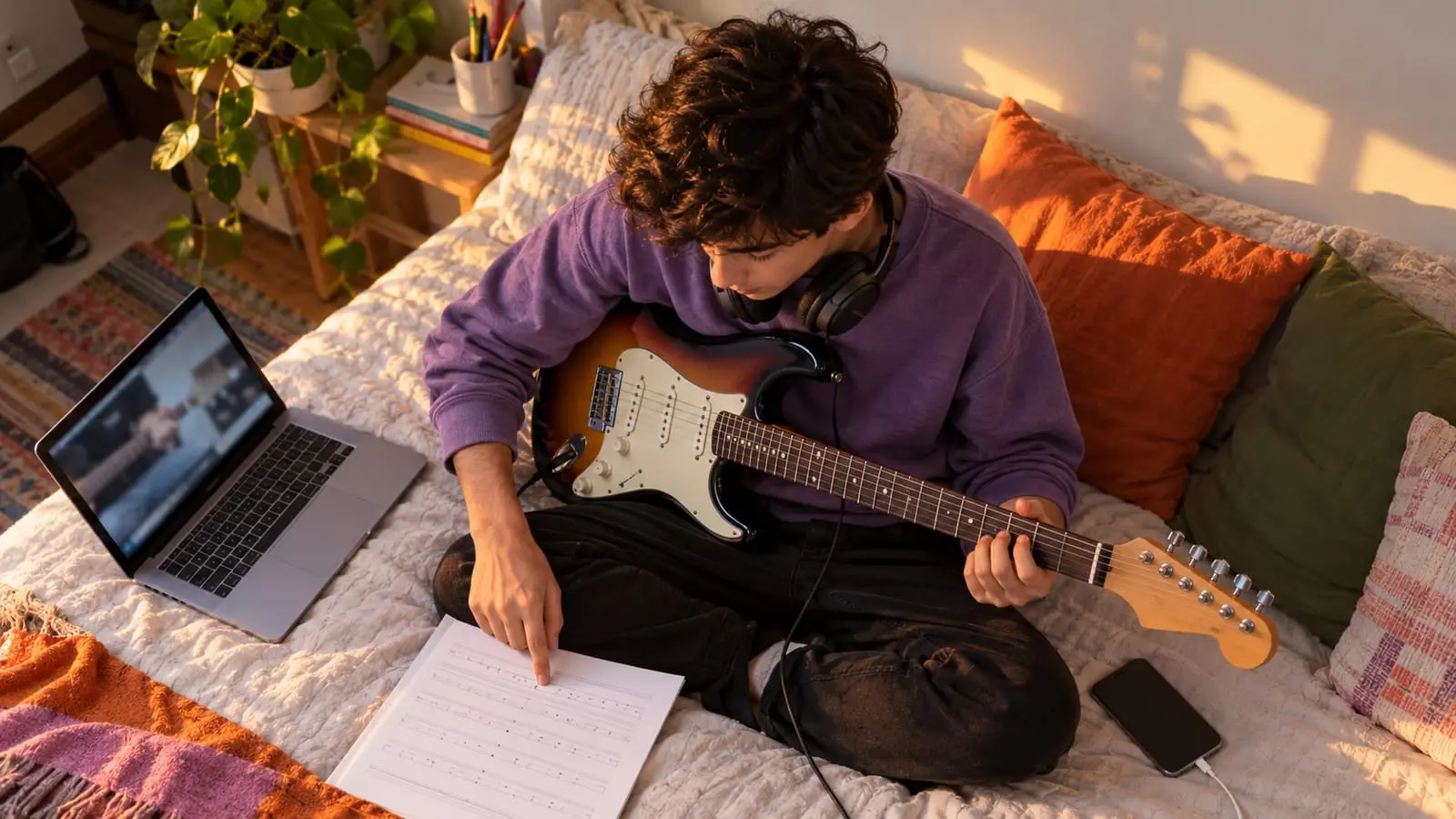
Tablature (or tab) tells you where to put your fingers: each horizontal line is a string, and each number tells you which fret to press. Read it from left to right; 0 means an open string, and numbers stacked vertically are played at the same time.
It’s the quickest way to start learning songs and riffs, but it has a major limitation: it rarely shows the rhythm. That’s why you should always read a tab with the recording playing alongside it.
In short
- In guitar tabs, the top line is the 1st string (high E), and the bottom line is the 6th (low E).
- For four-string bass, from top to bottom: G, D, A, E.
- Each number is a fret; 0 means an open string; stacked numbers are played together.
- The most common symbols are h (hammer-on), p (pull-off), / and \ (slides), and b (bend).
- Tabs don’t show rhythm or fingering: listen to the song and use the sheet music when available.
What each line and number means
The most common beginner mistake is reading tab upside down. In standard guitar and bass tabs, the top line is the highest-pitched string, and the bottom line is the lowest. Imagine the guitar lying faceup across your lap: the thick string is closest to you, at the bottom of your field of vision.
| Tab line | Guitar (6 strings) | Bass (4 strings) |
|---|---|---|
| 1st (top) | 1st string: high E (e) | 1st string: G |
| 2nd | 2nd string: B | 2nd string: D |
| 3rd | 3rd string: G | 3rd string: A |
| 4th | 4th string: D | 4th string: E, the lowest |
| 5th | 5th string: A | — |
| 6th (bottom) | 6th string: low E | — |
- Many tabs put each string’s letter name at the start of the line; lowercase "e" usually marks high E to distinguish it from low E.
- On a five-string bass, there’s an extra line at the bottom for low B.
- A two-digit number, such as 12, means one fret, not a 1 and a 2.
- A chord looks like a column of numbers. C major, for example, reads from top to bottom: 0, 1, 0, 2, 3, with no number on the 6th string because it isn’t played.
Two examples you can read right now
Here, each tab is laid out as a table: each row is a string, and each column is a moment in time. A dash (–) means that string isn’t played at that moment. First, the C major scale on guitar in first position:
| String | 1 | 2 | 3 | 4 | 5 | 6 | 7 | 8 |
|---|---|---|---|---|---|---|---|---|
| e (1st) | – | – | – | – | – | – | – | – |
| B (2nd) | – | – | – | – | – | – | 0 | 1 |
| G (3rd) | – | – | – | – | 0 | 2 | – | – |
| D (4th) | – | 0 | 2 | 3 | – | – | – | – |
| A (5th) | 3 | – | – | – | – | – | – | – |
| E (6th) | – | – | – | – | – | – | – | – |
| Note | C | D | E | F | G | A | B | C |
Now, a classic bass pattern: root, fifth, and octave on A. It forms the basis of countless bass lines in rock, pop, and Latin music.
| String | 1 | 2 | 3 | 4 |
|---|---|---|---|---|
| G (1st) | – | – | – | – |
| D (2nd) | – | – | 7 | – |
| A (3rd) | – | 7 | – | 7 |
| E (4th) | 5 | – | – | – |
| Note | A | E | A | E |
In this pattern, press fret 5 with finger 1 and the notes at fret 7 with finger 3 or 4. That choice—which finger to use—is exactly what the tab doesn’t tell you.
Technique symbols: h, p, /, b, and more
| Symbol | Name | What you do | Example |
|---|---|---|---|
| h | Hammer-on (ascending slur) | Play the first note, then hammer another finger onto a higher fret without plucking again | 5h7 |
| p | Pull-off (descending slur) | Lift your finger with a slight pull on the string to sound the lower note | 7p5 |
| / | Upward slide | Slide your finger to a higher fret without releasing the string | 5/7 |
| \ | Downward slide | Slide your finger to a lower fret | 7\5 |
| b | Bend | Push the string sideways to raise the pitch to the indicated note | 7b9 |
| r | Release | Release the bend and return to the original note | 7b9r7 |
| ~ | Vibrato | Move the string repeatedly to make the pitch waver | 7~ |
| x | Muted note | Strike the string without letting it ring: a percussive sound | x |
| PM | Palm mute | Rest the edge of your palm on the strings near the bridge | PM---- |
| <12> | Natural harmonic | Lightly touch the string directly above fret 12 without pressing it down | <12> |
In slap bass tabs, you’ll find T (thumb strike) and P (pop: pulling the string with your index or middle finger). Since P can also mean pull-off, always check the legend. Symbols vary slightly between websites and software.
How to read a new tab, step by step
- Check the header for tuning and capo instructions. If it says "Drop D" or "half step down," retune before playing; if it says "Capo 2," put the capo at fret 2. Fret numbers are usually counted from the capo.
- Tune your instrument; for bass, you can use the bass tuner.
- Listen to the song while following the tab with your finger to locate each phrase.
- Play a short section of one or two phrases until you can do it without looking so much.
- Learn the rhythm from the recording: sing or hum the part and notice where the long notes fall.
- Choose your fingering: within one position, assign one finger per fret so you don’t have to jump around with your hand.
- Practice with a slow metronome and increase the speed once you can play cleanly.
Tablature vs. sheet music: strengths and limitations
| Aspect | Tablature | Sheet music |
|---|---|---|
| Where to play | Exact string and fret | Only the note; you choose the position |
| Rhythm | Rarely, except in tabs with note values | Always, precisely |
| Time needed to learn it | Minutes | Weeks or months of practice |
| Instruments | Only fretted instruments: guitar, bass, ukulele | Any instrument and voice |
| Dynamics and phrasing | Rarely included | Included |
| Playing with other musicians | Limited | The shared language |
Ideally, learn both: tabs help you learn a song quickly, while sheet music helps you understand the music and read with any musician. If you want to take that step, start with our guide to reading sheet music from scratch.
Common mistakes when learning from tabs
- Believing everything in the tab. Many are uploaded by amateurs and contain mistakes. If something doesn’t sound like the recording, trust your ears.
- Ignoring the tuning in the header. Several rock bands record a half step down; in standard tuning, everything will sound "almost" right.
- Playing everything with one finger because the tab doesn’t show fingering.
- Not learning the rhythm. The right notes at the wrong time won’t sound like the song.
- Relying only on tabs. This limits you to songs someone has already transcribed.
An electric guitar or electric bass teacher can help you choose fingerings, correct questionable tabs, and combine tabs and sheet music to suit what you want to play. If you’re new to guitar, use this guide alongside our basic chords guide.
Frequently asked questions
Is it bad to learn guitar only from tabs?
It’s fine for getting started and playing songs, but it has limitations: without written rhythm, you depend on the recording, and without sheet music, it’s harder to play with other musicians or apply for a music degree. Combining both gives you a more complete foundation.
Are ukulele tabs read the same way?
Yes, with four lines. In the most common tuning, from top to bottom: A, E, C, and G. The top line is still the string closest to the floor when you play.
How do I work out the rhythm if the tab doesn’t show it?
Listen to the recording phrase by phrase, hum each phrase, and tap the pulse with your foot. Some tabs include rhythmic note values below the numbers; if yours does, learn to read them, since they’re the same ones used in sheet music.
What does "half step down tuning" mean in a tab?
All the strings are lowered by a semitone: E♭, A♭, D♭, G♭, B♭, E♭ on guitar. Read the tab numbers the same way, but the song will now match the recording.
Sources
We checked the facts in this article against these sources on October 22, 2026.