
How long does it take to learn to play electric bass?
Within a few weeks you're playing your first bass lines; developing groove and playing confidently in a band takes longer. These are the real stages of learning electric bass.
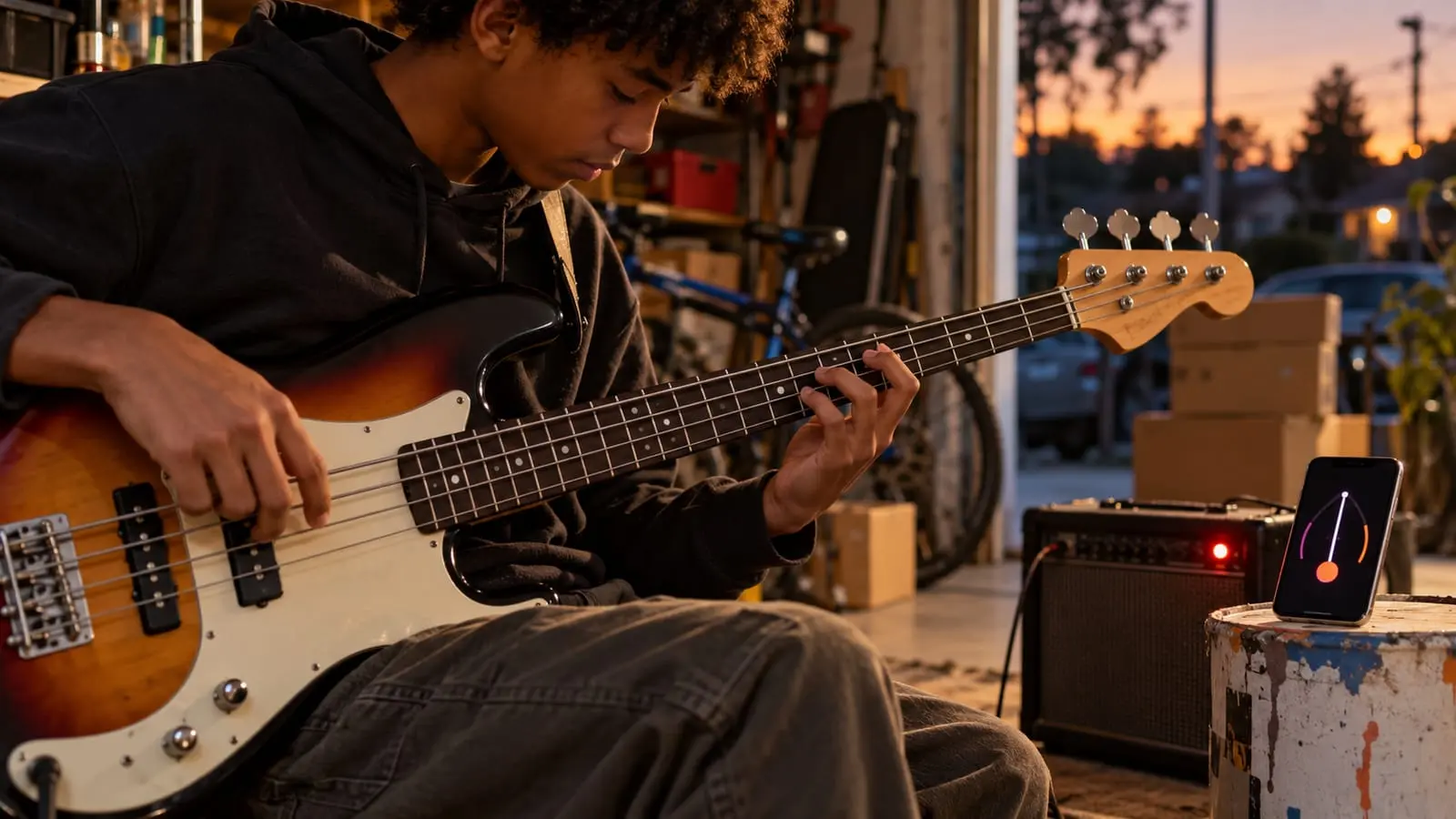
Bass is a welcoming instrument for beginners. With regular practice—20 to 30 minutes almost every day—you can play simple lines based on the root of each chord and accompany rock or pop songs in two to six weeks. Developing groove, meaning locking in with the drums with precise timing and note lengths, usually takes six months to a year; creating your own lines and reading fluently takes one to two years, and playing confidently in several styles takes two to four years.
These are rough timelines. They vary with your consistency, whether you already play another instrument, your age, and the music you want to make: playing rock in a school band calls for different skills than a salsa tumbao or a jazz walking bass line.
In short
- Your first bass lines based on chord roots usually come together in the first few weeks.
- Groove takes the most time to develop and is what bands value most: playing in time, with the right note lengths, locked in with the kick drum.
- Creating your own lines with fifths, octaves, and passing tones usually comes between four months and the end of your first year.
- Reading bass clef is optional when you start, but it opens the door to wind bands, orchestras, and formal study.
- If you already play guitar, you'll progress quickly on the fretboard, but you need to learn to play fewer notes and think like a bassist.
The stages of learning electric bass and how long they take
Bass usually plays one note at a time, so the first steps can feel quick. The challenge lies in playing each note at exactly the right moment, with the right length and volume, rather than in the number of notes.
| Stage | What you achieve | Approximate time with regular practice |
|---|---|---|
| First steps | Posture, a comfortable strap height, plucking with alternating index and middle fingers, finding notes on all four strings, and muting strings you aren't playing. | 2 to 6 weeks |
| Roots and basic groove | Eighth-note lines on the root of each chord, using a metronome and simple songs. | 1 to 4 months |
| Bass lines | Fifths, octaves, arpeggios, and passing tones; understanding how to build a line. | 4 months to 1 year |
| Reading | Reading bass clef, rhythms with rests and syncopation, and following chord symbols. | 6 months to 2 years |
| Playing in a band | Following a song's form, listening to the drummer, and playing live without losing your place. | 6 months to 2 years |
| Styles and intermediate skills | Funk and slap, salsa tumbao, jazz walking bass, and Colombian rhythms. | 2 to 4 years or more |
As an external benchmark, Trinity College London estimates about 60 total hours (lessons plus independent study) to prepare for its Grade 1 bass exam, about 180 for Grade 5, and about 320 for Grade 8, and clarifies that these are averages that vary with each person’s experience.
Groove: the hardest and most important part
A bassist who plays few notes with good groove often finds a band sooner than one who plays lots of notes with shaky timing. Groove isn't mysterious; you build it with very concrete skills:
- Timing: play right on the beat, without rushing in choruses or dragging in quieter sections.
- Note length: decide how long each note lasts. A note cut off at the right moment sounds very different from one left ringing.
- Locking in with the kick drum: in many styles, the bass and kick drum work as a single instrument.
- Dynamics: keep note volumes even, without some jumping out and others disappearing.
Here's an exercise many teachers use: set the metronome to click only on beats 2 and 4, like a snare drum, and play a one-note line for five minutes. It may seem boring, but it trains exactly what makes a bassist sound good.
Tablature, chord symbols, or bass clef?
There are three ways to read music for bass, and each has a place in your learning:
| System | What it tells you | Limitation |
|---|---|---|
| Tablature | Which string and fret to use for each note. | It rarely shows rhythm; you need to know how the song sounds. |
| Chord symbols | The song's chords, so you can build your own line. | It doesn't tell you which notes to play: you need to understand harmony. |
| Sheet music in bass clef | Exact notes, rhythms, rests, and dynamics. | It takes longer to learn to read fluently. |
Many bassists start with tabs; our guide to reading guitar and bass tabs explains how. But if you want to play in wind bands or salsa orchestras, or apply for a music degree, reading bass clef becomes necessary.
From copying bass lines to creating your own
At first, you copy bass lines from songs. Over time, your teacher will ask you to build your own from the chords. You get there step by step:
- Play only the root of each chord, with a steady rhythm.
- Add the fifth, the basic movement in many styles, from cumbia to rock.
- Add the octave to give the line more movement.
- Play through the chord's full arpeggio.
- Use passing or approach tones to lead into the next chord.
Each style has its own rules. In salsa, for example, the bass tumbao often anticipates a chord change and leaves the first beat of the measure open, which can be puzzling if you come from rock. Learning lines by ear from the music you listen to is the best way to understand those differences.
Playing in a band: the real test
You can sound great in your room and lose your place at your first rehearsal. In a band, everything changes: the volume, the need to listen to everyone else, and the pressure of having to keep going.
- Learn each song's form: how many times the chorus repeats, where the bridge is, and how it ends.
- Stand where you can see the drummer; many cues come through eye contact.
- Simplify if you lose your place: returning to the root in time is better than playing a complex line in the wrong spot.
- Before your first rehearsal, play each song all the way through with the recording, without stopping when you make a mistake.
A school band, a group of friends, or open jam sessions are good places to start. Playing with others often speeds up your progress more than extra hours of solo practice.
What helps or slows your progress
| Speeds up progress | Slows progress |
|---|---|
| Practicing with a metronome, programmed drum tracks, or songs. | Always practicing without a timing reference. |
| Tuning before every practice session with the bass tuner. | Playing out of tune without noticing, because low notes are harder to judge by ear. |
| A bass that feels comfortable in your hands; short-scale models help children and players with small hands. | An instrument with very high string action or a neck you can't comfortably reach around. |
| Playing with other musicians early on. | Spending years playing alone in your room. |
| Listening closely to the bass lines in music you enjoy. | Playing too many notes, as if it were a guitar. |
Frequently asked questions
Is bass easier to learn than guitar?
At first, it often seems easier because you play one note at a time and don't have chord shapes to learn. But bass has its own challenges: your timing and groove are exposed, and a rhythmic mistake affects the whole band. It isn't easier or harder; it calls for different skills.
Do you play bass with a pick or your fingers?
Both approaches are valid. Many teachers start with alternating index and middle fingers because this gives you more control over the sound and is the most common technique in many styles. Picks are common in rock, and learning to use one later gives you another option.
Do I need an amplifier to practice bass?
Yes—at least a small amp or an audio interface with headphones. Without amplification, an electric bass is very quiet, and you can't clearly hear the note lengths, which are exactly what you need to work on. Our guide to choosing your first electric bass covers the basic equipment.
At what age can you start learning electric bass?
There is no fixed minimum age: what matters is being able to reach the neck comfortably, which many children can do around ages 9 or 10; a short-scale bass (about 30 inches, compared with the standard 34) helps. In our electric bass lessons, the teacher adapts posture and repertoire to each student’s age and hands.
Sources
We checked the facts in this article against these sources on October 22, 2026.