
Guitar or bass? Which to learn based on your style
One builds the harmony and plays the solos; the other holds down the groove for the whole band. We help you choose based on how you feel music.
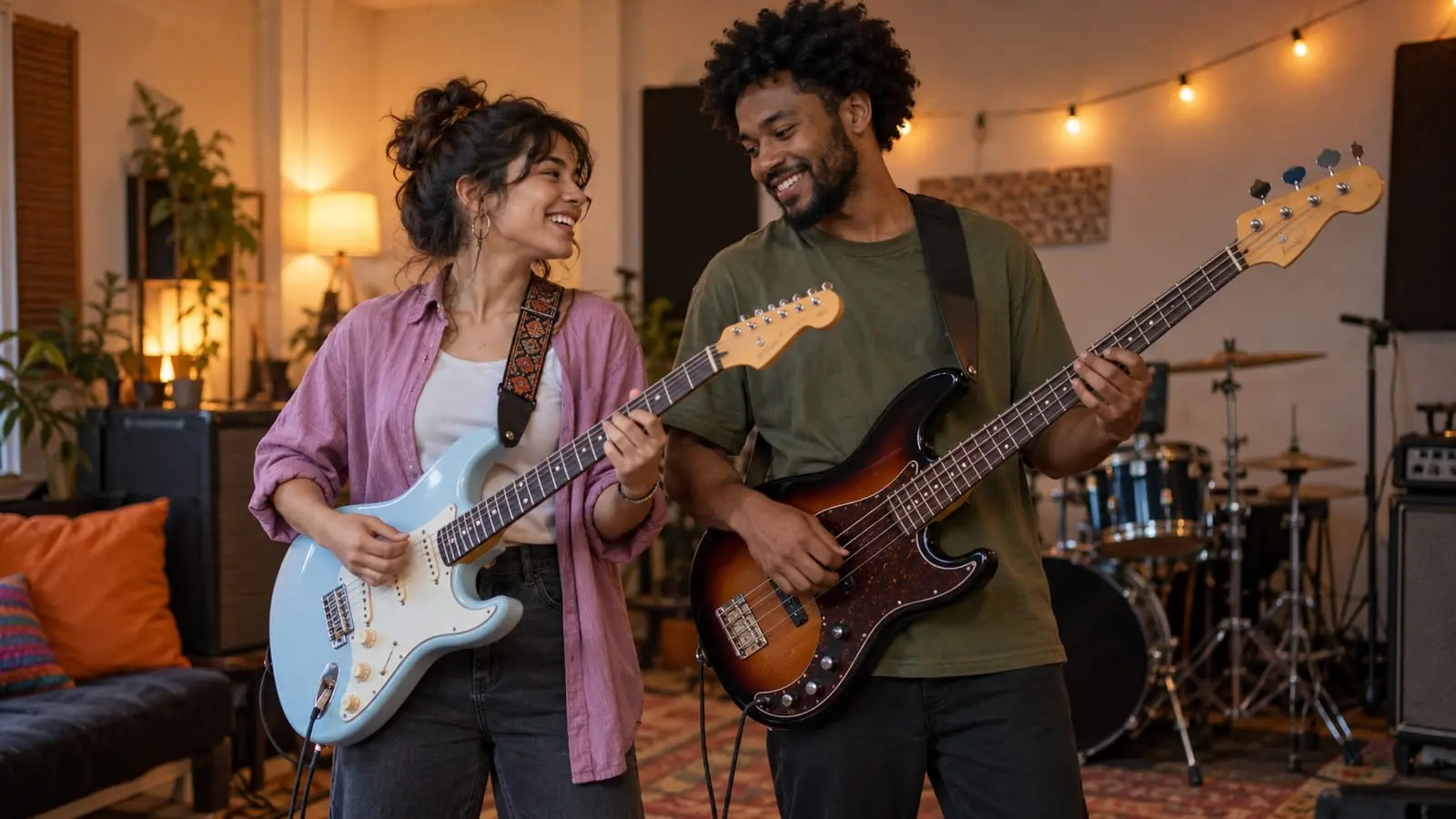
It depends on the role you enjoy playing in music. If you want chords to sing over, melodies, solos, and the option of playing alone in your room, choose guitar. If you love groove, feeling rhythm in your body, and providing the foundation for the whole band, choose bass.
Bass seems simpler at first because you play one note at a time; guitar requires chords within the first few weeks. But neither is a “lesser” instrument: as you progress, both offer the same depth.
In short
- Guitar handles harmony and melody; bass connects the drums' rhythm to the harmony.
- Bass has four strings tuned like the four lowest guitar strings, an octave lower.
- Your first bass lines come quickly; the bassist's main challenge is playing perfectly in time.
- Guitar is very rewarding to play on your own; bass shines with other musicians or backing tracks.
- Bands almost always need a bassist, and moving from guitar to bass, or vice versa, is common.
Guitar vs. bass: a quick comparison
| Aspect | Guitar | Electric bass |
|---|---|---|
| Role in music | Harmony and melody: chords, arpeggios, riffs, and solos. | A bridge between rhythm and harmony: root notes and groove alongside the drums. |
| Strings and tuning | Six: E, A, D, G, B, E. | Four: E, A, D, G, an octave below the guitar. |
| The first few weeks | Chords and chord changes; fingertips feel a little sore. | Single-note lines; thick strings and wide stretches along the neck. |
| The challenges that come later | Barre chords, solos, picking or fingerstyle technique, richer harmony. | Absolute rhythmic precision, even tone, walking bass, slap. |
| Playing alone at home | Very rewarding: you can accompany yourself singing. | Sounds incomplete on its own; practice with backing tracks or a metronome. |
| In bands | There are usually several guitarists looking for a band. | A bassist is almost always needed. |
| Equipment | Acoustic: no extras. Electric: amp and cable. | Always needs a bass amp and cable, or headphones with suitable equipment. |
| Suggested starting age | From ages 6 or 7, with a small nylon-string guitar. | Around ages 9 or 10; a little earlier with a short-scale bass. |
What each instrument does in a band
Think of a song as a house. The drums are the floor, the bass is the supporting columns, and the guitar is the walls and windows. Take away the guitar and the song loses color; take away the bass and everything feels ungrounded, even if many listeners cannot explain why.
In salsa, bass plays the tumbao, anticipating the chord and driving the dancers forward. In vallenato and modern cumbia, bass is half the dance. In rock and funk, bass and drums act as a single rhythmic engine. Guitar, meanwhile, can strum chords in a bolero, play rock riffs, or take the solo in a ballad.
How hard is it to start? Beyond the myths
On guitar
The first hurdle is changing chords: placing three or four fingers at once, in time, without muffled notes. The second, a few months later, is the barre chord. In return, just four chords let you accompany many songs.
On bass
Playing one note at a time makes your first lines come quickly. The challenges are physical and rhythmic: the neck is long, the strings are thick, and your left hand needs to stretch without tension. Timing is unforgiving: if the bassist rushes or drags, the whole band becomes unsteady. Practicing with a metronome from day one is part of the technique.
To see the stages of learning bass with approximate timelines, read how long it takes to learn electric bass.
What does your musical personality tell you?
Answer these questions honestly as you listen to your favorite music:
- Do you sing the melody or nod along to the bass line?
- Do you picture yourself at the front of the stage or at the back, holding everything together with the drummer?
- Does a guitar solo excite you, or a groove that makes you move?
- Do you enjoy playing alone for hours, or do you prefer the feeling of playing with a group?
If your answers lean toward melody, the spotlight, and playing alone, guitar suits you. If groove and teamwork sound like you, you may be a bassist without knowing it yet. To learn more about that role, read why learn electric bass.
Choose guitar if… / choose bass if…
Choose guitar if…
- You want to sing and accompany yourself.
- You are drawn to solos, riffs, and chords.
- You will mainly practice alone at home.
- It is for a child aged 6 to 8 who cannot yet comfortably reach along a bass neck.
Choose bass if…
- The first thing you hear in a song is the bass line.
- You enjoy salsa, funk, reggae, vallenato, or modern cumbia.
- You want to join a school band or a band with friends soon.
- You enjoy supporting the music more than being in the spotlight.
Explore the approach in our acoustic guitar, electric guitar, and electric bass lessons. If you have chosen guitar, the next step is deciding whether to start with acoustic or electric.
Switching from one to the other later
Since the four bass strings are tuned like the four lowest guitar strings, your knowledge of the fretboard transfers in either direction.
- From guitar to bass: learn to pluck with alternating index and middle fingers, mute unused strings, and think about rhythm before notes. A common mistake among guitarists playing bass is filling every space with notes.
- From bass to guitar: you will have solid rhythm and know each chord's root; you still need to build full chords and get used to thinner strings.
Many musicians play both. Knowing bass makes you a better guitarist because you understand where the harmony comes from; knowing guitar makes you a better bassist because you understand the chords you support.
Frequently asked questions
Is bass easier than guitar?
It often seems so at first because you play one note at a time. Over time, the difficulty evens out: bass requires very high rhythmic precision, while guitar requires more coordination to play harmonies.
Can you learn bass without knowing guitar?
Yes. Bass is a complete instrument in its own right, and you can start from scratch. You do not need to learn guitar first.
How many strings should a beginner bass have?
Four. Five- and six-string basses extend the range, but their wider necks make the first few months harder without offering beginners much benefit.
Can I practice bass without an amp?
For a while, yes, but you cannot hear it well or learn to control the sound. A small bass amp or equipment that lets you use headphones is best.
Sources
We checked the facts in this article against these sources on October 22, 2026.