
How do you choose your first trombone? Slide, size and F attachment
A tenor trombone with a smooth slide is the best way to start. We help you decide whether you need an F attachment and how to check a new or used trombone.
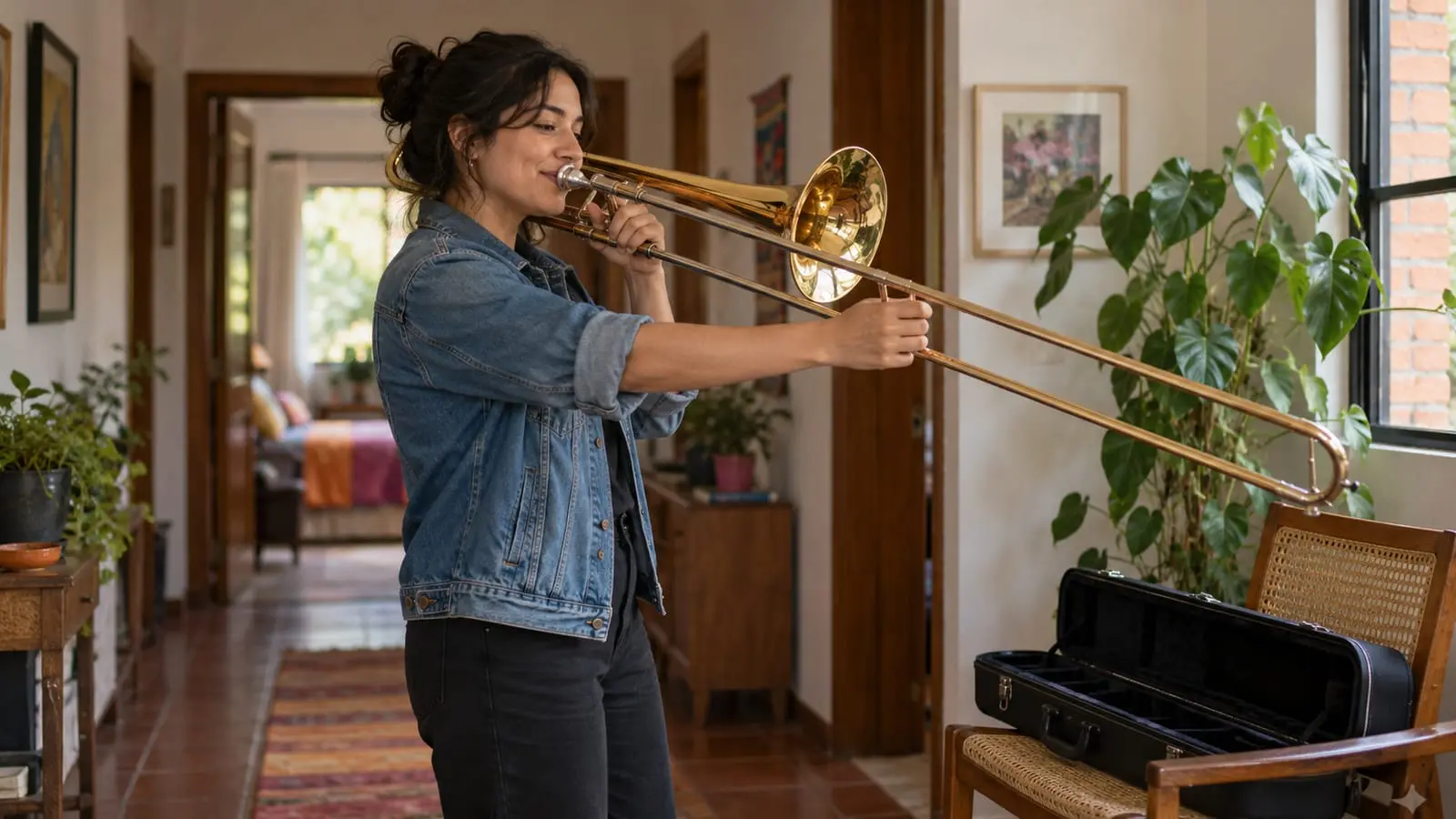
For beginners, the best choice is usually a small- or medium-bore B flat tenor trombone without an F attachment, with a slide that moves smoothly from end to end. It is light, straightforward, and suitable for school band, popular music, and beginner method books.
An F attachment—the F rotor—can make sense in some cases, especially for children who cannot reach the farther slide positions, but it is optional. The condition of the slide, however, is essential.
In short
- A B flat tenor trombone without an F attachment is the most common starting point: it weighs less and has fewer parts to adjust.
- Check the slide first: it should move smoothly without catching, with straight tubes and no dents.
- A beginner will find a small or medium bore easier to fill with air than a large one.
- If a child cannot reach sixth and seventh position, an F rotor is an option, though it adds weight.
- A dented or misaligned slide is the most delicate repair on a used trombone.
Which type of trombone should you start with
| Type | Features | For a beginner? |
|---|---|---|
| Tenor without an F attachment | Slide and bell; small or medium bore; the lightest option | Yes, it is the most common choice |
| Tenor with an F attachment | Adds a rotor and extra tubing activated by the left thumb | Sometimes: for children with short arms or students planning to play in an orchestra |
| Bass trombone | Large bore and bell, with one or two rotors | No; it needs a lot of air and is heavy |
| Alto trombone | Smaller and higher-pitched | Rarely; used for specific repertoire |
| Plastic trombone | Very light and resistant to knocks | As a stepping stone for young children or a way to try the instrument; it does not replace a metal trombone |
The bore is the inside diameter of the slide tubing. Student trombones usually have a small bore, around 0.500 to 0.508 inches, or a medium bore, around 0.525, with a bell of about 7½ to 8 inches. Large bores of 0.547 are common in orchestras and on trombones with an F rotor, and require more air than a beginner can supply.
Many student trombones come with a small or medium-sized mouthpiece that works well for beginners; ask your teacher which one is suitable. Check that the mouthpiece shank matches the bore size: small-shank and large-shank mouthpieces are not interchangeable.
The slide: what to check first
A trombone can have a scratched bell and still play well, but a damaged slide makes learning very difficult: the student has to fight the instrument at every position change. Here is how to check it:
- With the slide clean and lubricated, move it from first to seventh position and back: it should travel evenly, without catching or making noise.
- Hold the trombone vertically, release the slide lock, and let the slide drop a few centimeters, with your other hand ready to catch it. It should move smoothly; if it stops at one point, there is a dent or a bent tube.
- Look at both outer tubes from the front and the side: they should be straight and parallel. Run your fingers over them to feel for dents, even small ones.
- Check the bend at the end of the slide: it is the first part to hit the floor or a wall, so dents often appear there.
- Test the lock: with the slide fully closed and locked, it should not slip out when you tilt the trombone downward.
- Look for fresh solder joints or repairs on the tubes; these show that the slide has been damaged before.
A stiff slide sometimes just needs cleaning and the right lubricant, but a dent or a misaligned tube calls for careful work by a repair technician. Our guide to cleaning a trombone explains the maintenance that prevents most of these problems.
Children and arm reach
The trombone has seven slide positions. Seventh position requires extending the right arm almost fully, which is the challenge for children: arm length matters more than age.
- Ask the child to stand with good posture and move the slide to sixth position without leaning or changing their grip. If they can reach comfortably, a standard tenor trombone is suitable to start with.
- If the child cannot reach sixth or seventh position, the teacher can initially choose exercises and songs that avoid them; arms grow faster than you might expect.
- The F rotor lets you play notes from sixth and seventh position with the slide much closer in. It is a practical solution, but makes the instrument heavier and harder to hold.
- Watch how the child handles the weight: the left hand supports almost all of the trombone. If the bell starts to droop or the child leans to one side after a few minutes, adjust the posture or wait a little longer before starting.
That is why a child should try the trombone in person before you buy it, ideally with the teacher present. A sizing chart cannot replace seeing the child play.
With or without an F attachment?
| Aspect | Without an F attachment | With an F attachment |
|---|---|---|
| Weight | Lighter | Heavier, especially on the left-hand side |
| Maintenance | Simple | The rotor needs oil and regular checks |
| Low register | Reaches low E in seventh position | Fills nearly the entire range below that E (except low B-natural) and offers alternate slide positions |
| Farther slide positions | You need to reach sixth and seventh position | Notes from sixth and seventh position can be played near first and second |
| Typical use | School band, popular music, beginner playing | Orchestra, lower-register repertoire, advanced students |
If the used trombone you are considering has a rotor, check that it turns smoothly, that the lever springs back into place, and that you hear no air leaking when you activate it. A poorly adjusted rotor makes the instrument sound dull on the very notes that use it.
What else to check on a new or used trombone
- Bell: small dents along the rim are cosmetic; dents near the bend or in the narrow section have more effect.
- Tuning slide: the one on the bell section should move by hand rather than being stuck.
- Slide-to-bell connection: the nut joining them should tighten securely without force. If it is loose, the instrument wobbles while you play.
- Water key: the cork should seal, and the spring should close the key on its own.
- Case: the slide should have its own compartment, secured and protected so that nothing presses on it during transport.
Warning signs include a seller who will not let you test the slide, a slide that “just needs some cream,” fresh solder joints on the tubes, or a very low-quality new trombone whose slide catches straight out of the box. Be wary of peeling lacquer or a maker no repair technician recognizes, as spare parts may not be available later.
Transport and accessories
A trombone is long, and so is its case. If you travel by bus or TransMilenio, try carrying the case before buying: backpack straps and a sturdy handle make a difference. Never carry the slide unlocked or leave it leaning against a wall: it is the part most likely to get damaged.
- Slide cream or lubricant and a small water spray bottle, as recommended by your teacher.
- A trombone stand for breaks; laying it on a chair is a quick way to dent the slide.
- A cloth, mouthpiece brush, and flexible cleaning brush for the inside.
- A practice mute if you practice in an apartment.
- A metronome and a tuner: on the trombone, pitch depends on where you place the slide, and a tuner helps you find each position.
Before paying, ask your teacher to play it: long tones in each position, slurs, and a scale are enough to check the slide and intonation. If you do not yet have a teacher, you can start trombone lessons and choose your instrument with their guidance. If you are still deciding between brass instruments, see trumpet or trombone.
Frequently asked questions
At what age can a child start playing trombone?
There is no fixed age: it depends on arm length and the strength to hold the instrument. Many children start around nine or ten; for younger children, some teachers use plastic trombones or suggest starting with a more compact brass instrument.
Can you learn on a plastic trombone?
For beginners or young children, yes: it is light, withstands knocks, and lets you work on embouchure and slide positions. Its sound and slide do not match those of a good metal trombone, so sooner or later it is worth upgrading.
Is a trombone with an F attachment harder to play?
It is not harder, but it weighs more and adds a lever you need to learn to use. A reasonably tall adult beginner usually does not need one at first; for a child with short arms, it can help.
Which mouthpiece should you use when starting trombone?
The mouthpiece included with a student trombone is usually suitable, as long as its shank fits the instrument's bore. Decide whether to change it with your teacher, based on your embouchure and the music you play.
Sources
We checked the facts in this article against these sources on October 22, 2026.