
Singing for kids: how to protect their voice while they learn
A child's voice isn't a miniature adult voice. How to recognize when they're straining it, which songs suit them and how to support them through the voice change.
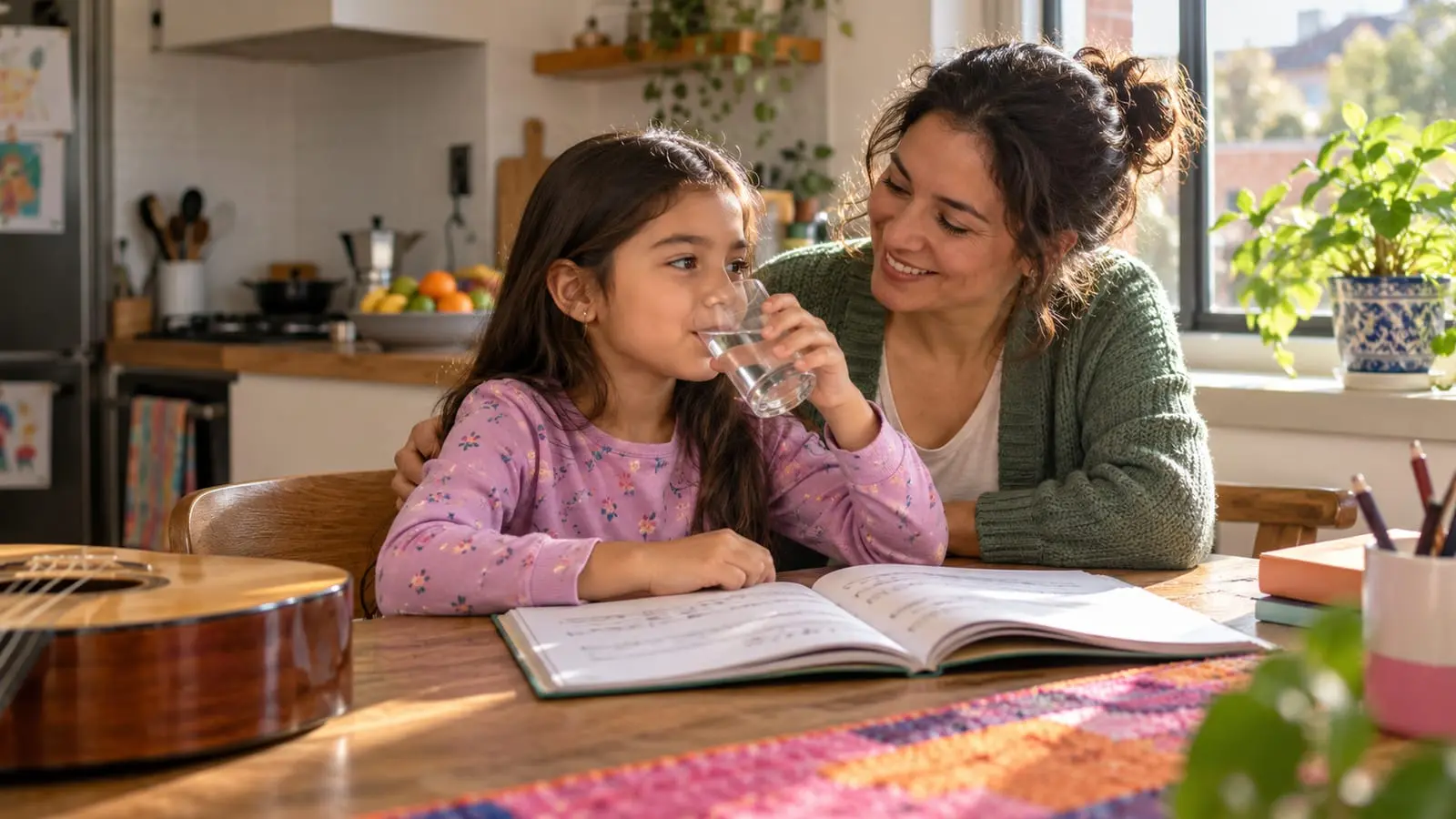
There are three keys to caring for a child's singing voice: singing in a range that's comfortable for their age, without shouting or copying adult singers' power; choosing songs in a suitable key; and resting their voice when they're hoarse or tired. A good singing teacher teaches all of this through play.
This guide is for parents of children who sing all day, belong to the school choir, or want to start lessons. It doesn't replace a doctor's advice: if anything about your child's voice worries you, speak to their pediatrician.
In short
- A child's voice is lighter and higher than an adult's; you shouldn't expect the power of an adult singer.
- A tense neck, red face, raised chin, or hoarseness after singing are signs of strain.
- Almost any song can be transposed to a comfortable key: a teacher can do it in minutes.
- Singing in a choir teaches listening, singing in tune with others, and singing without shouting.
- During the voice change, children can keep singing gently, within a comfortable range, and with patience.
A child's voice isn't a miniature adult voice
Children's vocal folds are smaller than adults', and their voices are naturally higher and lighter. That's a characteristic, not a limitation. Problems arise when a child tries to sound like the adult singer they hear on the radio: louder, lower, or with more “edge” than their voice can produce comfortably.
A healthy child's voice sounds clear and in tune, with no visible effort. The goal of lessons is to help children sing freely, accurately, and with enjoyment, rather than sound “big,” and to learn habits they can use throughout their lives.
Signs your child is straining their voice
- The veins or muscles in their neck stand out when they sing.
- They turn red or raise their chin to reach high notes.
- They shout instead of singing when the melody rises.
- They finish singing hoarse, clearing their throat, or with a weak voice.
- They complain of throat discomfort or itchiness when singing.
If you notice any of these signs, have your child stop, drink water, and rest their voice. Then tell the teacher so they can review the repertoire, key, and technique.
Suitable repertoire: what to sing and how to adapt it
Repertoire is the most powerful tool for caring for the voice. The idea is to adapt the music your child likes, rather than forbid it.
| Type of song | What to consider | How to adapt it |
|---|---|---|
| Circle-game songs and children's songs | They usually have a comfortable range and short phrases. | Ideal for starting out; add rhythm and movement games. |
| Songs from movies | Some have very high or powerful passages written for adult voices. | Lower the key and sing with a light voice, without copying the “shout” of the original version. |
| Pop and urban music | The range may be comfortable, but the lyrics aren't always age-appropriate. | Check the lyrics and choose suitable songs or versions. |
| Ballads by adult singers | The verses may be too low and the chorus too demanding. | Change the key or save them for later. |
| Colombian music and Christmas carols | Many traditional songs have simple melodies and a moderate range. | Good repertoire for choirs, Christmas novenas, and school events. |
The most helpful trick: transpose the song, meaning change its key to fit comfortably within your child's vocal range. A teacher can do this in minutes, and many karaoke tracks let you raise or lower the key.
What a children's singing lesson is like
Children learn vocal technique through play. A typical lesson includes:
- Breathing games: blowing a feather, making bubbles, or slowly blowing out an imaginary candle.
- Warm-up: gentle sirens, lip trills like an engine, and animal sounds that go up and down.
- Pitch accuracy: repeating short patterns sung by the teacher, starting with two or three notes.
- Posture: feet firmly planted, relaxed shoulders, and an aligned head.
- A song: worked on phrase by phrase, with attention to lyrics, breathing, and expression.
Individual singing lessons often work well from age 7 or 8, when children can follow instructions and practice a little at home. Before then, introductory music lessons and choir offer a more playful way to develop the voice.
Children's choirs: a great place to learn
Choir singing teaches things individual lessons don't always achieve: listening to others, singing in tune together, breathing at the same point as the group, and respecting each voice's turn. You'll find choirs in schools, parishes, cultural centers, and music schools.
A good children's choir director makes sure children use their “singing voice,” rather than their playground voice. If your child comes home hoarse after rehearsals, they may be singing too loudly to hear themselves over everyone else; mention it to the director or their teacher.
Voice changes during adolescence
The voice changes at puberty. In boys, the change is usually more noticeable: the voice becomes lower, cracks and breaks appear, and notes that used to be easy become unstable for a while. Girls' voices change too, sometimes becoming breathier or less stable. The timing and duration vary greatly from person to person.
- Keep singing gently. There's no need to stop singing, but do ease the demands on the voice.
- Sing in the range that's comfortable today, without chasing old high notes or forcing new low ones.
- Adjust keys and repertoire with the teacher as often as needed.
- Be patient and keep a sense of humor about voice cracks: they're part of the process, not a failure.
It's a good time to strengthen other areas: music reading, theory, or an instrument for self-accompaniment.
Habits at home for a healthy voice
- Drink water throughout the day, not just before singing.
- Warm up for a few minutes before singing, even at home.
- Avoid shouting from room to room or over background noise; at games and during recess, cheer without straining your voice.
- Don't spend long periods imitating characters' hoarse or very low voices.
- Keep karaoke volume moderate so you don't have to sing over the music.
- Rest the voice when your child has a cold or is hoarse, instead of “singing to make it go away.”
If your child already sings regularly, how to care for your voice and vocal warm-up exercises offer routines they can adapt with their teacher.
Frequently asked questions
At what age can a child take singing lessons?
Individual singing lessons often work well from age 7 or 8. Before then, children develop their voices through introductory music lessons and choirs, with games and age-appropriate songs.
Is it bad for my child to sing adult songs?
Not necessarily. The risk lies in copying the original singer's power or register. With an adjusted key and a light voice, many adult songs can be sung without problems, as long as you check that the lyrics are appropriate.
Should my child stop singing during the voice change?
In general, there's no need to stop singing, but it should be gentle, in a comfortable range, with adapted repertoire. If there's discomfort or persistent hoarseness, consult their pediatrician.
How do I know if my child has a talent for singing?
Enjoying singing and practicing matter more than initial talent. Pitch accuracy and vocal control can be developed. If your child enjoys singing, it's worth learning with a teacher who cares for their voice.
Sources
We checked the facts in this article against these sources on October 22, 2026.