
Classical or popular singing? Differences and how to choose
Both offer complete vocal techniques and share the same foundations. We compare sound, repertoire and goals to help you choose the path that suits your voice.
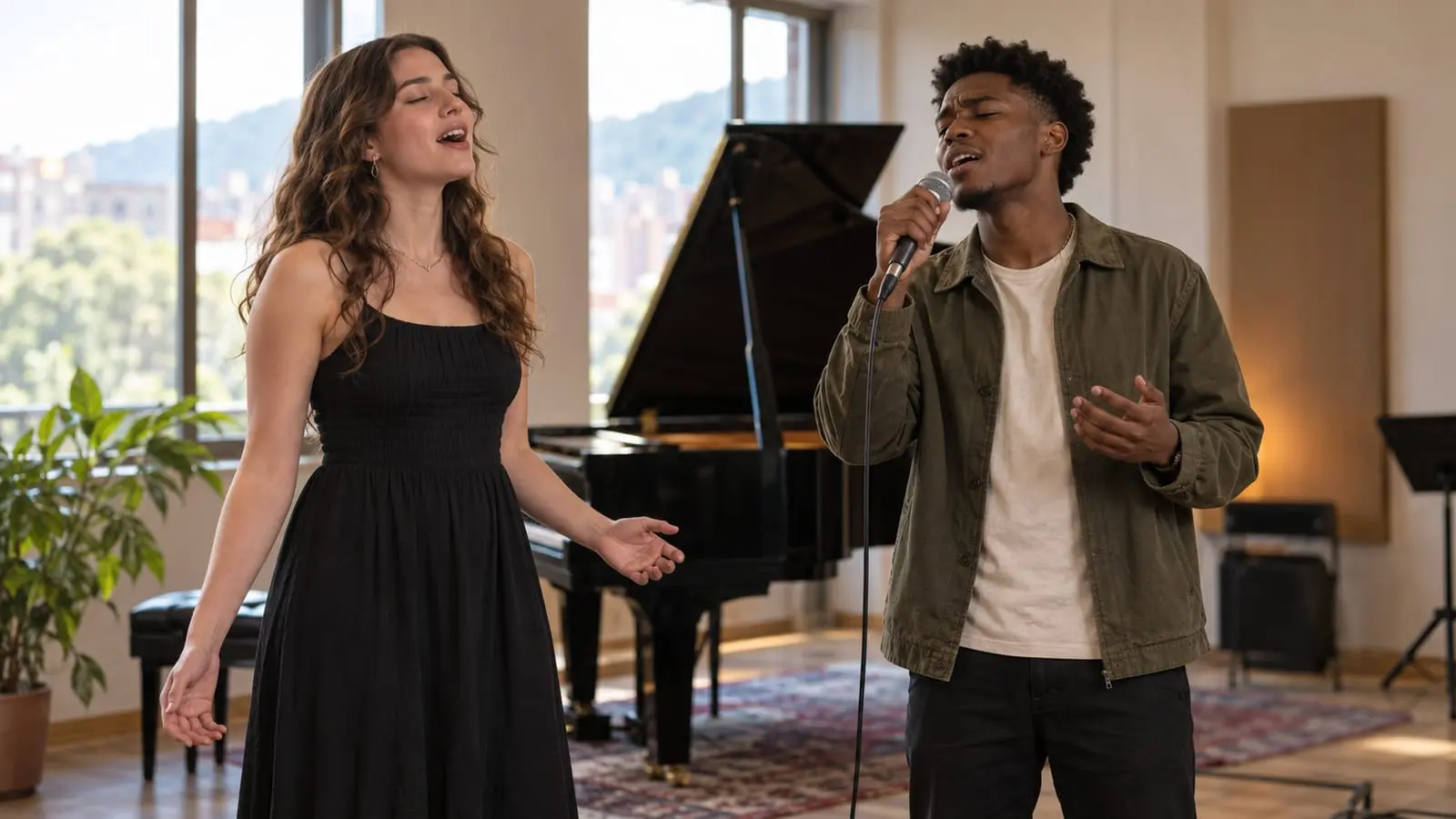
It depends on the music you want to sing and where you picture yourself performing it. If you love opera, zarzuela, lieder, sacred music, and singing over a piano or orchestra without a microphone, choose classical singing. If you want to sing pop, rock, ballads, bolero, salsa, Colombian music, or musical theater, using a microphone and your own style, choose popular singing.
Both involve complete, demanding techniques, and share the same foundation: breathing, posture, pitch accuracy, and singing without tension. That's what you work on first, whichever path you take.
In short
- Classical singing projects without a microphone and aims for an even tone, plenty of space, and consistent vibrato.
- Popular singing relies on a microphone, stays closer to the speaking voice, and develops different vocal colors, such as mixed voice and belting.
- The foundation is shared: breathing, posture, pitch accuracy, free vocal production, and voice care.
- Choose according to your goal: choirs, opera, or a university focus on classical voice; or bands, studio work, events, and musical theater.
- You can switch styles or sing both; what changes is how you use your voice, while vocal health remains essential.
Classical vs. popular: a comparison
| Aspect | Classical singing | Popular singing |
|---|---|---|
| Amplification | Without a microphone: the voice projects over the piano or orchestra. | With a microphone: using it well is part of the technique. |
| Sound | Round, spacious, and resonant; consistent vibrato. | Closer to the speaking voice; vibrato is an expressive tool. |
| Registers | The aim is an even tone from low to high. | Different colors are developed: chest voice, mixed voice, belting, head voice, and breathiness. |
| Study repertoire | Early Italian arias, lieder, art songs, opera, zarzuela, and oratorio. | Pop, rock, ballads, bolero, salsa, vallenato, Andean music, jazz, and musical theater. |
| Languages | Italian, German, French, Latin, and Spanish, with diction study. | Mostly Spanish and English; diction follows the style. |
| Sheet music | Very important: you sing what's written. | Useful, but much is learned by ear. |
| Interpretive freedom | Expressed through phrasing, tone color, and dynamics. | The melody can be adapted, embellished, and improvised on. |
| Voice classification | Clearly defined: soprano, mezzo-soprano, contralto, tenor, baritone, and bass. | Range and tone color matter more than the label. |
| Where you perform | Choirs, opera, sacred music, recitals, and conservatories. | Bands, recording studios, events, social media, and musicals. |
What you learn first in either style
The first lessons are very similar in both styles. A good teacher builds the foundation before asking for a classical sound or powerful belting:
- Breathing and support: inhaling without raising your shoulders and managing airflow as you sing. We work on this in breathing exercises for singing.
- Posture: an aligned body, a relaxed neck, and a loose jaw.
- Pitch accuracy and listening: singing scales, intervals, and simple melodies accurately.
- Singing without tension: letting the sound emerge without squeezing your throat or forcing high notes.
- Registers: getting to know your chest and head voices, and how to connect them.
- Voice care habits: warming up, staying hydrated, and resting your voice.
Some teachers see classical training as the best foundation for any style; others prefer to teach your chosen style from the start. Both approaches work when the technique is healthy and aligned with your goal. If you haven't started yet, read what to expect from your first singing lessons.
Myths worth letting go of
- “Popular singing has no technique.” It does: controlling mixed voice, belting, or a clean melisma takes as much training as singing an aria.
- “Classical singing is only for huge voices.” Projection is built through technique, not just natural volume.
- “Classical training ruins your voice for pop.” It doesn't; it gets your voice used to a particular setup. Changing styles simply calls for readjusting.
- “Belting is shouting and damages your voice.” With proper training, it's a healthy tool; forcing it without technique is what causes harm.
Choose classical if… / choose popular if…
Choose classical singing if…
- You love opera, zarzuela, lieder, or sacred music.
- You sing or want to sing in a choir.
- You want to study music at a university with a focus on classical voice.
- You're drawn to singing in other languages and reading scores accurately.
Choose popular singing if…
- You want to sing the music you listen to: pop, rock, ballads, salsa, bolero, or Colombian music.
- You picture yourself with a band, in a studio, or onstage with a microphone.
- You're interested in musical theater.
- You want to accompany yourself on guitar or piano and develop your own style.
In singing lessons, your teacher listens to your voice, discusses your goal, and builds a plan in either style.
Your goal matters more than your voice
If you plan to study music at university
In Colombia, some programs focus on classical singing and others on popular music or jazz, and each requires a different audition. Check the program's focus before choosing your preparation style; our music university preparation page explains how to prepare for that test.
If you sing for enjoyment
Choose the style of the music that makes you sing in the shower. Motivation keeps you practicing, and you can learn healthy technique in either style.
If it's for a child
With children, the goal isn't a classical sound or adult-style belting. Lessons focus on repertoire suited to their voices, vocal play, and pitch accuracy. Specialization comes after the voice changes, once the instrument matures.
Switching styles or singing both
Many singers move between styles. Breathing, pitch accuracy, listening skills, and discipline carry over. What you adjust depends on which direction you're going:
- From classical to popular: letting go of constant vibrato, bringing the voice closer to speech, developing mixed voice, and learning to use a microphone.
- From popular to classical: creating more resonant space, refining legato, studying languages, and projecting without amplification.
The key is to avoid combining vocal setups without realizing it. With a teacher who knows both styles, alternating between them becomes an advantage.
Frequently asked questions
Which is harder: classical or popular singing?
Neither is easier. Classical singing requires projection without a microphone, languages, and very fine control of legato; popular singing requires mastery of several vocal colors, microphone technique, and the interpretation of each style.
Can you sing both classical and popular music?
Yes, many singers do. It's helpful to build a solid foundation in one before alternating, and to work with a teacher who helps you change vocal setups without tension.
What is belting?
It's a way of singing with a bright, powerful sound in the middle-to-upper range, widely used in pop and musical theater. With proper training, it doesn't involve shouting or damaging your voice.
At what age can you start classical singing?
Children can sing in choirs and learn technical foundations from an early age. Demanding classical repertoire usually waits until the voice matures after adolescence; adults can start at any age.
Sources
We checked the facts in this article against these sources on October 22, 2026.
- Revista Educación (Universidad de Costa Rica): technical differences between popular and classical singing (2025)
- Pontificia Universidad Javeriana: Music Studies (concentrations in Performance and in Jazz and Popular Music)
- NAfME: guide to the male voice change during adolescence
- NIDCD (NIH): caring for your voice