Music therapy activities for children, adults and older adults: examples
Music therapy activities involve listening, singing, playing percussion, improvising or composing, chosen by a music therapist for a specific goal. They vary by age: rhythm and play for children, listening and songwriting for adults, singing and memories for older adults.
In this article
- At a glance
- What are music therapy activities, and how are they classified?
- Which music therapy activities work for children?
- Which music therapy activities are used with adults experiencing stress or anxiety?
- Which music therapy activities help older adults and people with dementia?
- Overview: music therapy activities, who they are for and what you need
- What happens in a group music therapy workshop?
- Can you do music therapy activities at home?
- Where can you find music therapy in Bogotá or online?
- Frequently asked questions
- Sources
- About the author
At a glance
- There are four types of activities: listening, singing or playing existing music, improvising and composing. The goal determines which to use.
- Children: rhythm and turn-taking games. Adults experiencing stress: guided listening and songwriting. Older adults: singing and songs from their youth.
- Making music at home is valuable, but music therapy requires a trained music therapist who sets goals and evaluates progress.
- Cochrane reviews find probable benefits for symptoms of autism, depression and dementia, without claiming cures.
- No musical knowledge is needed: your body, your voice and a few drums or tambourines are enough to get started.
You may be looking for something to do with a child, someone experiencing stress or a grandparent whose memory is fading. The same activity can be a game at home or a therapeutic intervention in a professional's hands.
Here are examples for children, adults and older adults, what each activity targets, how to organize a group workshop and what you can do at home. Music therapy complements medical care and any therapies you already receive; it does not replace them.
What are music therapy activities, and how are they classified?
In music therapy, activities and techniques often mean the same thing: what people do with music during a session. The American Music Therapy Association describes receptive experiences, such as guided listening, and active experiences, such as performing familiar music, writing songs, and improvising.
- Guided listening: listening to a piece of music with a purpose, such as relaxing, recalling memories, or putting an emotion into words.
- Re-creation: singing or playing existing songs, alone or in a group.
- Improvisation: creating music in the moment with the voice, drums, or simple instruments.
- Composition: writing an original song or lyrics with support from the music therapist.
What makes an activity therapeutic is its purpose: there is an agreed goal, someone observes how the person responds, and the plan is adjusted. For the full picture, read what music therapy is.
Which music therapy activities work for children?
For children, almost everything is approached through play. These music therapy exercises are commonly used with children and are always adapted to each child's age and needs:
- Rhythm and turn-taking games: an adult plays a pattern on a drum, and the child repeats it or responds. This addresses attention, turn-taking, and listening.
- Percussion improvisation: playing drums, claves, maracas, and xylophones together. This addresses expression, coordination, and the feeling of being heard.
- Action songs: singing and making the gestures described in the lyrics. This addresses language, memory, and coordination.
- Movement to music: walking, stopping, and changing speed in response to the music, as in freeze dance. This addresses self-regulation and body awareness.
- Sound stories: accompanying a story with instrumental sounds. This addresses attention, vocabulary, and imagination.
- Hello and goodbye songs: a consistent musical routine at the beginning and end. This provides a sense of security and helps with transitions.
For autistic children and children with Down syndrome or ADHD, the music therapist adjusts the volume, tempo, and structure. We discuss this in our guides on autistic children, Down syndrome, and ADHD. For a broader overview, see our guide to music therapy for children.
If you also want your child to learn an instrument, percussion lessons for children and early music classes develop rhythm through play.
Sourced figure
A Cochrane review of 26 studies with 1.165 participants concludes, with moderate certainty, that music therapy probably reduces overall autism symptom severity; effects were measured immediately after the intervention.
Which music therapy activities are used with adults experiencing stress or anxiety?
Adults often seek a space to express what is hard to put into words and to ease tension. Some activities used include:
- Guided listening and relaxation: listening to a calm piece of music while following the breath or doing a body scan. Afterward, participants discuss what came up. This addresses tension and present-moment awareness.
- Choosing and discussing meaningful songs: the person brings songs connected to important moments and talks about them. This addresses identifying and expressing emotions.
- Songwriting: writing lyrics about a situation, a loss, or a wish, and setting them to a simple melody. This addresses emotional processing and a sense of accomplishment.
- Free improvisation: playing without rules using drums, a keyboard, or the voice. This addresses expression without words.
- Singing and breathing: gentle vocal exercises and familiar songs. This addresses breathing, voice, and physical well-being.
For depression, the 2017 Cochrane review included 9 studies with 421 participants. With moderate certainty, music therapy added to usual treatment may reduce depressive symptoms in the short term without additional adverse effects. The authors call for larger studies.
If you want to ease stress by learning music at your own pace, that is a different approach that can also help: see learning music to manage stress.
Which music therapy activities help older adults and people with dementia?
For older adults, the focus is on companionship, mood, and memory. Songs from their youth are often a powerful starting point because they are easy to remember. These are the most common activities:
- Reminiscing with songs from their youth: singing or listening to music from the person's younger years and discussing the memories it brings back. This addresses autobiographical memory and conversation.
- Group singing: familiar songs, with lyrics available if needed. This addresses mood, a sense of belonging, and breathing.
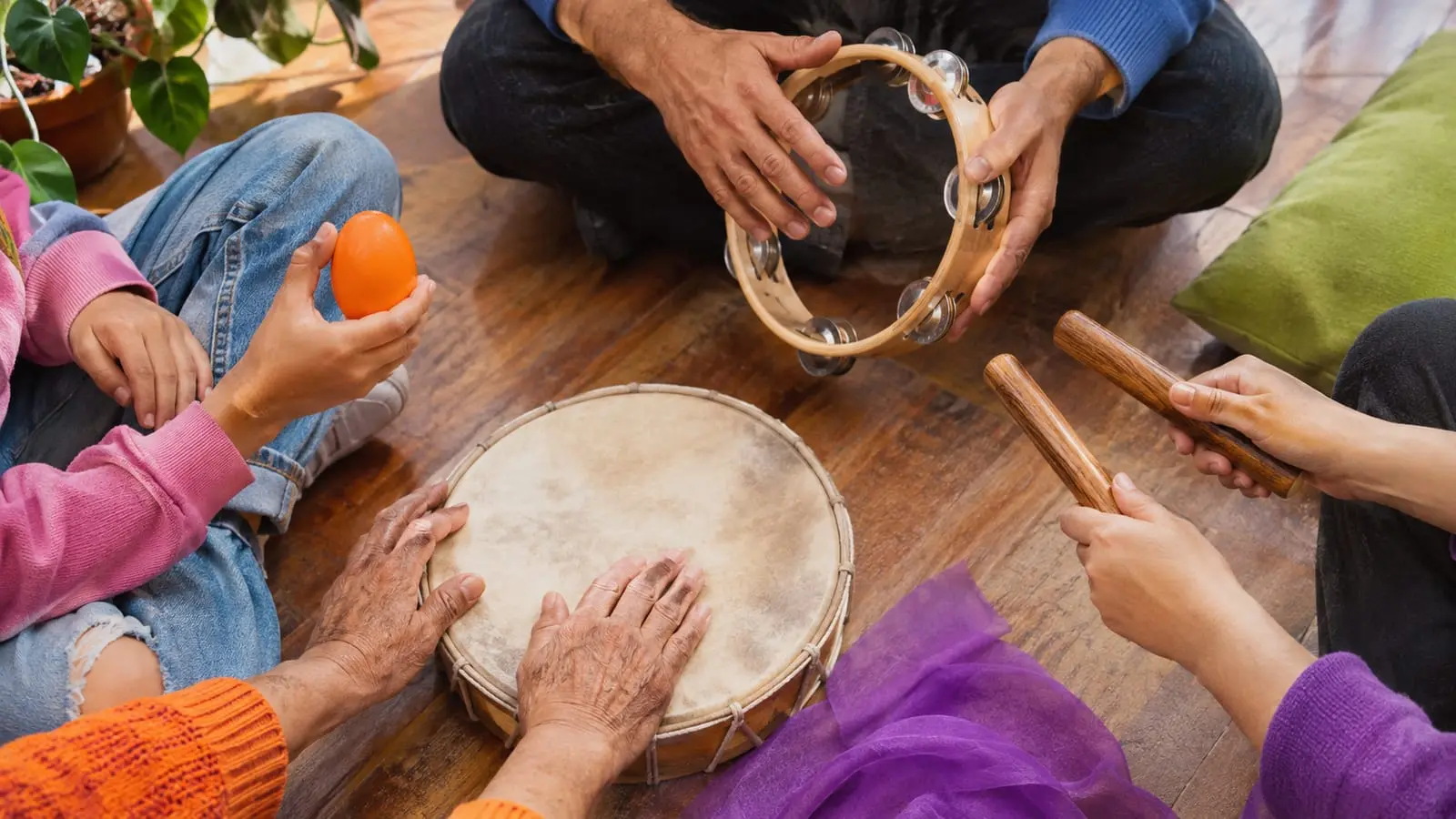
- Simple percussion in a circle: using a tambourine, claves, and maracas to keep the beat of a song. This addresses attention, coordination, and participation.
- Seated movement: moving arms and feet to the beat while sitting in a chair. This addresses gentle mobility and energy.
- Listening and relaxation: quiet music at a low volume during moments of restlessness. This focuses on calm.
Sourced figure
Cochrane's 2025 update includes 30 studies with 1.720 participants: music-based therapy probably improves depressive symptoms in dementia, while no clear effect on agitation or cognition is expected.
For more ideas beyond music therapy, see the benefits of learning an instrument for older adults and our guide to music therapy for older adults.
Overview: music therapy activities, who they are for and what you need
| Activity | Who it is for | Skills it develops | What you need |
|---|---|---|---|
| Rhythm and turn-taking games | Children | Attention, listening, and turn-taking | A drum, claves, or hand claps |
| Action songs | Children | Language, memory, and coordination | Your voice and space to move |
| Movement to music | Children and older adults | Self-regulation and mobility | A sound system and open space or a chair |
| Guided listening and relaxation | Adults and older adults | Tension and present-moment awareness | Calm music and a quiet place |
| Songwriting | Adults and teenagers | Emotional expression | Paper, your voice, and a simple instrument |
| Percussion improvisation | All ages | Expression and coordination | Drums, tambourines, or xylophones |
| Reminiscing with songs from their youth | Older adults | Memory and conversation | A playlist of songs from their younger years |
| Group singing | Adults and older adults | Mood and a sense of belonging | Familiar songs and lyrics |
What happens in a group music therapy workshop?
A music therapy workshop is a series of group sessions with a shared goal and a recurring structure. Workshops are used in schools, care homes and centers for older adults, rehabilitation centers, and workplace teams. A music therapy workshop for adults, for example, may focus on stress management.
A typical structure for a 60-minute group session:
- Sung welcome: a hello song that names each participant.
- Warm-up: group movement or rhythm to get started.
- Main activity: improvisation, singing, or songwriting based on the group's goal.
- Calm closing: listening or relaxation, followed by time to discuss the experience.
Small groups allow everyone to participate. The workshop is planned in advance: the music therapist determines who will take part, what the goal is, and how to assess whether it worked.
Can you do music therapy activities at home?
You can sing with your children, play your grandmother's favorite songs, or improvise on drums in the living room. These are good ideas, and there is nothing wrong with them. Still, it helps to be clear about what each involves.
If you are unsure which option fits, reading music therapy or music lessons can help. And if you want a child or an adult to learn to play or sing, that happens in a music lesson, not a therapy session.
What you can do at home
- Sing songs the person enjoys, without expecting them to sing in tune.
- Play rhythm imitation games with hand claps or a pot and spoon, and practice keeping the beat with the metronome.
- Create a playlist for specific moments, such as relaxing before bed.
- Let the person choose the music, even if it is not what you would choose.
Where can you find music therapy in Bogotá or online?
At Gissi, we offer music therapy in 60-minute sessions, usually held weekly, led by music therapists with master's or doctoral degrees. Sessions take place in your home in Bogotá or by video call. The first session is an initial assessment, and goals are agreed on with the family and reviewed through ongoing progress monitoring. No musical knowledge is needed.
We also work with institutions, including care homes and centers for older adults, schools, and rehabilitation centers. To receive a proposal, contact us on WhatsApp.
Frequently asked questions
What is music therapy used for?
It uses music to address goals such as emotional expression, attention, communication, mood or mobility, depending on the person. Cochrane reviews find probable benefits for autism, depression and dementia symptoms, always alongside treatment and never as a cure.
How does a music therapy session work?
It starts with an initial assessment. The music therapist then suggests activities such as singing, playing percussion or guided listening, observes the person's response and adjusts the plan. Goals are agreed on beforehand and reviewed over time.
What activities are used in music therapy?
Guided listening, singing familiar songs, improvising with simple instruments, and songwriting. The music therapist selects and adapts each activity to the person's goals and age.
What music therapy exercises are useful for children?
Rhythm and turn-taking games, action songs, movement to music, and percussion improvisation. They can support attention, language, and coordination, and are adapted to each child. For children with diagnoses such as autism or ADHD, guidance from a music therapist is advisable.
What are good music therapy activities for older adults?
Singing songs from their youth, playing simple percussion in a circle, moving to the beat while seated, and listening to calm music. Reviews suggest probable benefits for depression and behavioral problems in dementia, but these activities are not a cure.
Can I do music therapy at home on my own?
You can do musical activities at home, and they are often good for mood and companionship. But that is not music therapy: music therapy requires a trained music therapist who assesses the person, sets goals, and evaluates progress.
What is a music therapy workshop for adults like?
It usually brings together a small group with a shared goal, such as managing stress. It combines singing, rhythm, guided listening, and sometimes songwriting, with time at the end to discuss the experience.
Do I need musical knowledge to participate?
No. Activities are adapted to each person and can use the voice, the body, and simple instruments.
Sources
We checked the facts in this article against these sources on November 8, 2026.
About the editorial team
Author
Bachelor of Music Education, Universidad Pedagógica Nacional · Music teacher with 6+ years teaching children, teens and adults
Gisselle Torres holds a degree in Music Education from the Universidad Pedagógica Nacional. She is a flutist and has taught music for more than 6 years. She teaches children, teens and adults at home and online, and writes these guides from what works in her lessons.
See Gisselle's profile and lessons
Fact check
We check every figure and fact in each guide against published sources and update it when they change. Last review: November 8, 2026.