Music Therapy for Children: Benefits, Sessions, and Starting Age
Music therapy for children uses music professionally, with a trained music therapist, to address goals such as communication, emotional regulation, or attention. It can start in infancy, adapts to each age, and complements rather than replaces medical care.
In this article
- At a glance
- What is children's music therapy?
- At what age can music therapy start? Stages from 0 to 18 years
- What can music therapy help children with? Situations where it may offer support
- What does a music therapy session with a child involve?
- What is your role, and how is progress measured?
- Benefits of music therapy for children: what the evidence says
- How do you choose a music therapist, and where can sessions take place?
- Music therapy or music lessons? Signs it may be a good fit
- Music therapy for children at Gissi
- Frequently asked questions
- Sources
- About the author
At a glance
- Each session has defined goals for the child and is led by a trained music therapist. It isn't a music lesson or a cure.
- It adapts to each age: songs and lullabies for babies, rhythm games for preschoolers, and songwriting for teens.
- It is used with autism, Down syndrome, ADHD, language delays, cerebral palsy, anxiety, and hospitalized children. The strongest evidence is for autism.
- Your participation matters: you provide context, join in when the music therapist asks, and repeat what helps at home.
- No musical experience is needed. Ask about the session leader's training in music therapy.
If your child communicates very little, gets overwhelmed easily, or already receives therapy and you want a different setting, it's natural to wonder whether music therapy could help. It isn't an instrument lesson or background music: each session is planned, observed, and reviewed with the family.
This guide explains how it may help at different ages, what sessions involve, what you do, and what scientific reviews show. At the end, you'll find out how we offer music therapy at Gissi.
What is children's music therapy?
The American Music Therapy Association defines it as the clinical, evidence-based use of music interventions to achieve individualized goals within a therapeutic relationship, delivered by a credentialed professional who has completed an approved program. With children, that means playing, singing, making music, and moving with a purpose that the music therapist defines together with you.
For children, music is a natural language. It allows them to communicate without words, take turns, imitate, regulate their bodies through rhythm, and express emotions they cannot yet name. That is why it is used across so many ages and situations. For an overview covering all ages, see what is music therapy.
At what age can music therapy start? Stages from 0 to 18 years
Activities vary considerably with age. These are the most common stages:
- Babies and toddlers (0 to 3 years): music therapy for babies draws on the voice, lullabies, songs with gestures, and rocking. It focuses on connection with a caregiver, calm, and shared attention, almost always with the family present. For a group option with a parent, see the early childhood family music program.
- Preschool (3 to 6 years): action songs, rhythm games, simple percussion instruments, and musical routines. Sessions focus on turn-taking, vocabulary, imitation, and self-regulation.
- School age (6 to 12 years): sessions become more structured. Children improvise with a partner, learn songs to practice social or attention skills, and begin talking about what music brings up for them.
- Teenagers: the focus is usually self-expression. Activities include writing lyrics, composing, choosing and discussing the songs they listen to, and practicing ways to manage stress.
Ages are a guide, not a rule. An eight-year-old may need the rhythm and repetition used with a preschooler, and that is fine. The music therapist adapts the session to where the child is developmentally.
What can music therapy help children with? Situations where it may offer support
The fact that it can offer support does not mean it guarantees a result. This table summarizes common areas of focus and what we know from the sources we reviewed:
| Situation | What music therapy can address | What the evidence says |
|---|---|---|
| Autism (ASD) | Communication, interaction, sensory and emotional regulation, shared play | The 2022 Cochrane review finds that it probably reduces overall symptom severity and improves quality of life, with moderate-certainty evidence. Results for social interaction and communication are unclear. |
| Down syndrome | Language, coordination, attention, emotional expression | We do not cite reviews specific to this condition. It is used to complement the child's therapy plan. |
| ADHD | Sustained attention, self-regulation, following instructions through rhythms and games with rules | We do not cite reviews specific to this condition. It is worth discussing with the healthcare team as a complementary option. |
| Language delays | Turn-taking, articulation, vocabulary through songs and rhythm | We do not cite reviews specific to this condition. It complements speech-language therapy; it does not replace it. |
| Cerebral palsy and motor difficulties | Coordination, breathing, and movement supported by a beat | We do not cite reviews specific to these conditions. Sessions are coordinated with the rehabilitation team. |
| Anxiety and emotional regulation | Calm, emotional expression, stress management | We do not cite reviews specific to these concerns. It offers support, rather than serving as a standalone clinical treatment. |
| Premature babies and hospitalization | Calm and physiological stability through the voice and gentle music, support for the child and family | For premature babies, the 2023 Cochrane review finds that it probably reduces heart rate and found no harm. It does not show developmental improvements at two years of age, with low-certainty evidence. |
If your child has a specific diagnosis, these guides explore it further without repeating the same information: music lessons for children with autism, Down syndrome, and music and ADHD.
What does a music therapy session with a child involve?
The process is usually similar across most services:
- Initial assessment. The music therapist talks with you, reviews reports from the school or other therapists, and observes how your child responds to music, instruments, and the voice.
- Goals. You agree on a small number of goals, such as making a request with a gesture, waiting for a turn, or calming down after frustration. These are written down so they can be reviewed.
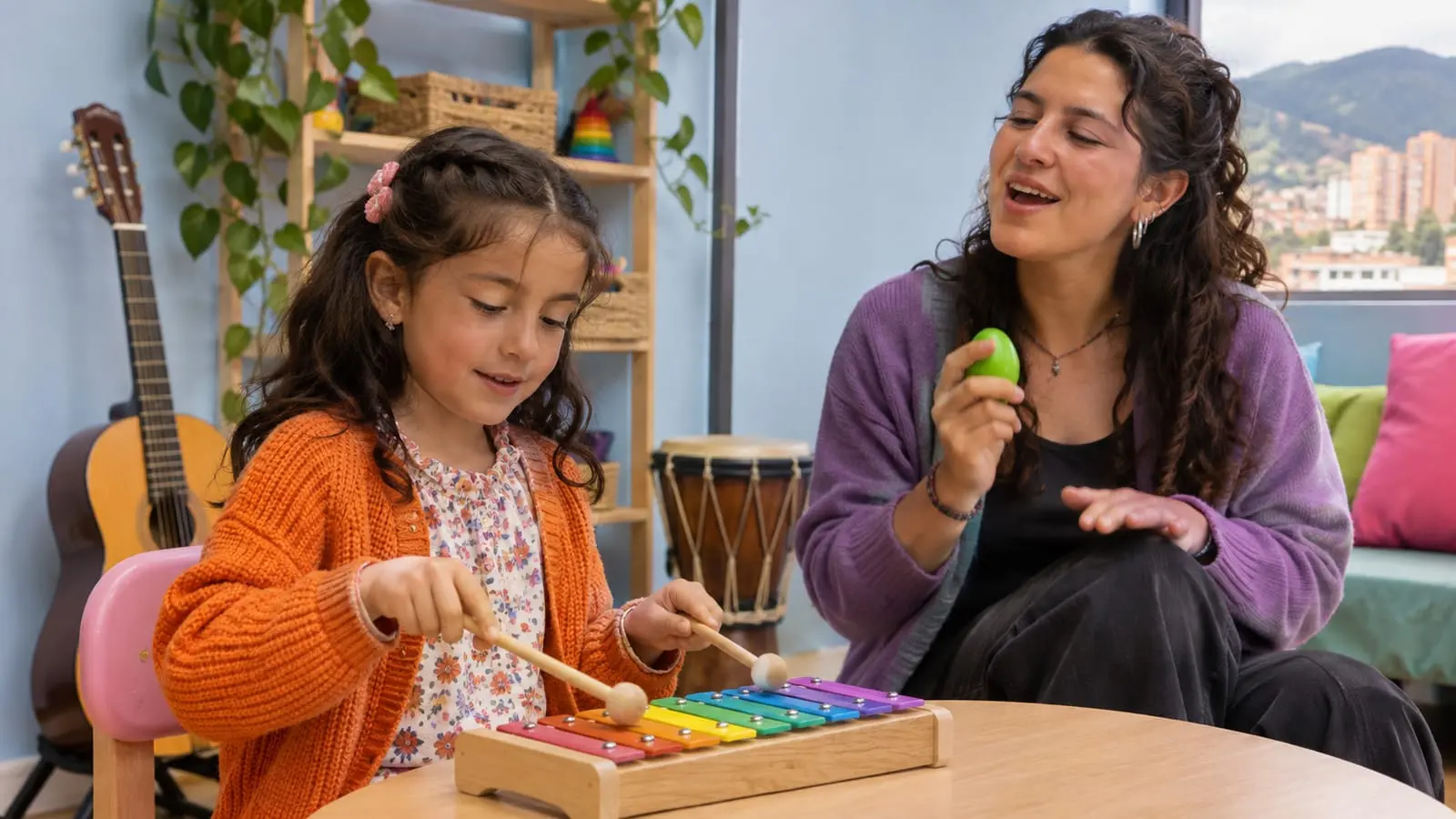
- Sessions. These combine songs, drums and other simple instruments, improvisation with a partner, movement, and time for listening. The child leads as much as the adult: if a sound catches their interest, the music therapist follows that interest and turns it into a purposeful activity.
- Follow-up. Observations from each session are recorded, and the therapist reviews with you whether the goals are still appropriate.
Children may move around the room, play standing up, or switch activities. That is not misbehavior: it is part of the process. For ideas for games and activities you can try yourself, see music therapy activities.
What is your role, and how is progress measured?
You are not just an observer. With young children, it is common for you to participate in the session. With older children, the music therapist may ask you to join at the end or talk afterward. In every case, you can:
- Describe how your child is doing at home and at school: sleep, mood, and recent changes.
- Share which songs and sounds your child enjoys or finds uncomfortable.
- Repeat a song or routine at home that the music therapist suggests.
- Let the therapist know about changes in medication, therapies, or school.
Progress is measured by comparing observations from each session with the initial goals: more eye contact, more turns taken, less time needed to calm down, or more words or gestures. A good music therapist shows you concrete examples and adjusts the plan when something is not working.
Benefits of music therapy for children: what the evidence says
We're discussing likely benefits, with limitations. These are the findings we read directly in primary sources.
Autism
Sourced figure
The Cochrane review concludes that music therapy probably produces a substantial reduction in overall autism symptom severity, with moderate certainty.
The review included children, adolescents, and young adults. It also probably brings a small to moderate improvement in quality of life. No clear difference was found in social interaction or communication, with low or very low certainty.
Few studies measured adverse effects, and the review indicates that music therapy probably does not increase them. Long-term effects remain unknown.
Premature babies
Sourced figure
The 2023 Cochrane review found that music and voice probably reduce heart rate in premature babies.
No harms were reported, although few studies explicitly looked for them. There were no clear improvements in development at age two or in parents' postpartum anxiety or depression, with low certainty.
How do you choose a music therapist, and where can sessions take place?
The title music therapist does not always imply specific training. Before starting, ask:
- Where they studied music therapy and what degree they hold.
- Which ages and conditions they have worked with.
- How they define and record goals, and how they keep you informed.
- How they coordinate with the school, doctor, or other therapists.
- What they do not promise: a responsible professional does not talk about cures.
There are three common options for where sessions take place. At home, your child is in a familiar environment, and you can see the work up close. Video calls work well for children who can stay focused on a screen, with an adult nearby to help, and are a good option if you live far away. At school or a rehabilitation center, sessions fit into your child's routine and the work of the team already supporting them.
Music therapy or music lessons? Signs it may be a good fit
It may be worth asking about music therapy if your child pays close attention to sounds and songs, finds rhythm calming, has difficulty communicating or regulating emotions, or already attends therapies and you are looking for a different space for self-expression. You do not need a specific sign: a conversation with the music therapist can clarify whether it makes sense.
In a music lesson, the goal is to learn to play or sing. In music therapy, the goal is therapeutic, and music is the means. The two can go together, and many children do both. If you are unsure, read music therapy or music lessons and explore early music learning for younger children.
Music therapy for children at Gissi
At Gissi, we offer music therapy in 60-minute sessions, usually weekly, led by music therapists with master's or doctoral degrees. Sessions take place in your home in Bogotá or by video call. The first session is the initial assessment. Based on that assessment, we agree on goals with you and track progress. No musical knowledge is needed.
We also work with schools and rehabilitation centers. If you are interested in sessions for an institution, message us on WhatsApp and we will put together a proposal.
Frequently asked questions
Does music therapy help children with autism?
The 2022 Cochrane review finds that it probably reduces overall symptom severity and improves quality of life, with moderate-certainty evidence. Effects on social interaction and communication are unclear, and long-term data are lacking. For more detail, see our guide to music lessons and autism.
Does it help children with ADHD or hyperactivity?
Rhythms, games with rules, and routines are used to work on attention and self-regulation. This guide does not cite systematic reviews on ADHD, so it is worth viewing music therapy as a possible complementary option and discussing it with the healthcare team.
Does my child need to know music?
No. No one evaluates how well they play or whether they sing in tune. Sessions use simple instruments, the voice, movement, or simply listening.
Can music therapy take place by video call?
Yes, and it works best with an adult nearby to support the child and a large screen. Some children benefit more from in-person sessions. The music therapist can help you decide what is appropriate for your situation.
What does a music therapist do with a child?
They conduct an initial assessment, agree on a few goals with you, and plan sessions using songs, simple instruments, improvisation, and movement. They record observations each session and review progress with you to adjust the plan.
Can a baby have music therapy?
Yes. With babies, therapists use voice, lullabies, songs with gestures, and rocking, usually with family present, to support connection, calm, and shared attention.
How long does it take to notice progress?
It depends on each child and their goals, and none of the sources supports promising a timeline. Progress is usually reviewed with the music therapist at regular intervals, and the plan is adjusted.
Sources
We checked the facts in this article against these sources on November 8, 2026.
About the editorial team

Author
Bachelor of Music Education, Universidad Pedagógica Nacional · Music teacher with 6+ years teaching children, teens and adults
Gisselle Torres holds a degree in Music Education from the Universidad Pedagógica Nacional. She is a flutist and has taught music for more than 6 years. She teaches children, teens and adults at home and online, and writes these guides from what works in her lessons.
See Gisselle's profile and lessons
Fact check
We check every figure and fact in each guide against published sources and update it when they change. Last review: November 8, 2026.