Music Therapy or Music Lessons: Differences and How to Choose What You Need
Music lessons teach playing or singing and are led by a music teacher. Music therapy uses music to address a therapeutic goal and is led by a trained music therapist. Choose based on your goal: learning music or working on well-being, communication or emotions.
In this article
- At a glance
- Who is each one for?
- Music therapy vs. music lessons: a comparison table
- Who leads each one, and what are the goals?
- What does each type of session look like?
- What does research say about music therapy?
- Three common misconceptions
- How do you choose between music therapy and music lessons?
- Music therapy and music lessons at Gissi
- Frequently asked questions
- Sources
- About the author
At a glance
- Music lessons: the goal is learning an instrument or singing, and progress is measured through repertoire, technique and reading.
- Music therapy: the goal is therapeutic (communication, emotional regulation, well-being), led by a music therapist with specialized training.
- You don't need musical knowledge or a diagnosis to start either one.
- They can coexist: many families start with one and add the other later.
- Neither replaces medical treatment or existing therapies.
Many families ask the same question: my child (or I) needs music, but should we choose lessons or therapy? Both use music and look similar on the surface, but answer different questions: what do I want to learn, and what do I need to work on?
This guide compares both with a table, session examples and three questions to help you decide. Neither guarantees an outcome. At Gissi, we offer them separately: music lessons and music therapy.
Who is each one for?
Music lessons
For anyone who wants to learn: a child asking to play piano, an adult who has always wanted to sing or an older adult seeking a meaningful hobby. You don't need a diagnosis or special reason. For a starting point, explore early music education classes, piano lessons or singing lessons.
Music therapy
For someone who may benefit from a therapeutic process guided by music: a person with autism, Down syndrome or ADHD, someone with language difficulties, an older adult with dementia or someone experiencing stress, anxiety or rehabilitation. Supporting that process doesn't mean resolving it. For more detail, read what music therapy is.
Music therapy vs. music lessons: a comparison table
| Aspect | Music lessons | Music therapy |
|---|---|---|
| Goal | Learn to play an instrument or sing | Work toward therapeutic goals using music as a tool |
| Who leads it | A music teacher | A music therapist with specialized training |
| Starting point | Your skill level and what you want to play or sing | An assessment of the person's needs and strengths |
| How progress is measured | Repertoire, technique, and music reading | Agreed-upon goals and observations recorded during each session |
| What a session involves | Exercises, repertoire, and practice between lessons | Singing, playing, improvising, or listening, adapted to the person |
| Musical knowledge required | No, you can start from scratch | No |
| Relationship with the healthcare team | Not applicable | Coordination with doctors and therapists is recommended |
The table is a simplification. In practice, a good music teacher also cares about a student's emotional well-being, and a music therapist also works with sound and rhythm.
Who leads each one, and what are the goals?
In a lesson, the teacher asks what you want to play and puts together a plan: exercises, repertoire, music reading, and practice at home. Progress is musical: a new song, a scale, or more accurate pitch.
In music therapy, the music therapist starts with an assessment and sets a few goals with the person or family, such as improving communication, emotional regulation or attention. Music is the tool; its effect matters more than the performance.
The American Music Therapy Association describes it as the clinical use of music interventions to achieve individual goals within a therapeutic relationship, delivered by a credentialed professional.
What does each type of session look like?
A music lesson
An individual piano or singing lesson, at home in Bogotá or live online, usually includes a warm-up, work on a piece, reading or technique, and a brief assignment for the week. Learn how home music lessons in Bogotá work.
A music therapy session
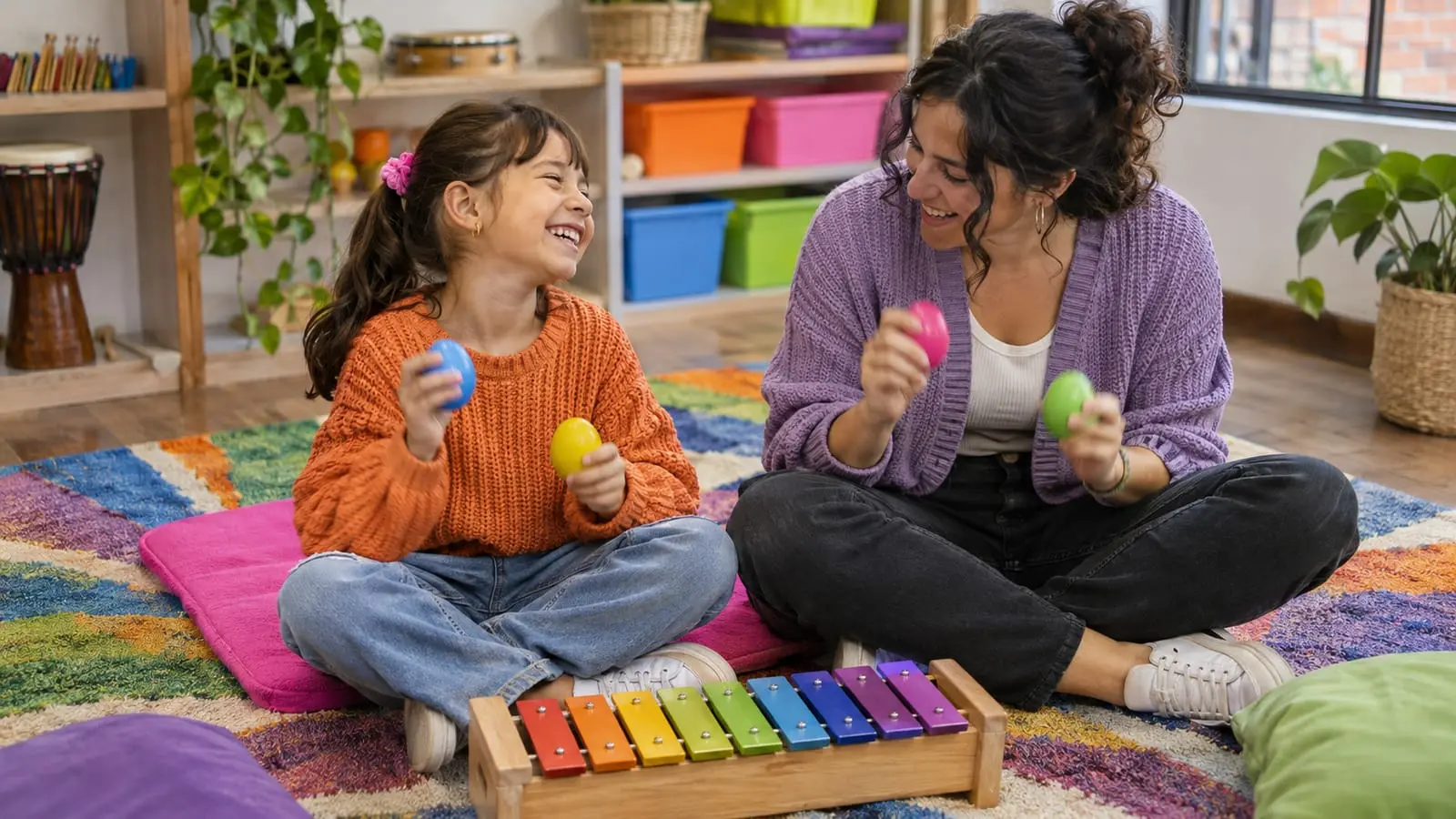
It may include singing a song with movements, two people playing drums or a xylophone, improvising a musical conversation, or listening to a piece and discussing what it brings up. It is adapted to the person, and observations are recorded.
What does research say about music therapy?
Cochrane reviews of music therapy find probable benefits in some cases, always with limitations.
Sourced figure
Cochrane's review of music therapy for autism concludes that it probably reduces overall symptom severity, with moderate certainty.
- Autism: the effect on social interaction is unclear.
- Dementia in institutional care: a review of 22 trials found that it probably reduces depressive symptoms but probably doesn't change cognition.
- Depression: added to usual treatment, it may be more effective than treatment alone, especially in the short term.
These results refer to sessions led by trained professionals. No equivalent review demonstrates the same effects for music lessons, which serve a different purpose. Learning music can be valuable in its own right, without presenting it as treatment.
Three common misconceptions
- Assuming an adapted lesson is music therapy. A teacher can adjust the pace, instructions, and sensory input, and that helps. But they do not conduct a therapeutic assessment or set therapeutic goals and should not present the lesson that way.
- Expecting music therapy to teach instrumental skills. The person may end up playing a drum or singing a song, but learning an instrument is not the purpose of the session.
- Choosing based on the diagnosis instead of the goal. Two children with the same diagnosis may need different things. Start with what you want to achieve and what the person enjoys, and consult the people supporting them.
How do you choose between music therapy and music lessons?
Ask yourself three questions:
- What do I want to achieve? If the answer involves playing, singing, or reading music, start with lessons. If it involves communicating better, regulating emotions, or finding a guided space for calm, consider music therapy.
- Is there a diagnosis or a healthcare team? If so, consult the team. If not, you don't need a diagnosis to study music.
- What does the person enjoy? Motivation matters in both. If they like the piano, a lesson may be the best place to start; if they need another type of support, music therapy may be a better fit.
If you have a child with autism or ADHD and don't know where to start, these guides can help: music lessons for children with autism and music and ADHD. Both explain how to adapt lessons without presenting them as therapy. For younger children, the music therapy for children guide describes a session in detail.
Music therapy and music lessons at Gissi
Music lessons are taught by teachers selected by Gissi, at home in Bogotá or live online. Music therapy is led by a music therapist, also at home in Bogotá or online. If you're unsure which option suits you, tell us about your situation and we'll help you decide. Start by exploring our music lessons to learn about the format.
Frequently asked questions
Can music lessons serve as therapy?
Learning music can be valuable and lift your mood, but a lesson isn't therapy. It has no clinical assessment, therapeutic goals or clinical records. If you want to work on communication, emotional regulation or well-being, consult a music therapist.
Can a music teacher provide music therapy?
A music teacher can adapt lessons, but that isn't music therapy. Music therapy requires specialized training in the field, an initial assessment and documented therapeutic goals.
Should my child with autism or ADHD have music therapy or music lessons?
It depends on your goals. Lessons help you learn music at an adapted pace. Music therapy is appropriate for working on therapeutic goals. Consult your child's healthcare team; both can coexist.
Can music therapy take place online?
Yes. At Gissi, sessions led by a music therapist can take place at home in Bogotá or online by video call.
Do I need any musical knowledge to start either option?
No. Music lessons can start from scratch, and music therapy requires no musical knowledge.
Can I take music lessons and music therapy at the same time?
Yes. Their different goals complement each other: music therapy addresses therapeutic goals, while lessons develop a musical skill. Each professional should know that the person is doing both.
How can I tell if someone is really a music therapist?
Ask where they studied music therapy, whom they've worked with, how they define and record goals, and how they coordinate with the healthcare team. A responsible professional doesn't promise cures.
Sources
We checked the facts in this article against these sources on November 8, 2026.
- American Music Therapy Association: what music therapy is
- Cochrane: music therapy for autistic people (plain-language summary)
- Cochrane: music-based interventions for people with dementia (van der Steen et al., 2018)
- Cochrane: music therapy for depression (Aalbers et al., 2017), discussed in BJPsych Advances
About the editorial team
Author
Bachelor of Music Education, Universidad Pedagógica Nacional · Music teacher with 6+ years teaching children, teens and adults
Gisselle Torres holds a degree in Music Education from the Universidad Pedagógica Nacional. She is a flutist and has taught music for more than 6 years. She teaches children, teens and adults at home and online, and writes these guides from what works in her lessons.
See Gisselle's profile and lessons
Fact check
We check every figure and fact in each guide against published sources and update it when they change. Last review: November 8, 2026.