Music Therapy for Older Adults: Benefits, Alzheimer's, and Getting Started
Music therapy for older adults uses music professionally, with a trained music therapist, to address goals such as mood, communication, or movement. It complements medical care rather than replacing it, and does not cure or stop dementia or Alzheimer's.
In this article
- At a glance
- What is music therapy for older adults?
- What are the benefits of music therapy for older adults?
- Does music therapy help with Alzheimer's and dementia?
- Goals, music therapy activities, and evidence at a glance
- What does a music therapy session for older adults involve?
- Music therapy at home or in a group?
- An activity for home: a personalized playlist
- Music therapy in care homes and adult day centers
- How do you choose a music therapist?
- Music therapy for older adults at Gissi
- Frequently asked questions
- Sources
- About the author
At a glance
- Music therapy for older adults uses songs, singing, gentle percussion, listening, and movement with defined goals. No musical knowledge is needed.
- For dementia, Cochrane's 2025 update indicates that it probably slightly improves depressive symptoms, although it shows no clear benefit for agitation or cognition.
- Sessions can be one-on-one at home or in a group at a care home or adult day center. The choice depends on the person and their goals.
- A playlist of songs from their youth is a good activity at home, but it is not music therapy.
- Ask about specific training in music therapy, how the initial assessment works, and how progress is measured.
If you're looking into this for your mom, your dad, or yourself, you're probably wondering whether it really helps or just means playing pleasant music. The difference is the purpose: sessions are planned, observed, and adjusted. They aren't background music or instrument lessons.
Here you'll learn what it may help with, what the evidence says about dementia and Alzheimer's and its limitations, what a session involves, and how to choose a provider. Music therapy complements medical care; it doesn't replace it.
What is music therapy for older adults?
The American Music Therapy Association describes it as the clinical, evidence-based use of music interventions to achieve individual goals within a therapeutic relationship with a trained professional. Techniques include listening to selected or created music, singing, playing instruments, songwriting, and moving to music.
With older adults, what sets it apart from simply "playing music for them" is its purpose. The music therapist chooses what to offer, observes how the person responds, and adjusts the session. For an overview of the field, read what is music therapy.
What are the benefits of music therapy for older adults?
These are the most common goals. None is a guarantee: everyone responds differently, and goals are agreed upon after getting to know the person.
- Memory and reminiscence: songs from a person's youth often bring back memories, names, and conversations.
- Mood and depression: singing or listening together can offer space for expression and companionship.
- Anxiety and restlessness in dementia: a predictable musical routine may help some people feel calmer.
- Communication: someone who rarely speaks sometimes sings an entire set of lyrics, opening a channel of communication with family.
- Loneliness and social connection: group sessions give people a reason to spend time with others.
- Movement and walking: rhythm is used to guide walking or coordinate movements, for example after a stroke or with Parkinson's, always in collaboration with the rehabilitation team.
- Palliative care: it can support patients and their families through meaningful songs and moments of calm.
Does music therapy help with Alzheimer's and dementia?
Cochrane summarizes health research. Its 2025 update on music-based therapy for people with dementia replaces the 2018 version. Most participants lived in care facilities, and almost all sessions were group sessions.
Sourced figure
That was the number of people living with dementia worldwide in 2021, according to OMS, with nearly 10 million new cases each year: the need is widespread.
Sourced figure
This is the total number of people with dementia randomized in the 30 trials from 15 countries included in Cochrane's 2025 review.
These are the main findings:
- Depression: compared with usual care, it probably slightly reduces depressive symptoms, with moderate certainty.
- Behavior: it may improve overall behavioral problems, with low certainty.
- Social behavior: compared with other activities, it may improve social behavior, with low certainty.
- Agitation and aggression: it probably does not reduce them.
- Cognition and emotional well-being: no clear benefit was found.
- Anxiety: the evidence is too uncertain to draw a conclusion.
The effects were no longer evident weeks after treatment ended, although few studies assessed this follow-up period. No serious adverse events were reported, but reporting was inconsistent. The authors also note that the studies have biases because staff knew who was receiving the therapy.
Goals, music therapy activities, and evidence at a glance
| Goal | Example activity | What the evidence says |
|---|---|---|
| Mood and depression in dementia | Singing familiar songs in a group | Cochrane 2025: probably a small improvement compared with usual care |
| Behavior and getting along with others | Gentle group percussion, taking turns, and simple rhythms | Cochrane 2025: may improve overall behavior and social behavior, with low certainty |
| Agitation | Quiet listening to selected music | Cochrane 2025: probably no clear effect |
| Memory and reminiscence | Starting a conversation with a song from the person's youth | No clear benefit for cognition according to Cochrane 2025; personal and relational value is not measured well in these studies |
| Movement and walking (stroke, Parkinson's) | Walking or moving the arms to a beat | Not reviewed here: discuss it with the rehabilitation team |
What does a music therapy session for older adults involve?
The first step is an initial assessment: the music therapist talks with the person and their family, asks about their history, preferences, and health, and observes how they respond to music. This leads to a small set of agreed goals that are reviewed over time.
After that, a session usually combines several elements:
- A sung greeting, to mark the start and help orient the person.
- Meaningful songs from their youth, sung or listened to, sometimes with a conversation about what they remember.
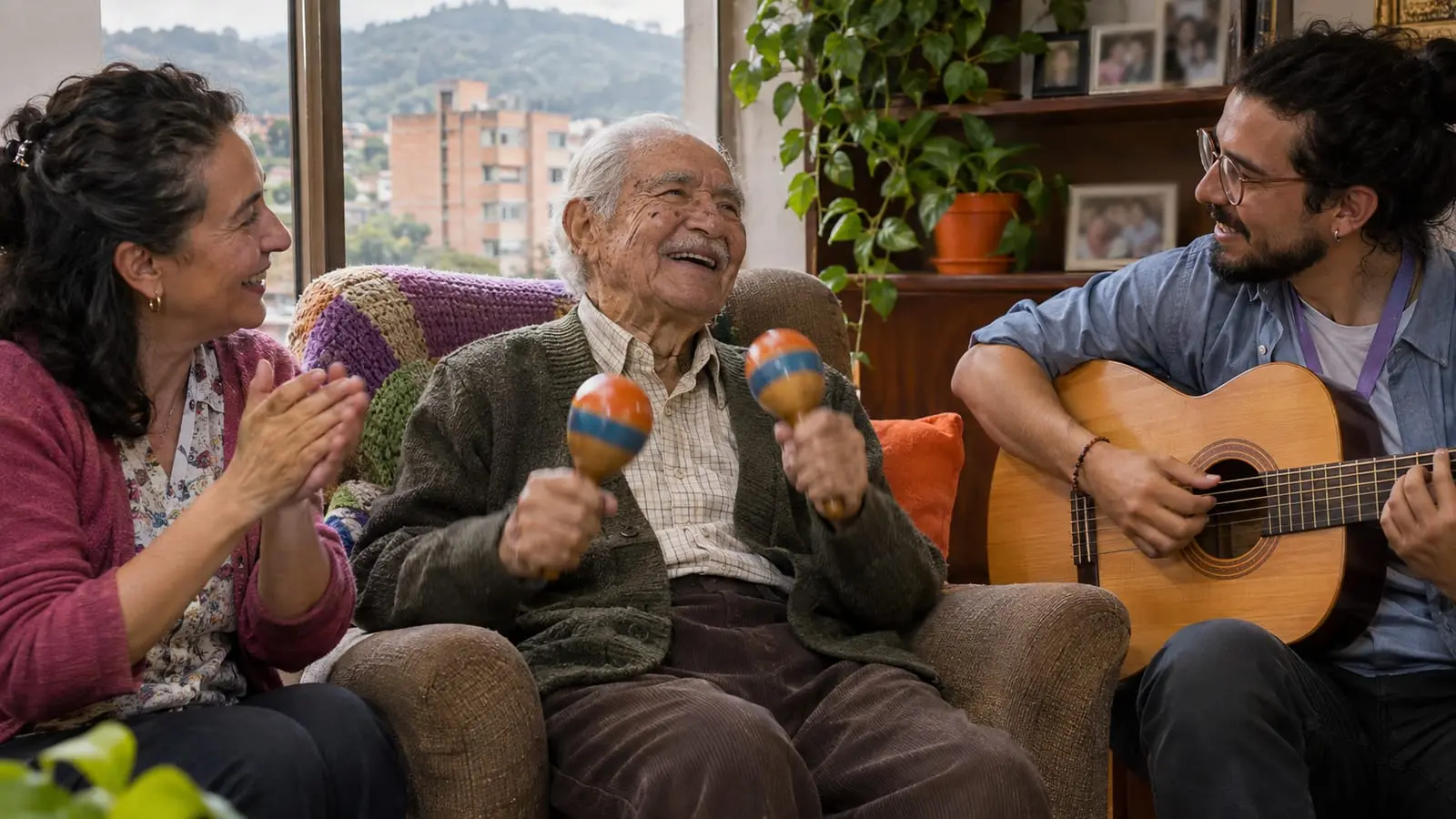
- Gentle percussion: drums, maracas, or claves played to the rhythm of the song.
- Guided listening: a piece chosen for a purpose, followed by discussion or silence.
- Simple movement, seated or standing, depending on what the person can comfortably do.
- A closing moment with a calm song.
The pace is slow, there are breaks, and the person's wish not to participate is respected. Watching, listening, or tapping a finger to the beat counts, too.
Music therapy at home or in a group?
Individual sessions allow everything to be tailored to one person: their repertoire, pace, and level of fatigue. They are often a good choice when someone has a very particular musical history, finds groups difficult, or has specific goals. Group sessions offer companionship, taking turns, shared laughter, and a sense of belonging that is hard to provide in an individual session.
Your role as a family member or caregiver matters. You can share a list of songs your family member enjoyed, tell the music therapist how the week went, and take part in the session if the professional suggests it. Singing with your dad or mom is also a way to spend time with them. If you care for someone with dementia, WHO reminds us that caregivers need support and breaks of their own.
An activity for home: a personalized playlist
This is not music therapy, but it can support the person between sessions or while you decide whether to begin. The idea is to put together a playlist of songs they enjoyed between ages 15 and 30, the ones they danced to or sang with family.
- Ask family and friends what music the person liked. Look through old records or cassettes.
- Choose 10 to 15 songs and play them at a comfortable volume, without other background noise.
- Listen together without rushing. If the person sings, sing along.
- Observe their response. If they seem restless or sad, change the song or stop.
- Use it during quiet moments, rather than as a way to calm a crisis at all costs.
If you notice that a song brings up strong emotions or distress, tell the healthcare team or music therapist. For more ideas, explore these music therapy activities that you could adapt.
Music therapy in care homes and adult day centers
Music therapy workshops for older adults in institutional settings have been studied the most, because groups form naturally there. For residents, they can offer a predictable activity, space to express themselves, and time to connect with others. For staff, they offer a way to get to know each person better through their songs and see what calms or lifts their spirits.
- Group sessions at regular times, with small groups of people with similar abilities.
- A space without background noise, with comfortable chairs arranged in a circle.
- Recorded observations shared with nursing staff, occupational therapists, or the healthcare team.
- Simple ideas for staff to use music between sessions, such as singing during bathing or meals.
If you run a care home or day center, ask how the workshop accommodates residents with and without dementia and how its effectiveness is measured. You can also explore our music programs for older adults.
How do you choose a music therapist?
The term "music therapy" is used very loosely. Before you begin, ask:
- Where they studied music therapy and what degree they hold.
- Whether they have worked with older adults and people with dementia.
- What the initial assessment involves and how goals are agreed upon with the family.
- How they document progress and whom they coordinate with.
- What they do not promise: talk of cures or slowing Alzheimer's is a warning sign.
Neither you nor your family member needs musical experience. If that person would instead like to learn to play or sing for enjoyment, there are voice lessons and piano lessons, and you can read about the benefits of learning an instrument for older adults. The distinction is explained in music therapy or music lessons.
Music therapy for older adults at Gissi
At Gissi, music therapy is led by music therapists with master's or doctoral degrees. Sessions last 60 minutes and are usually weekly, at home in Bogotá or by video call. The first session is the initial assessment; after that, goals are agreed upon with the family and progress is monitored.
We also work with care homes and centers for older adults, as well as rehabilitation centers, based on a proposal we develop with you through WhatsApp. No musical knowledge is needed.
Frequently asked questions
What is music therapy for older adults?
It is the professional use of music with a trained music therapist to work toward goals such as mood, communication, movement, or connection with others. It complements medical care and does not replace it.
Does music therapy help with Alzheimer's?
It may support mood and interactions with others for some people. Cochrane's 2025 update indicates that it probably slightly improves depressive symptoms in dementia, but shows no clear benefit for agitation or cognition. It does not cure or stop the disease.
Does my family member need musical knowledge?
No. Activities are adapted: singing familiar songs, keeping the beat on a drum, listening, or moving. No one judges whether they sing in tune.
How long is a session, and how often are sessions held?
It depends on the service and the person. At Gissi, sessions last 60 minutes and are usually weekly. The first is an initial assessment to agree on goals with the family.
Are individual or group sessions better?
It depends. An individual session is tailored to one person and works well when there are specific goals or difficulties with groups. Group sessions offer companionship and shared participation, and are the most common format in care homes and adult day centers.
Can a playlist of their songs replace music therapy?
No. It is a good activity at home for sharing time and memories, but it has no assessment, goals, or professional to observe and adjust it. It can complement sessions.
Can you work with a care home or adult day center?
Yes. At Gissi, we develop a proposal for the institution through WhatsApp, with group sessions or workshops based on residents' and staff needs.
Sources
We checked the facts in this article against these sources on November 8, 2026.
About the editorial team
Author
Bachelor of Music Education, Universidad Pedagógica Nacional · Music teacher with 6+ years teaching children, teens and adults
Gisselle Torres holds a degree in Music Education from the Universidad Pedagógica Nacional. She is a flutist and has taught music for more than 6 years. She teaches children, teens and adults at home and online, and writes these guides from what works in her lessons.
See Gisselle's profile and lessons
Fact check
We check every figure and fact in each guide against published sources and update it when they change. Last review: November 8, 2026.