Music activities for older adults: 18 ideas for home or a care home
The easiest music activities for older adults are singing familiar songs, guessing melodies, clapping along to the beat, moving scarves, and talking about memories. A family member or caregiver can lead them without musical knowledge; they are not music therapy.
In this article
- At a glance
- What activities can you do with music for older adults?
- What cognitive activities can you do with music for older adults?
- What music activities and games involving movement can you suggest?
- What recreational activities encourage sharing and conversation?
- What does the evidence say about music and well-being in later life?
- How can you make these activities safe and respectful?
- When is it music therapy rather than just a music activity?
- How does this differ from learning an instrument or the topics in other articles?
- Frequently asked questions
- Sources
- About the author
At a glance
- These 18 music activities are recreational: you can lead them at home or in a care home without musical knowledge.
- Each includes materials, steps, and a variation for limited mobility or memory loss.
- The evidence suggests benefits for mood and well-being, but it is uneven, and findings on cognition are mixed; these activities are not a treatment.
- Moderate volume, short sessions, consent, and never forcing participation are the foundations of safety.
- When therapeutic goals, assessment, and follow-up are involved, you need a trained music therapist.
If you are looking for activities for older adults that are simple, inexpensive, and truly enjoyable, music is a good place to start: almost all older adults have songs they know by heart that mean something to them. You do not need musical knowledge or instruments.
Here you will find 18 music activities, grouped into cognitive, physical, and social activities, with what you need, how to lead them, and a variation for people with limited mobility or memory problems. You will also learn what the evidence says (including its limitations), how to keep activities safe, and when you need a music therapist.
What activities can you do with music for older adults?
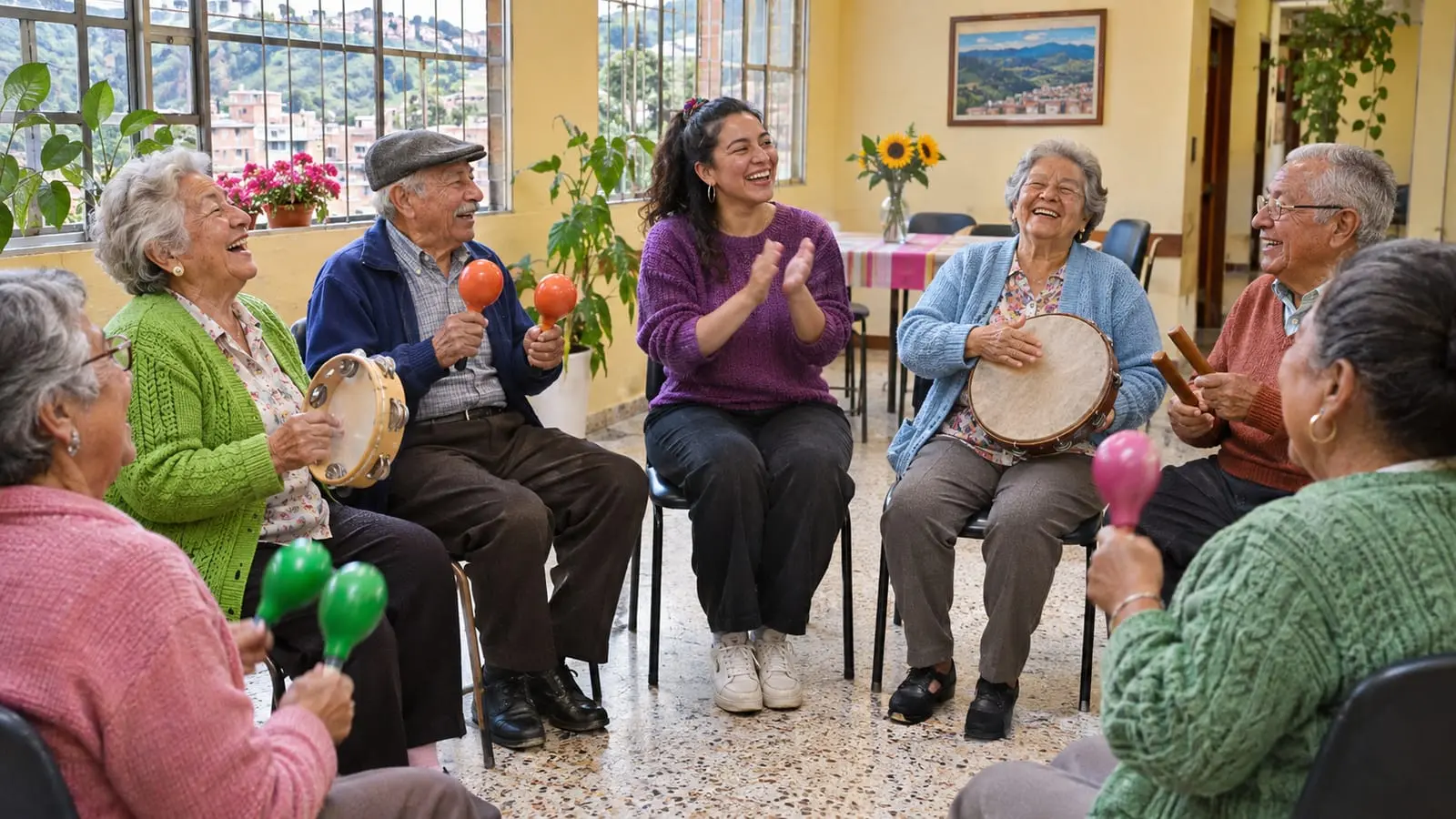
Activities that do not require musical knowledge: singing familiar songs, guessing titles, clapping along to a beat, moving scarves, sharing memories prompted by a melody, or playing simple instruments. These are recreational activities designed for spending time together and having fun, and a family member, caregiver, or care home's activities team can lead them.
Below you will find 18 activities organized into three groups: cognitive, physical, and social. Each explains what you need, how to do it, and a variation for someone with limited mobility or memory problems. Choose two or three per session and repeat the favorites: routine also provides a sense of security.
Before you begin, an important clarification: these activities are recreational. They do not treat an illness or replace medical care, and they are not music therapy, which is led by a trained professional. We explain the difference below.
What cognitive activities can you do with music for older adults?
Cognitive activities with music engage attention, recall, and language through familiar songs. They are not tests or exercises to “measure” memory: if someone cannot remember, change the question rather than pressing them.
- Sing with printed lyrics. You need: large-print lyrics and a list of the group's songs. How to do it: choose three or four songs from their youth, hand out the lyrics, and start singing slowly, without rushing to get the pitch right. Ask which songs they want to sing first. Variation: if someone has difficulty reading, sing the chorus as an echo: you say a line and the group repeats it.
- Guess the song. You need: a music player or your own voice. How to do it: hum or play the first few seconds of a familiar song and let the group guess the title or singer. Count correct answers as a team, not individually. Variation: for someone with memory difficulties, offer two possible answers or let them sing the song without naming it.
- Name the decade. You need: three or four songs from different eras. How to do it: play a clip and ask which decade it was popular in and what people danced to or wore back then. The conversation matters more than getting the answer right. Variation: with people who tire quickly, use just one song per session and let them talk freely.
- Musical memories. You need: a song the group knows. How to do it: play the song and ask: what were you doing when this song was popular? Listen to the stories without correcting dates or details. Variation: if memory falters, ask about sensory associations (a smell, a party, a meal) instead of specific facts.
- Musical bingo. You need: cards with song titles or instruments, markers, and a playlist of clips. How to do it: instead of calling numbers, play a clip and have each person mark the title on their card. The first person to complete a line wins. Variation: reduce the card to four squares and play in pairs, with someone helping mark the card.
- Write a new verse. You need: a song with a simple melody and large sheets of paper. How to do it: choose a song everyone knows and replace one or two lines with something about the group: a name, a place, a dish. Sing the whole song with the new verse. Variation: anyone who does not write can dictate their contribution; you write it down and read it aloud.
What music activities and games involving movement can you suggest?
Music games involving movement combine rhythm and the body, either seated or standing with support. The music's beat gives movement a rhythm and makes it easier to follow as a group. Make sure each person chooses how much to move and when to stop.
- Clapping rhythm echo. You need: just your hands. How to do it: clap a short pattern (two or three beats) and ask the group to repeat it. Gradually make it longer and let someone suggest the next pattern. Variation: for limited mobility, use gentle taps on the knees or table.
- Seated body percussion. You need: comfortable chairs with space between them. How to do it: keep a beat by alternating clapping, tapping knees, and tapping feet along to a slow song. Change the pattern from time to time to maintain attention. Variation: if there is hand pain or stiffness, stick to a single movement, such as tapping the knees, and take a break every few minutes.
- Scarf movement. You need: scarves or lightweight fabric, one per person. How to do it: play music with a clear beat and ask everyone to draw shapes with their scarf: large circles if the music is slow, short movements if it is fast. Variation: for someone who can only move one hand or their fingers, simply holding the scarf and following the movement of their gaze is enough.
- Chair dancing. You need: sturdy chairs and music with a strong beat. How to do it: make simple arm and shoulder movements to the rhythm of a bolero, a porro, or a waltz. You start the movement and the group follows without pressure. Variation: offer smaller versions: just the head and hands, or simply tapping the beat with one foot.
- Homemade maracas. You need: small plastic bottles, rice or lentils, and tape. How to do it: partially fill each bottle, seal it securely with tape, and use them to accompany a song. Decorating them can also be part of the activity. Variation: for weak hands, use lightweight containers that are easy to grip, or one maraca shared by two people.
- Small rhythm band. You need: maracas, claves, tambourines, or simple drums. How to do it: give each person an instrument and assign each group an easy pattern. When the song plays, everyone plays their part. Start with just one pattern. Variation: if someone feels overwhelmed by several tasks at once, give them just the beat and let them join in and stop whenever they want.
What does the evidence say about music and well-being in later life?
Studies suggest that participating in artistic activities, including music, may contribute to well-being, but the evidence is uneven and rarely addresses activities as simple as those above. The WHO's 2019 scoping review brought together more than 3,000 studies and concluded that the arts have a role in preventing illness, promoting health, and supporting the management of some conditions. It includes everything from small studies without a comparison group to controlled trials.
Sourced figure
A 2023 systematic review in older adults with depression included 21 randomized trials and found that music therapy was associated with fewer symptoms of depression and anxiety and better cognition. This is music therapy, not recreation, and the authors call for better-designed studies.
The findings on cognition are less clear. A 2015 meta-analysis of 5 studies and 234 participants in residential care facilities, hospitals, and community settings found that, when the studies were pooled, short-term improvement on the MMSE (Mini-Mental) test was not statistically significant. Individual studies did show improvements with singing and other active activities, and the authors recommend longer, higher-quality studies.
Sourced figure
The 2015 meta-analysis on music therapy and cognition in older adults found no significant short-term improvement in MMSE scores when the studies were combined (mean difference of 0.73 points, confidence interval of −0.07 to 1.54).
What we do not know: whether brief, informal activities led by family members or caregivers produce the same effects as the interventions in the studies; how long the benefits last; and how much of the effect comes from music versus companionship and time spent together. That is why we discuss enjoyable activities here, not treatments. If the person has dementia or depression, consult their healthcare team.
How can you make these activities safe and respectful?
By paying attention to the person: making sure they can hear, sit comfortably, rest, and say no. These are common-sense and teaching guidelines, not medical rules:
- Moderate volume. Louder is not better. If participants use hearing aids, make sure they are wearing them and that they are working, and face them when you speak so they can read your lips.
- Short sessions. Between 20 and 40 minutes is usually enough; watch for signs of fatigue such as yawning, stillness, or irritability, and wrap up before they appear.
- Consent and freedom of choice. Ask whether they want to participate and which songs they like. Never force anyone to sing, dance, or come to the front; watching and listening are also ways to participate.
- Safe space. Stable chairs, no obstacles on the floor, and someone nearby to provide support if participants stand up.
- Meaningful song choices. A song can bring back sad memories. If someone becomes upset, slow things down, change the song, and stay with them without saying too much.
- Hygiene with shared instruments. Clean maracas and tambourines between sessions, and do not share mouthpieces or flutes.
When is it music therapy rather than just a music activity?
It is music therapy when a trained professional uses music with defined therapeutic goals for an individual or group, assesses those goals, and tracks them over time. A recreational activity aims for enjoyment; music therapy works toward a goal, such as better communication, emotional regulation, or supporting memory, and is led by a music therapist.
At Gissi, music therapy is led by music therapists with master's or doctoral degrees, with an initial assessment, agreed-upon goals, and follow-up, and can take place at home or by video call. If you need a better understanding of the concept, read what music therapy is. If you are interested in how this discipline applies to older adults, see music therapy for older adults.
| Music activity | Music therapy | |
|---|---|---|
| Who leads it | Family member, caregiver, activities team, or music teacher | Music therapist with specialized training |
| Goal | Enjoyment, sharing, and companionship | Therapeutic goals that are agreed upon and reviewed |
| Follow-up | No formal assessment or recordkeeping | Initial assessment and follow-up |
| What you can claim | That participants had a good time | Only what the professional can substantiate, as a complement to medical care |
How does this differ from learning an instrument or the topics in other articles?
These activities do not require learning: you can enjoy them from the very first time. If someone wants to go further, learning an instrument offers another path, with practice and progress. In learning music in later life, we look at how to get started, and in benefits of learning an instrument for older adults, we explore what is known about its effects. For activities with a therapeutic goal, see music therapy activities.
If you coordinate a nursing home, community center, or family compensation fund and want someone to lead regular sessions, the music programs for older adults page explains how we work with institutions.
Frequently asked questions
What activities can you do for older adults with limited mobility?
Seated body percussion, clapping rhythm echoes, small scarf movements, and listening circles. All can be done in a chair and simplified to a single movement, such as tapping the knees. Let each person decide how much to participate, and take breaks every few minutes.
What cognitive music activities work for people with memory loss?
Singing familiar songs, guessing a melody, and talking about memories often work because they start with something familiar. Avoid questions that require recalling exact facts. Do not promise improvements: studies on cognition have mixed findings, and if there is a diagnosis, consult the healthcare team.
How long should a music activity for older adults last?
Between 20 and 40 minutes is usually reasonable, with breaks and a calm closing song. Watch for fatigue in the group and finish before it appears. Repeating short sessions is better than holding one long session.
What music games for older adults do not require instruments?
Musical bingo, guess the song, name the decade, clapping rhythm echoes, and sung call and response. All use the voice, hands, or a music player. Instruments such as homemade maracas are optional.
Are these activities music therapy?
No. They are recreational activities that a family member, caregiver, or music teacher can lead. Music therapy is led by a trained music therapist and involves goals, assessment, and follow-up. One does not replace the other, and neither replaces medical care.
Do you need musical knowledge to lead these activities?
No. You just need the songs, the ability to clap the beat, and encouragement without pressure. If you would like support, a teacher from our network at Gissi can lead sessions at your institution.
What should you do if someone does not want to participate?
Respect their choice. Invite them to listen, choose a song, or join in with a gesture, and ask again another day. Watching and listening are also ways to participate. If they decline all activities or seem sad, discuss it with their family or healthcare team.
Sources
We checked the facts in this article against these sources on November 12, 2026.
About the editorial team
Author
Bachelor of Music Education, Universidad Pedagógica Nacional · Music teacher with 6+ years teaching children, teens and adults
Gisselle Torres holds a degree in Music Education from the Universidad Pedagógica Nacional. She is a flutist and has taught music for more than 6 years. She teaches children, teens and adults at home and online, and writes these guides from what works in her lessons.
See Gisselle's profile and lessons
Fact check
We check every figure and fact in each guide against published sources and update it when they change. Last review: November 12, 2026.