Workplace wellness activities: 14 ideas, 6 with music, and how to plan them in Colombia
Workplace wellness activities are voluntary activities a company organizes to support its employees' health and morale: movement breaks, workshops, recognition, family days, and music activities. They work best when they start with a needs assessment and you measure their results.
In this article
- At a glance
- What are workplace wellness activities, and where should you start?
- What Colombian regulations should you keep in mind?
- What employee wellness activities can you organize?
- What music-based team building activities can you do at work?
- How do you plan a workplace wellness program step by step?
- How can you make wellness activities inclusive?
- Frequently asked questions
- Sources
- About the author
At a glance
- Start with an assessment (a survey and a psychosocial assessment battery) and a few measurable goals, not a list of ideas.
- Ley 1857 de 2017 requires employers to facilitate a family day every six months, and Ley 2191 de 2022 protects the right to disconnect from work.
- Music formats such as drum circles and group songwriting require no prior experience.
- Research on music in the workplace is promising but limited: don't present it as a treatment for stress.
- Keeping activities voluntary, accessible, and free of pressure to perform is the foundation of inclusion.
If you work in HR or occupational safety and health and need to put together this year's workplace wellness activity program, you're probably looking for ideas that don't feel mandatory or repetitive. This guide brings together all kinds of options, with a section devoted to music, which has the advantage of requiring no prior skills.
You'll find Colombian regulations to review, 14 employee activity ideas, six music formats, ways to plan and measure your program, and ways to make it inclusive. You'll also learn what research says about music and workplace well-being, along with its limitations.
What are workplace wellness activities, and where should you start?
These are activities a company organizes to support its employees' health, morale, and relationship with work beyond their job duties: breaks, workshops, recognition, and time with family or coworkers. They work best when they grow out of an assessment rather than a trend, and when people can choose whether to participate.
If you work in HR or occupational safety and health, you have two starting points: what the regulations say and what your employees say. This guide gives you a list of ideas, a special section on music activities, ways to plan and measure, and ways to make activities inclusive. It is a guide to ideas, not legal advice: confirm each obligation with your employment lawyer or your ARL (occupational risk insurer).
What Colombian regulations should you keep in mind?
These are the regulations whose official texts we opened and reviewed. They do not cover the entire topic, and some obligations depend on the company's size and type.
| Regulation | What it says, briefly | What it means for your activities |
|---|---|---|
| Decreto 1072 de 2015 (art. 2.2.4.6.4) | Defines the Sistema de Gestión de la Seguridad y Salud en el Trabajo (SG-SST), the occupational safety and health management system, as a phased process of continuous improvement led by the employer with worker participation. | Plan activities within the SG-SST and with employee participation, rather than as a standalone event. |
| Ley 1857 de 2017 | The employer must facilitate, promote, and arrange a day every six months for employees to spend with their families, at its own venue or one arranged with the family compensation fund; if it cannot do so, it must allow that time off. | This is a wellness activity backed by law: plan it at the start of the year. |
| Ley 2191 de 2022 | Recognizes the right to disconnect from work and requires an internal policy with guidelines on the use of information and communication technologies and a complaint procedure. | No activity should encroach on rest periods or vacations; be mindful of schedules and chats. |
| Resolución 2764 de 2022 | Adopts the assessment battery, technical guide, and protocols for assessing and addressing psychosocial risk factors. Repeals Resolución 2404 de 2019. | Use its results as an assessment to decide which activities to prioritize. |
Sourced figure
Ley 1857 de 2017 states that employers must facilitate, promote, and arrange a day every six months for their employees to spend with their families.
Resolución 2764 applies to public and private employers and regulates psychosocial assessment. The wellness activities we describe here complement that work; they do not replace it: an afternoon of music is no substitute for an intervention addressing psychosocial risk. For the current text, consult the Gestor Normativo de la Función Pública or your ARL; we reviewed these regulations on November 12, 2026.
What employee wellness activities can you organize?
These 14 ideas, in addition to the music ideas we'll cover later, address the body, mind, relationships, and personal life. Choose a few and do them well instead of filling the calendar:
- Movement breaks. Five to ten minutes of stretching or movement during the workday, led by someone on your team or from your ARL.
- Walking meetings. For one-on-one conversations, go for a walk instead of sitting in a room.
- Breathing or quiet breaks. A brief, voluntary, screen-free break in the middle of the morning.
- Recognition. A specific, public thank-you for something someone did, rather than a generic award.
- Learning workshops. Short courses in something unrelated to the job, such as cooking, photography, languages, or music.
- Corporate volunteering. A team day with a foundation, always voluntary.
- Family day. The day every six months under Ley 1857: a picnic, a visit to the family compensation fund, or an afternoon of games.
- Celebrations. Birthdays and team achievements, taking care not to exclude anyone who doesn't celebrate.
- Talks on mental health and stress. With support from your ARL or a professional, in line with the psychosocial assessment.
- Flexible schedules. If the role allows it, occasional early departures or flexible start times.
- Reciprocal mentoring. Someone from one department teaches someone else a skill, and vice versa.
- Movement challenges. Walks, sports tournaments, or step challenges, with options for people with limitations.
- Rest areas. A quiet corner of the workplace with comfortable chairs that people can use without asking permission.
- Putting the right-to-disconnect policy into practice. It's not an event, but it is the wellness activity with the greatest potential impact: actually complying with Ley 2191.
What music-based team building activities can you do at work?
Activities that get your team making or listening to music together, without requiring anyone to know how. Making music as a group requires listening to others and coordinating with them, which is exactly what workplace team building or musical team building aims to achieve.
| Activity | What it involves | When it works well |
|---|---|---|
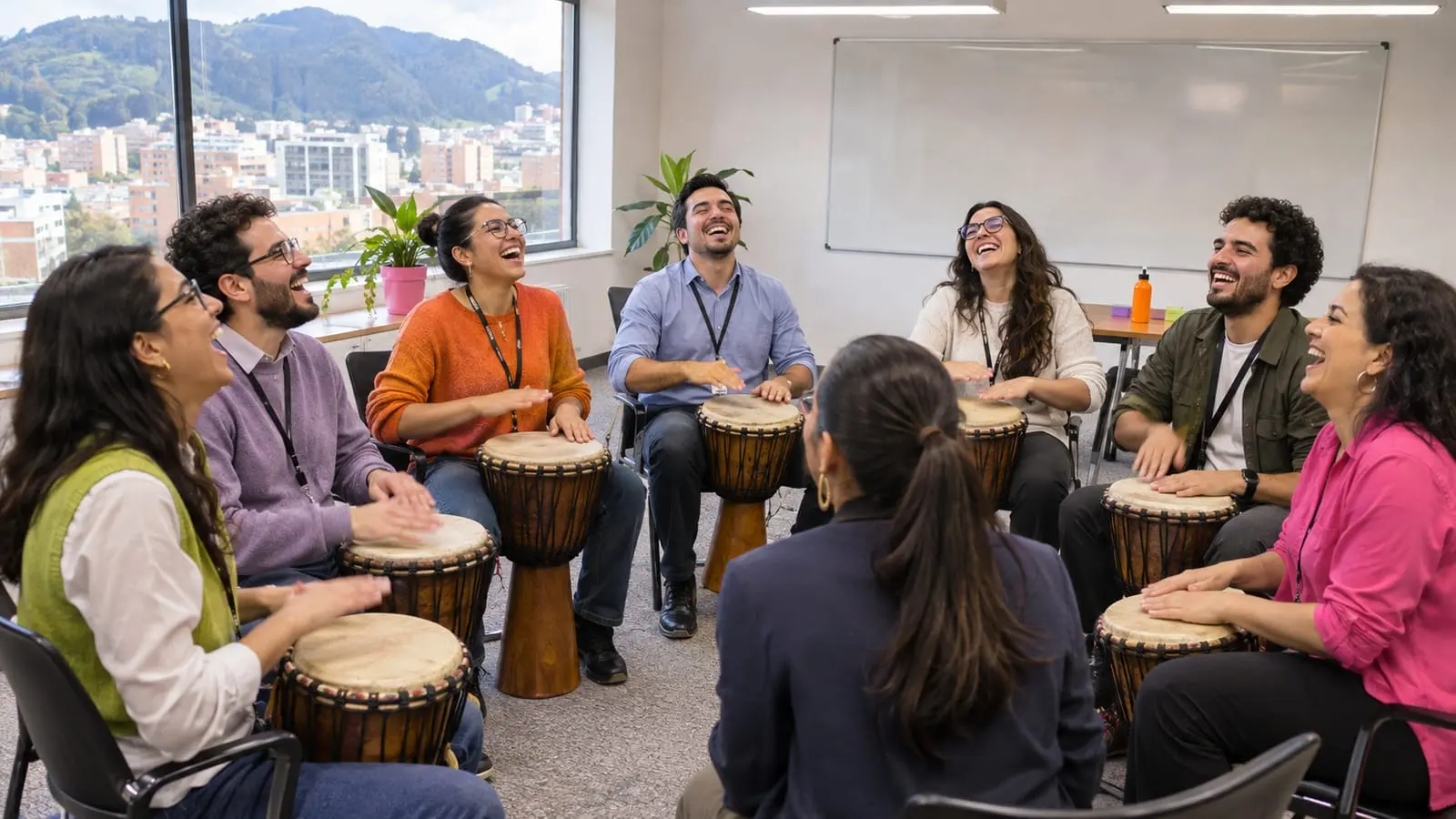
| Drum circle | The group plays simple instruments (drums, maracas, tubes), following a facilitator. To keep learning: percussion lessons. | Teams of any size, with no experience, in person. |
| Team choir | Singing familiar songs together, with lyrics visible and no evaluation. | Short weekly rehearsals, or a single performance at an event. |
| Songwriting workshop | Your team writes a song: lyrics about the company or the year, rhythm, and melody. | Year-end gatherings, kickoffs, anniversary celebrations. |
| Listening break | Five to ten minutes listening to a song, with team members taking turns choosing it. | Meetings to start or wrap up the week. |
| Short instrument workshop | A session to try guitar, ukulele, or keyboard, with no commitment. | People who want to explore, as an introduction to lessons. |
| Staff band | A group of employees rehearses a few songs and plays at the year-end event. | Companies with people who already play and want to share their music. |
At Gissi, corporate music workshops include drum circles with simple instruments, writing a song as a group, rhythm games, and music for your corporate event. A facilitator from our network leads them at your venue or over a video call. If some employees want to learn in depth, we also offer music lessons for adults.
What does research say about music and workplace well-being?
Studies suggest that music interventions in the workplace could help with mood and stress, but the evidence is limited and varied. A 2025 scoping review identified 25 studies with potential effects on well-being, stress, or productivity, and 5 with no effect. The authors note that most interventions are not described in detail and that more studies in workplace settings are needed.
Sourced figure
A 2025 scoping review of music interventions in the workplace found 25 studies with potential effects on well-being, stress, or productivity and 5 with no effects, with research still limited.
We don't clearly know which type of activity works best, how often to do it, or how long the effects last. You also shouldn't promise people that a music session will take away their stress. Present it as an enjoyable time together, and measure whether your team experienced it that way.
How do you plan a workplace wellness program step by step?
- Assess needs. Start with the health conditions assessment, the results of the psychosocial assessment battery, and a short, anonymous survey: what people need, which times work for them, and what doesn't interest them.
- Set a few goals. For example, more breaks, a better atmosphere in one department, or more participation from a particular shift. A measurable goal is better than “improving the atmosphere.”
- Build the year's calendar. Include the family day every six months, existing dates (year-end, anniversary), and open slots. Avoid accounting close periods or times with heavy workloads.
- Set a budget. Break down the cost of each activity (facilitator, materials, logistics, food) and leave room for unexpected expenses. Request written, fixed-price proposals before committing funds.
- Communicate in advance. Share dates, duration, whether participation is voluntary, and whether the activity takes place during or outside work hours. Respect the right-to-disconnect policy.
- Measure. Record attendance by department and shift, give a two- or three-question survey at the end, and check after three months whether what people said is reflected in what was done.
Measure participation and satisfaction before measuring broader outcomes such as absenteeism or turnover, which depend on many factors. If you notice certain departments never attend, ask them why before pushing for participation.
How can you make wellness activities inclusive?
By making them voluntary, accessible, and free of pressure to impress. An activity that excludes someone or puts them on the spot takes away from well-being instead of adding to it. These guidelines help:
- Voluntary. No one should feel that their performance review depends on participating.
- During work hours, whenever possible. If it's outside work hours, ask yourself who gets left out: someone who cares for family, or someone with a long commute.
- Accessible. Consider mobility, hearing, vision, and space. Offer seated versions and different roles (playing, keeping the beat, writing down lyrics).
- No pressure to perform. Many people feel self-conscious about singing or playing in front of others; make performing optional.
- Respect for beliefs and preferences. Food, alcohol, and repertoire can also include or exclude people.
- Distributed teams. For people in other cities or working remotely, choose video call formats, such as rhythm activities, that work at a distance.
If you haven't had time for yourself in a long while, one option is to start with music lessons for adults, and for stress in general, you can read learning music to manage stress.
Frequently asked questions
Which workplace wellness activities are easiest to implement?
Movement breaks, specific recognition, walking meetings, and a music listening break cost almost nothing and require no logistics. Start with one or two and measure participation before adding more.
Are companies in Colombia required to organize wellness activities?
It depends on the activity and the company. Ley 1857 de 2017 states that employers must facilitate, promote, and arrange a family day every six months. The SG-SST under Decreto 1072 is mandatory for public and private employers, but it does not prescribe a list of wellness activities. Confirm this with your employment advisor or your ARL.
How many people can participate in a corporate music workshop?
It depends on the format and the space. Gissi's workshops accommodate anything from a small team to a large group, with the number of facilitators and the activities adjusted to the actual group size. Send us your group size and date, and we'll send you a proposal.
What is musical team building?
It's a team building activity in which your team makes music together, such as a drum circle or writing a song. No experience is required: the facilitator explains each exercise, and everyone participates from the first minute. It is presented as a shared experience, not a treatment.
Can you do a wellness activity over a video call?
Yes. Rhythm games and song-based activities work well online and are a good option for teams in different cities. Ask participants to have their cameras and audio ready and to mute their microphones when it isn't their turn.
How can you measure whether a wellness activity worked?
Start by looking at attendance by department and shift and a short survey at the end. Major changes, such as absenteeism or turnover, have many causes and take time, so don't attribute them to a single activity.
Sources
We checked the facts in this article against these sources on November 12, 2026.
- Función Pública: Decreto 1072 de 2015, Decreto Único Reglamentario del Sector Trabajo (SG-SST)
- Función Pública: Ley 1857 de 2017 (family day every six months)
- Función Pública: Ley 2191 de 2022 (right to disconnect from work)
- Colpensiones, regulatory compendium: Resolución 2764 de 2022 (psychosocial risk factors)
- Scoping review: music interventions in the workplace (BMC, 2025)
About the editorial team
Author
Bachelor of Music Education, Universidad Pedagógica Nacional · Music teacher with 6+ years teaching children, teens and adults
Gisselle Torres holds a degree in Music Education from the Universidad Pedagógica Nacional. She is a flutist and has taught music for more than 6 years. She teaches children, teens and adults at home and online, and writes these guides from what works in her lessons.
See Gisselle's profile and lessons
Fact check
We check every figure and fact in each guide against published sources and update it when they change. Last review: November 12, 2026.