Types of Guitars: How Many Strings Each Has and Which to Choose
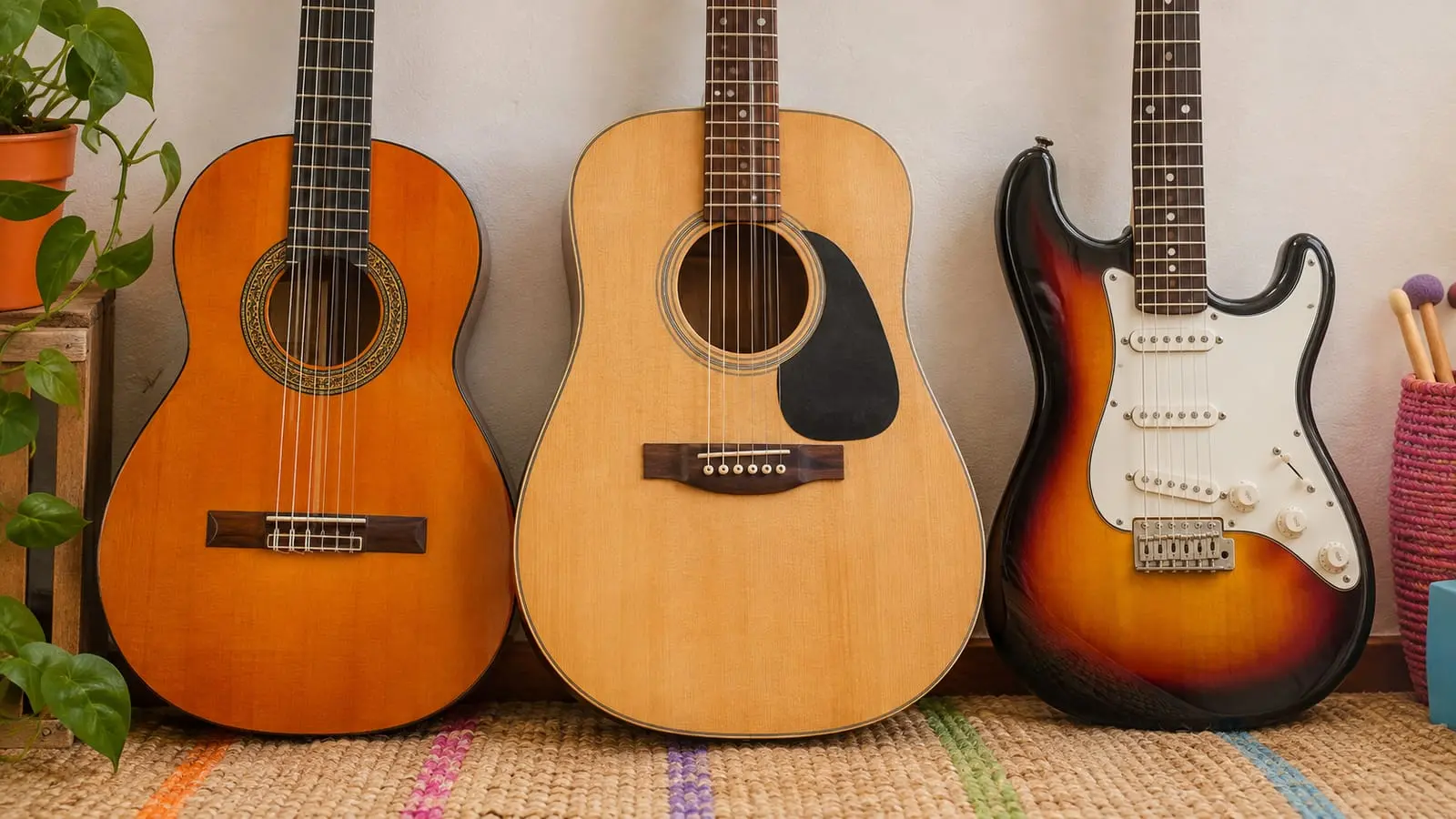
The most common guitar types are classical, acoustic, acoustic-electric, electric, and twelve-string. A standard guitar has six strings tuned E, A, D, G, B, E; a twelve-string groups its strings into six pairs.
In this article
- At a glance
- How many strings does a guitar have? Types at a glance
- Classical guitar: nylon strings and a wide neck
- Acoustic and acoustic-electric guitars: steel strings
- Electric guitar: pickups and an amplifier
- Types of guitar strings: nylon, steel, and wound
- Twelve-string guitar: six pairs
- Guitars with more than six strings
- Latin American guitar relatives: requinto and tiple
- Which to choose for the music you want to play
- Frequently asked questions
- Sources
- About the author
At a glance
- A standard guitar has six strings, from lowest to highest: E, A, D, G, B, E. This applies to classical, acoustic, acoustic-electric, and electric guitars.
- Classical guitars use nylon strings and have wider necks; acoustic, acoustic-electric, and electric guitars use steel strings.
- A twelve-string guitar has six pairs of strings: in the lower pairs, the second string sounds an octave higher, while the higher pairs are tuned in unison.
- An electric guitar needs amplification: pickups capture the strings' vibrations, and an amplifier turns the signal into sound.
- In Mexico, the requinto is a small six-string guitar; the Colombian tiple is a separate instrument with twelve strings arranged in four groups of three.
All guitars share the same basic playing approach, but their sound, necks, strings, and volume differ. Knowing which is which helps you avoid buying mistakes and choose for the music you want to play.
Here you will find a comparison table, what makes each type special, guitars with extra strings, and Latin American relatives of the guitar, such as the requinto and tiple.
How many strings does a guitar have? Types at a glance
The short answer is six. What differs between types is the string material, body, amplification method, and repertoire they are used for.
| Type | Strings | String material | What it sounds like | Associated with |
|---|---|---|---|---|
| Classical or Spanish | 6 | Nylon (bass strings are metal-wound) | Plays without amplification, with a soft, rounded tone | Classical music and learning |
| Flamenco | 6 | Similar to classical guitar strings | Plays without amplification, with a drier, more percussive tone | Flamenco |
| Steel-string acoustic | 6 | Steel | Plays without amplification, with a brighter, louder tone | Folk, pop, rock, singer-songwriters |
| Acoustic-electric | 6 | Steel | Sounds like an acoustic and can also plug into a sound system | Live performance and recording |
| Electric guitar | 6 | Steel | Needs an amplifier | Rock, blues, jazz, pop |
| Twelve-string | 12, in 6 pairs | Steel | Bright sound with a chorus effect | Accompaniment, folk, rock |
Standard tuning for six-string guitars, from the sixth string (the lowest) to the first (the highest), is E, A, D, G, B, E. To tune with a tuner or by ear, see how to tune a guitar step by step.
Classical guitar: nylon strings and a wide neck
The classical guitar, also called the Spanish guitar, uses nylon strings. Originally, players used gut strings, which nylon and other synthetic materials later replaced. The three bass strings are wound with metal wire, usually silver-plated copper.
- Wide neck. The nut measures between 48 and 54 mm, compared with about 42 mm on an electric guitar, and the fingerboard is flat. This leaves more space between the strings but requires a wider hand stretch.
- Lower tension. Nylon strings have less tension than steel strings, so they generally feel gentler on beginners' fingers.
- Played with the fingers. Players usually pluck with their fingertips and nails rather than strum with a pick.
- A design with history. In the XIX century, Spanish luthier Antonio de Torres gave the instrument the shape that remains the benchmark today.
Sourced figure
A classical guitar's nut measures between 48 and 54 mm, compared with about 42 mm on an electric: it has the widest neck among the most common guitar types.
This is the guitar used for classical repertoire and often for the first years of study. To compare it with a steel-string acoustic before buying, see how to choose your first acoustic or classical guitar and avoid common mistakes.
Acoustic and acoustic-electric guitars: steel strings
The acoustic guitar, sometimes called a steel-string or Saxon-style guitar, also has six strings, but they are metal. They have higher tension than nylon strings and produce a brighter, louder sound, suited to strumming and accompanying a singer.
The fretboard usually has a slight curve, the neck is narrower than a classical guitar's, and it often has fretboard inlays.
An acoustic-electric is an acoustic guitar fitted with pickups. It plays unplugged and can also connect to an amplifier or mixing console. You play it just like an acoustic: it has six steel strings and the same tuning.
Electric guitar: pickups and an amplifier
Unlike an acoustic guitar, an electric guitar does not rely on its body to amplify the sound. Magnetic pickups detect the metal strings' vibrations and convert them into a weak electrical signal, which travels through a cable to an amplifier or effects pedals. Without an amplifier, an electric guitar is barely audible even up close.
- Body. It can be solid, semi-hollow, or fully hollow. Solid wood bodies made from alder, mahogany, or ash are traditional choices.
- Strings. Six steel strings, with the same tuning as an acoustic: E, A, D, G, B, E.
- Pickups. Single-coil pickups sound brighter and can hum; dual-coil pickups, or humbuckers, cancel noise and produce a fuller sound.
- A relatively recent instrument. The first experiments date to the twenties, and the electric guitar became established in the following decades as big-band guitarists needed more volume.
To get started, you need a guitar and an amplifier; how to choose your first electric guitar and amplifier explains what to look for in each.
Types of guitar strings: nylon, steel, and wound
- Nylon: used on classical guitars; lower tension with a soft, round sound.
- Steel: used on acoustic, acoustic-electric, and electric guitars; brighter sound and higher tension.
- Wound: the three bass strings have a metal winding, usually silver-plated copper on a classical guitar.
Do not put steel strings on a classical guitar: it is built for lower tension. When it is time to replace them, follow how to change guitar strings.
Twelve-string guitar: six pairs
A twelve-string guitar has six pairs of strings played together. In the lower pairs, one string is tuned an octave above the other; in the higher pairs, both sound in unison.
The result is a very bright sound with a chorus effect, especially on sustained chords.
The paired strings sit very close together, making single notes harder to pick and melodic bends more demanding. This is why the instrument is mainly used for chords and rhythm. It is rarely a beginner's first choice, but with practice it is not excessively difficult to play.
Guitars with more than six strings
- Seven strings: adds a seventh low string, a B. The Russian guitar also has seven strings.
- Eight strings: extends the range even further with additional bass strings.
- Ten strings: an extended classical guitar popularized by Narciso Yepes.
- Four strings: the tenor guitar.
These are specialist instruments. If you are starting out, a six-string guitar in any of the types above is the usual starting point.
Latin American guitar relatives: requinto and tiple
The Spanish-speaking world has several string instruments that resemble the guitar and are sometimes mistaken for it. Two that often come up in searches are the requinto and tiple.
| Instrument | Strings | String arrangement | Where it's used |
|---|---|---|---|
| Standard guitar | 6 | Individual strings, from E to E | Worldwide |
| Mexican requinto | 6 | Smaller than a guitar, with a wider body; tuned like a guitar with a capo at the fifth fret, a fourth higher | Boleros, Yucatecan trova, and romantic trios |
| Colombian tiple | 12 | Four courses of three metal strings; in each course, the middle string sounds an octave lower | Bambuco, pasillo, torbellino, and Andean music |
| Tiple requinto (Colombia) | 10 or 12 | Four courses, with three strings or with two in some courses | Andean and carranga music |
The Colombian tiple is considered Colombia's national instrument. It is more than a small guitar: it has its own tuning and strings arranged in courses of three.
If it interests you, explore tiple lessons, our guide to tuning a tiple, and guitar or tiple: which to learn first. The name requinto means different things in different countries: in Mexico, it is a small six-string guitar, while Colombia has the tiple requinto.
Which to choose for the music you want to play
- Songs to sing with friends and family: a steel-string acoustic or a classical guitar.
- Classical music, boleros, or Latin American repertoire: a nylon-string classical guitar.
- Rock, blues, or pop with a band: an electric guitar and amplifier.
- Singing and playing on small stages: an acoustic-electric guitar.
- For a child: smaller guitars are available; see guitars for kids: size, strings, and first songs.
If you are torn between two, take time to compare them in electric or acoustic guitar: which to learn first, then try before buying. A teacher can help you choose based on your hands and your music. That is what our instrument buying advice program is for.
Once you have your guitar, acoustic guitar lessons and electric guitar lessons start with the instrument you choose.
Frequently asked questions
How many strings does a twelve-string guitar have?
Twelve, arranged in six pairs. In the lower pairs, the second string sounds an octave higher; the higher pairs are tuned in unison. This produces a brighter sound.
What is the difference between a classical and an acoustic guitar?
A classical guitar uses nylon strings, has a wider neck, and is usually played with the fingers. A steel-string acoustic has a narrower neck and a brighter, louder sound, and is often strummed with a pick or the fingers.
Does an electric guitar have the same strings as an acoustic?
It has six steel strings and the same tuning as an acoustic, but the strings are thinner. The difference is that its amplified sound comes from an amplifier rather than the guitar's body.
How many strings does a tiple have?
The Colombian tiple has twelve metal strings grouped into four courses of three strings. It is not a small guitar: it has its own tuning and is used for bambuco, pasillo, and other Andean rhythms.
How many strings does an electric guitar have?
Six, like an acoustic, with the same tuning: E, A, D, G, B, E. The strings are steel and thinner. Seven- and eight-string electrics add lower notes, but they are not a typical starting point for beginners.
What are the guitar strings called?
They are numbered from highest to lowest: the 1st is E, 2nd B, 3rd G, 4th D, 5th A, and 6th low E. The three lowest strings are wound strings, often called bass strings.
What is the best type of guitar for beginners?
The one that suits the music you want to play. Nylon-string classical guitars are gentle on fingertips and good for kids; steel-string acoustics suit songs; electrics suit rock with a band. What matters is a proper setup and low string action.
What is a seven-string guitar for?
It adds a seventh low string, B, extending the range downward. It is used in jazz, metal, and Russian guitar music. Beginners do not need it: a six-string guitar covers almost all basic repertoire and is easier to find.
Sources
We checked the facts in this article against these sources on November 8, 2026.
- Wikipedia: Guitar, types, string counts, and standard tuning
- Wikipedia: Classical guitar, nylon strings, neck, and Antonio de Torres
- Wikipedia: Electric guitar, pickups, amplifiers, and bodies
- Wikipedia: Twelve-string guitar, string pairs, and tuning
- Wikipedia: Tiple, twelve strings in four courses
- Wikipedia: Requinto (chordophone), variations by country
About the editorial team

Author
Bachelor of Music Education, Universidad Pedagógica Nacional · Music teacher with 6+ years teaching children, teens and adults
Gisselle Torres holds a degree in Music Education from the Universidad Pedagógica Nacional. She is a flutist and has taught music for more than 6 years. She teaches children, teens and adults at home and online, and writes these guides from what works in her lessons.
See Gisselle's profile and lessons
Fact check
We check every figure and fact in each guide against published sources and update it when they change. Last review: November 8, 2026.